A Day in Provence – Wednesday Market at Saint-Rémy-de-Provence

After Peter Mayle wrote A Year in Provence in 1989, Francophiles the world over yearned to relive his experiences enjoying the excellent markets, fascinating people, and delicious food of Provence.

So here we are. Nous sommes ici! Our home base for a week or so is Saint-Rémy-de-Provence, a quiet little town south of Avignon, north of Arles, east of Nimes, and west of Peter Mayle’s Ménerbes location. A perfect spot! It was van Gogh’s home for a year (more on that later). As with every town we’ve visited in France, it has a Centre Ville, generally including a large church.

On any other day, the parking lot across from the church is full of cars, but on Wednesday, any remaining cars are towed away to make room for the market, quite a big one, full of colors, sights, sounds, and smells that are truly Provençal.

This is partly a farmers market and so much more. Here you can buy fashionable clothes and all kinds of kitchen linens. We loved the colorful serving dishes.

2015-04-08 002

Lavender, olives, and cicadas are common decorations on the colorful dishware.

With limited room in our suitcases, we bypassed the clothing and moved on to consumables. So much to choose from.

2015-04-08 008

Twenty flavors of vinegar. We bought passion fruit…and hope it survives the trip home!

IMG_5470

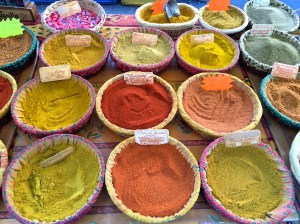
These are all different curry and chili powders.

2015-04-08 011

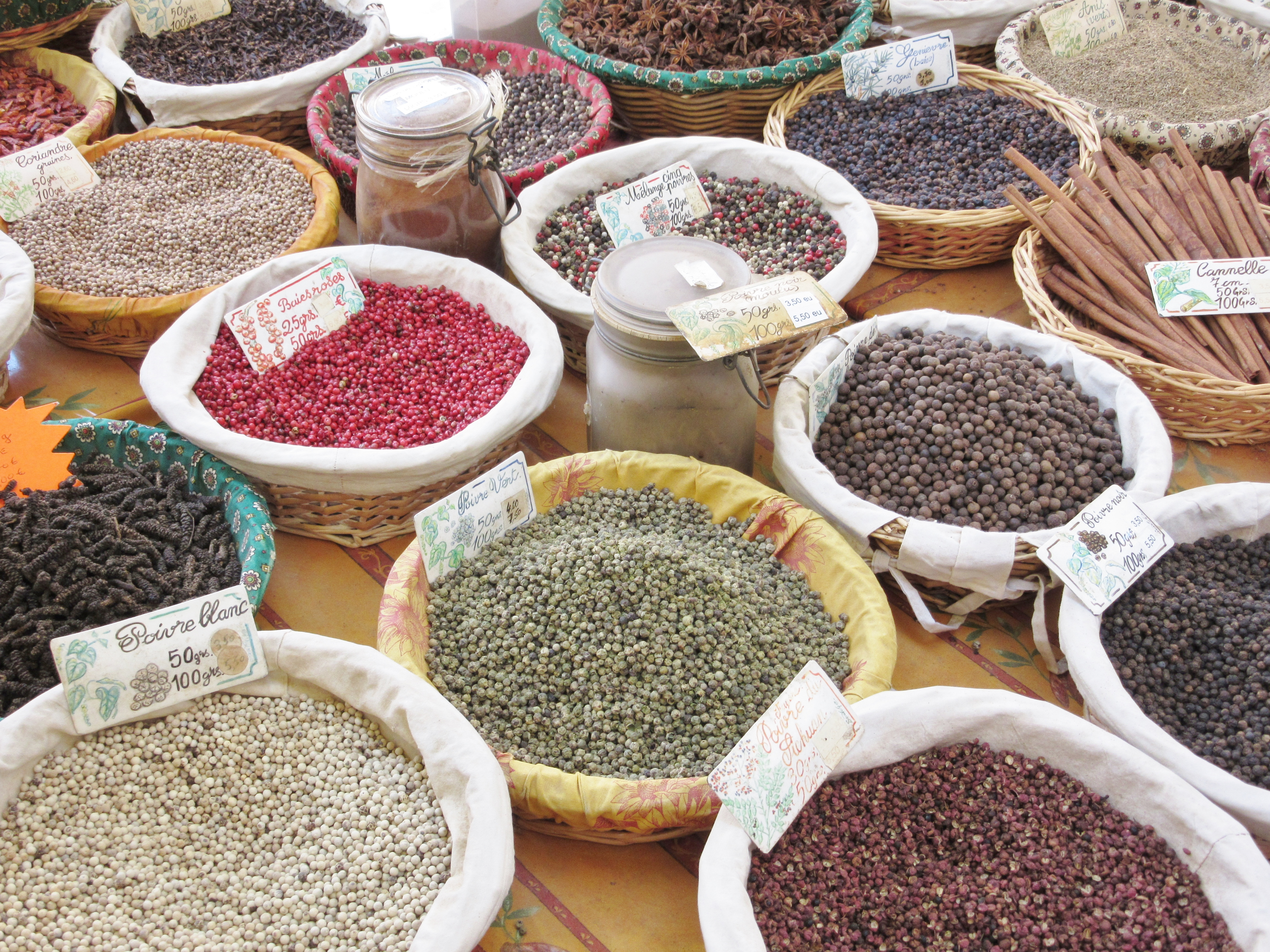
And just as many varieties of beans and lentils.

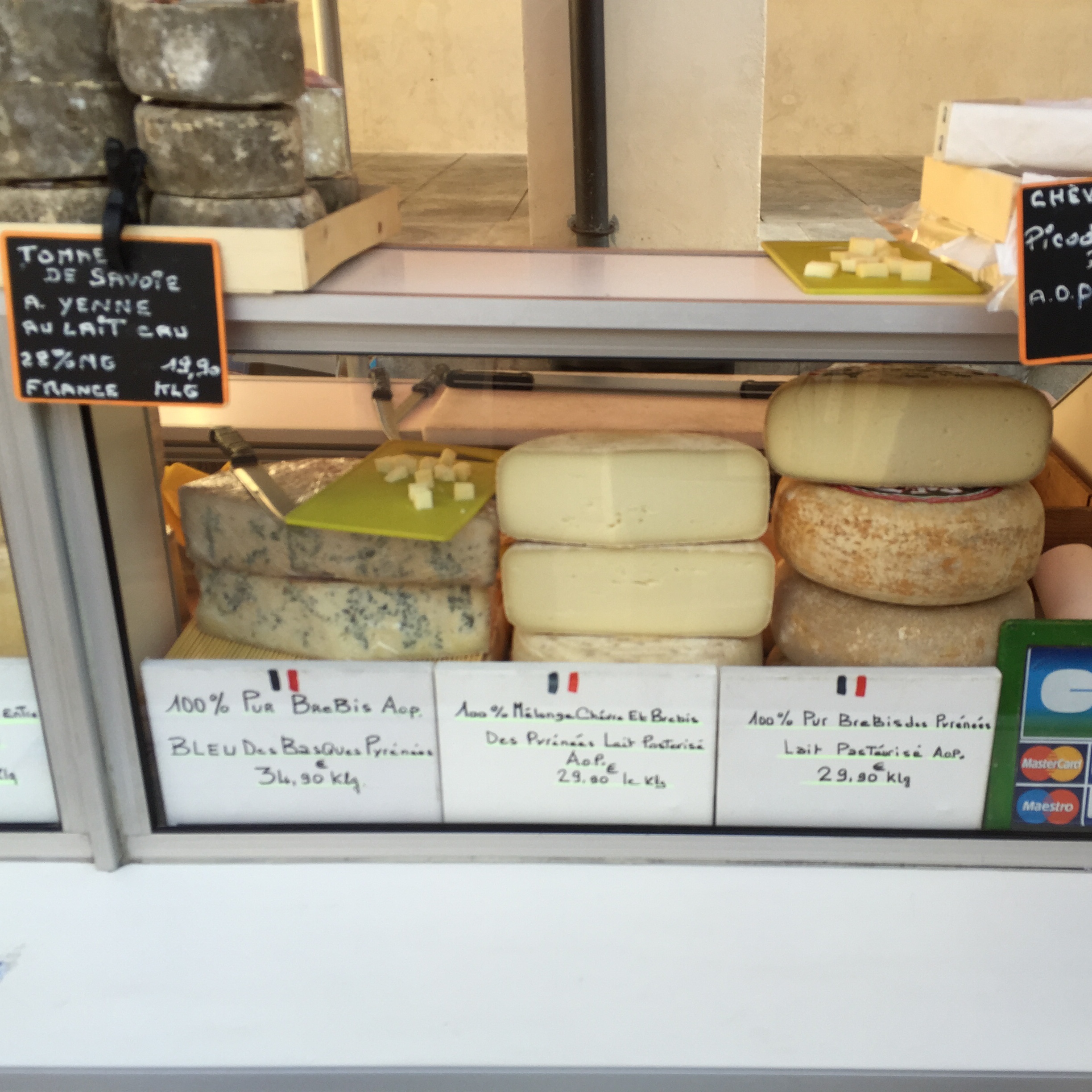
Then come the sausages and cheeses.

IMG_5459

Notice the “gouts” on the counter. Sample every cheese and then make a purchase.

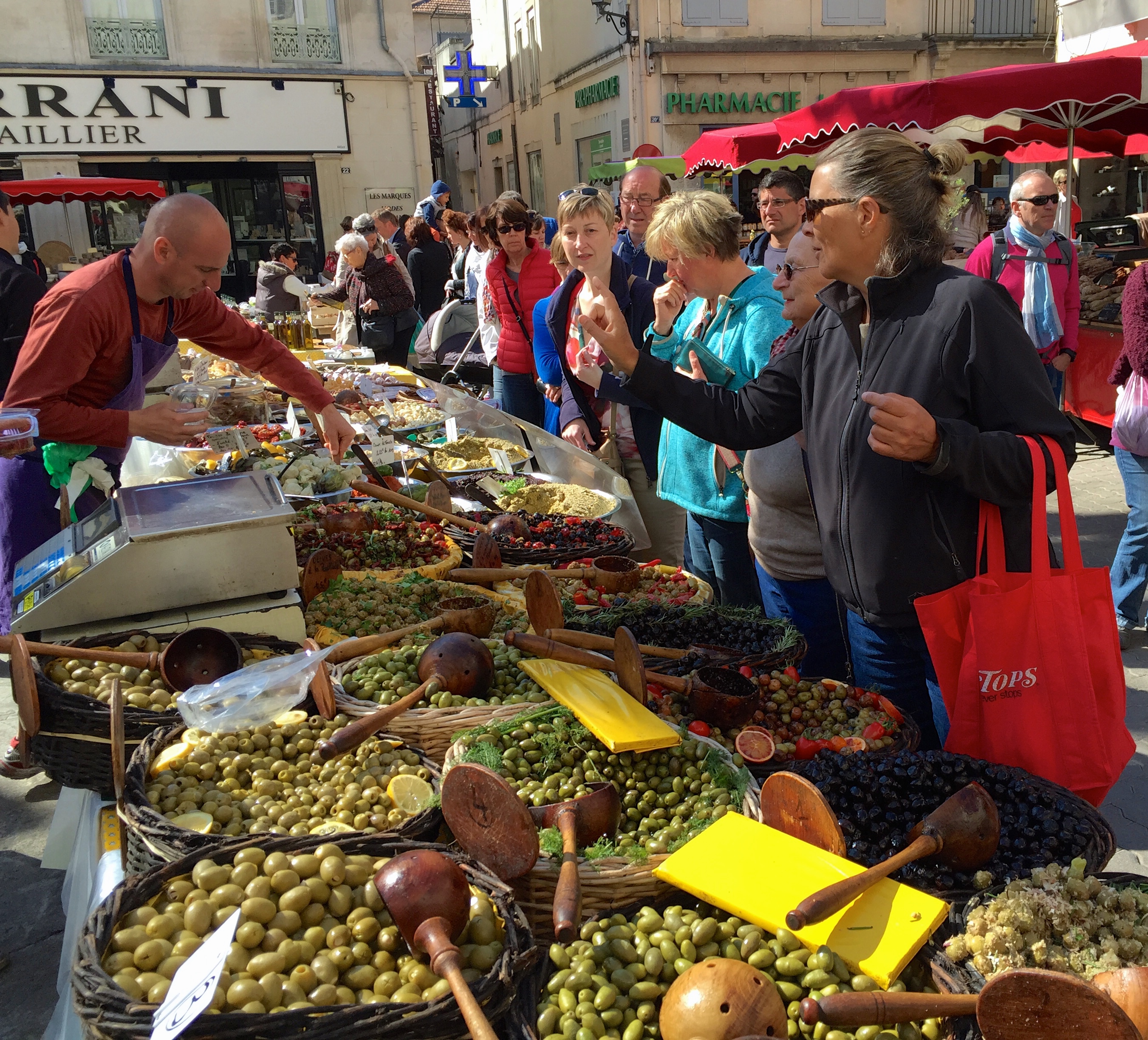
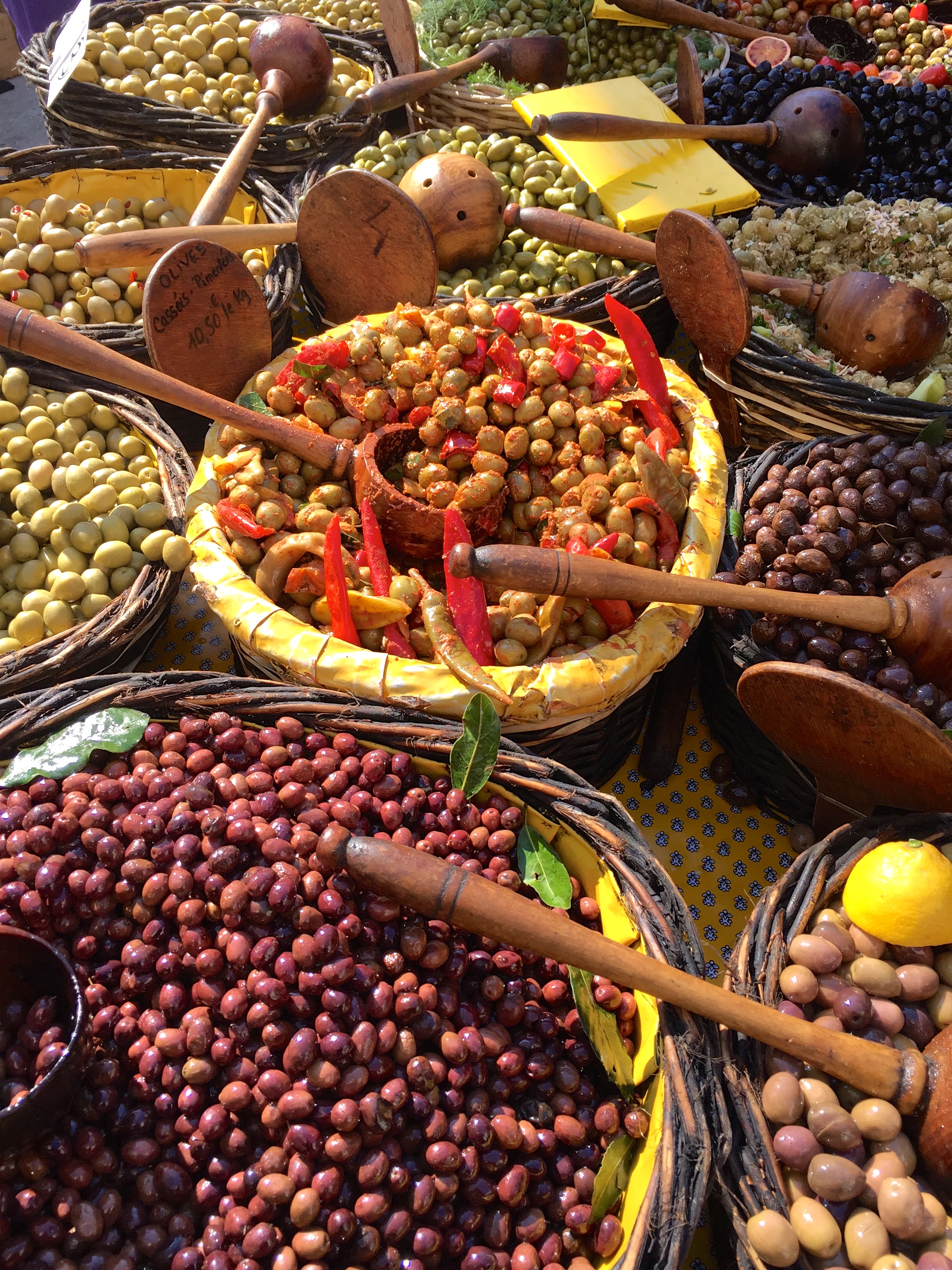
And olives! The most popular stand in the market has a dozen types of olives, many tapenades  and other preserved items, and buyers three layers deep.

IMG_5467

Note the Americaine with the Tops grocery bag at the olive stand.

IMG_5466

So many olives, so hard to choose! Solution: Buy a bit of each.

The fresh produce looks mouthwatering and tastes delicious. Many vendors offer samples!

2015-04-08 006

One Euro for a bunch of radishes, delicate and almost sweet.

2015-04-08 009

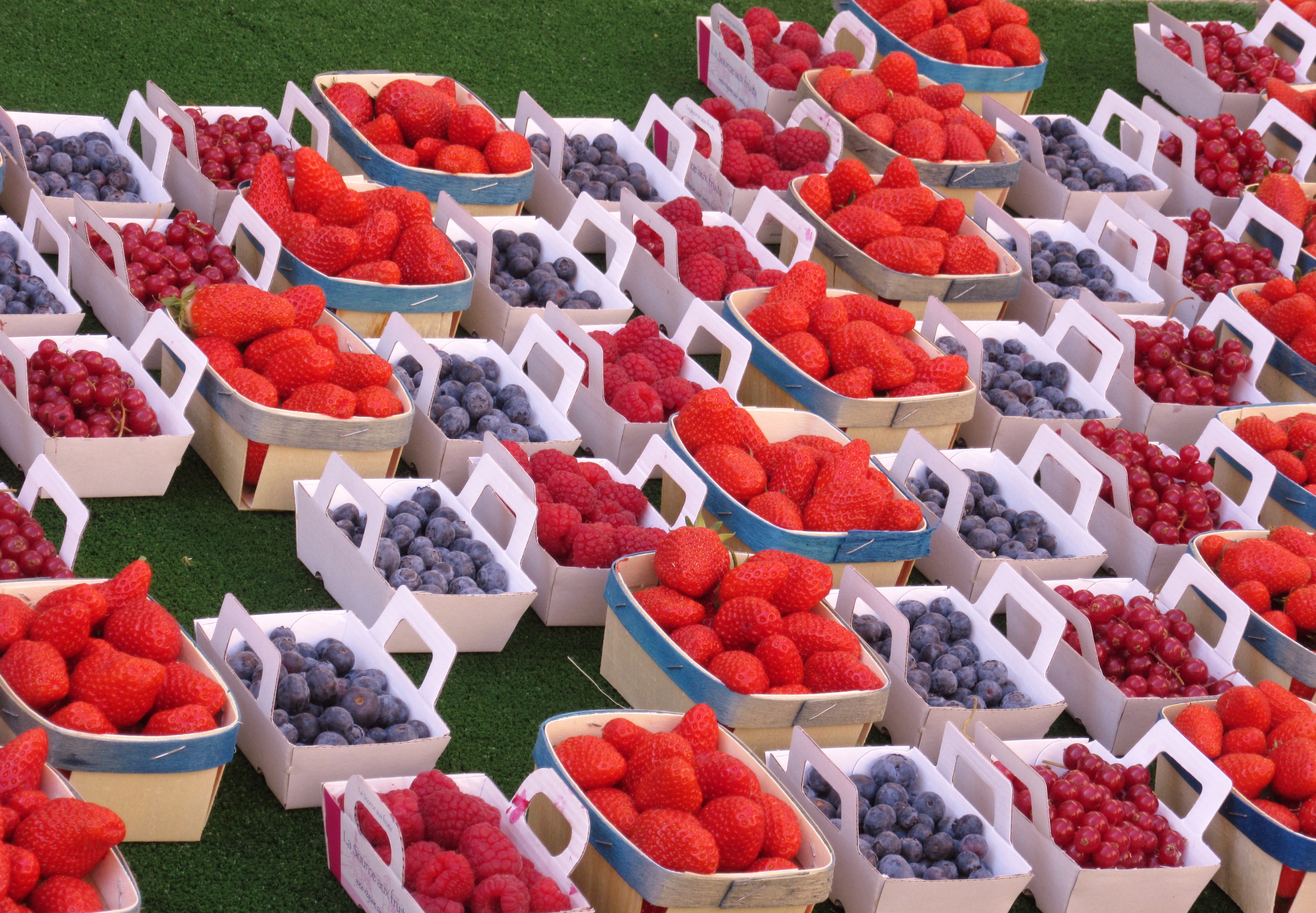
Who could resist these fresh berries?

IMG_5473

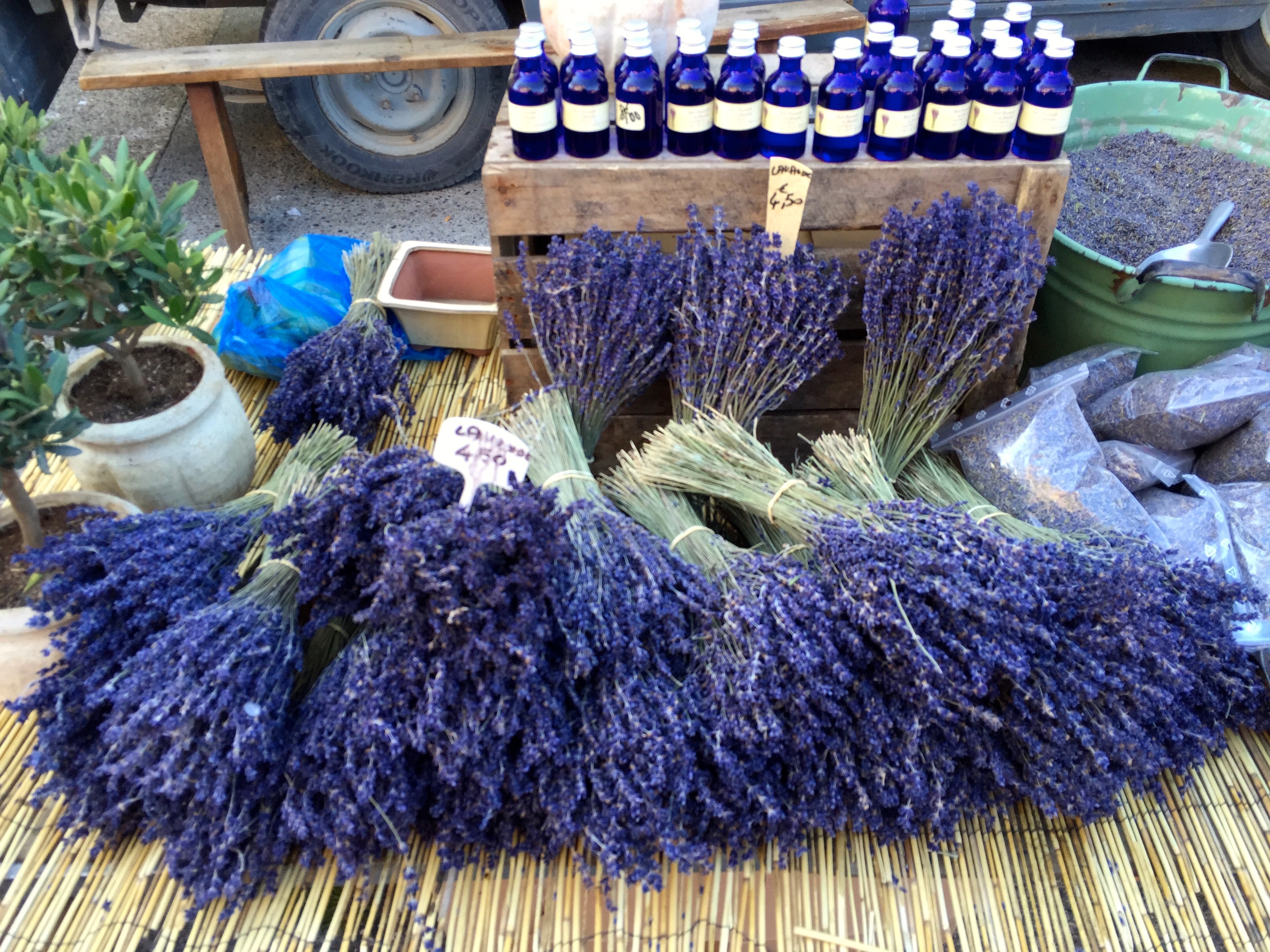
Finally because it’s Provence, the market has lavender. Not in season yet this year, but with lovely aroma and promise of color in the fields later in the spring.

After the morning market, it was time to pick up a baguette from the boulanger near our apartment and head home to make a gourmet lunch of cheese, sausage, olives, more olives, and radishes.

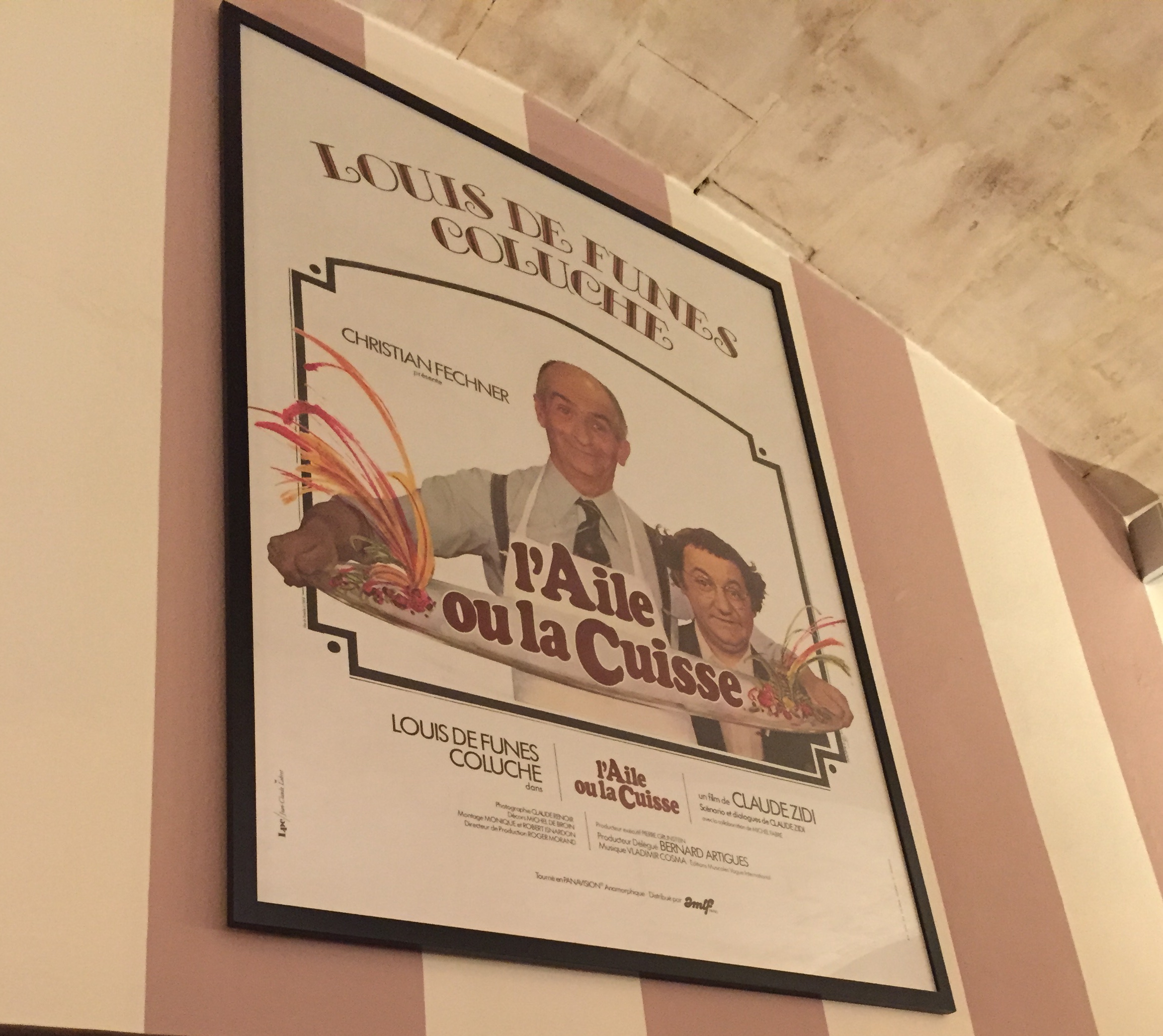
In the evening, we sampled the gastronomy at a local restaurant, L’aile ou la cuisse. (By the way, the gastronomic meal of the French is on UNESCO’s Representative List of the Intangible Cultural Heritage of Humanity.) The restaurant name means “the wing or the thigh” and it’s also the name of a French comedy from 1976 about a food critic who has lost his sense of taste.

IMG_5481

A film we’ll rent on Netflix…

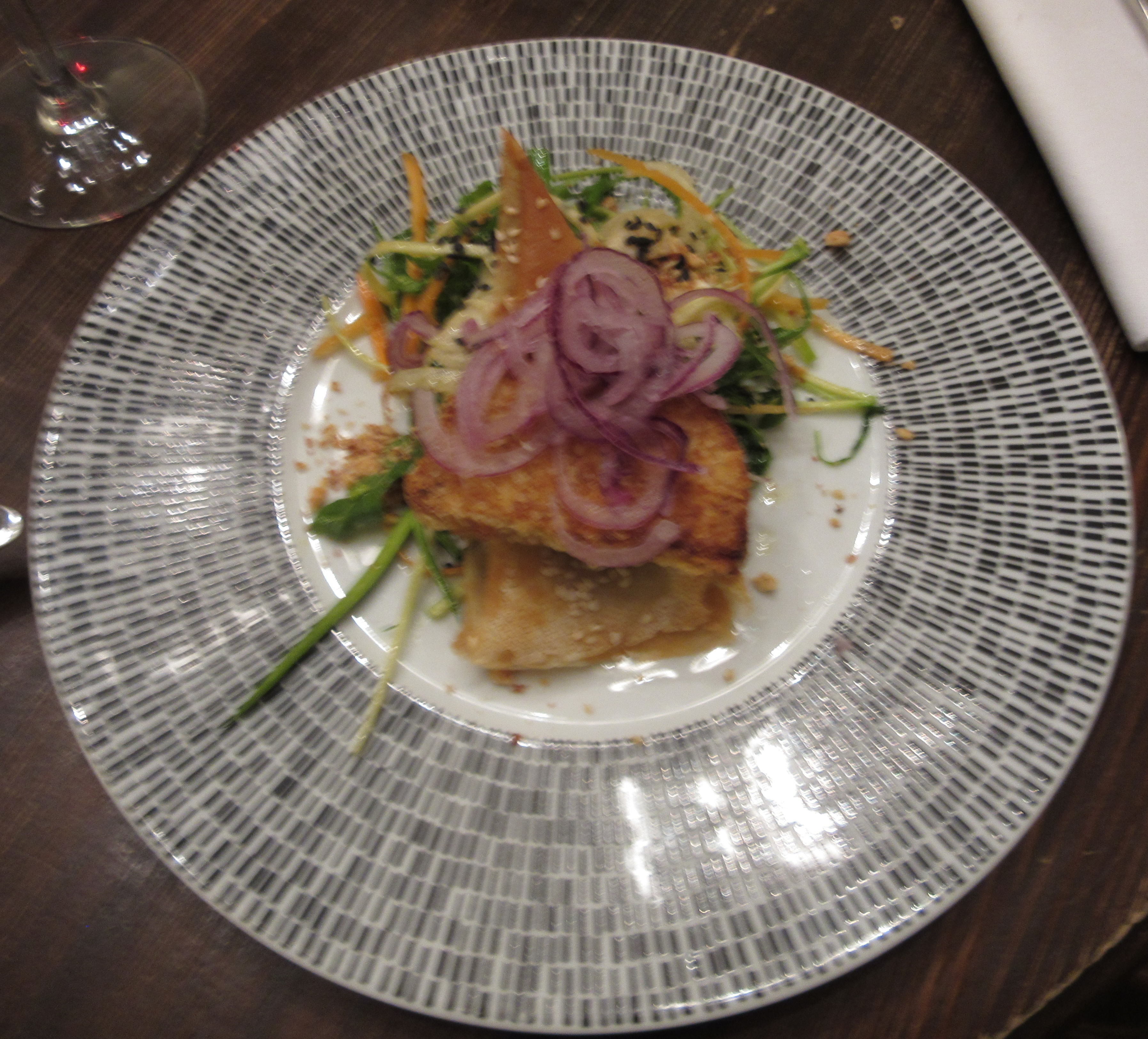
Fortunately we haven’t lost our sense of taste! We enjoyed our meals immensely. The entree (which is the appetizer, not the main) we chose was breaded and lightly sauteed goat cheese on salad.

2015-04-08 037

One of the best salads ever!

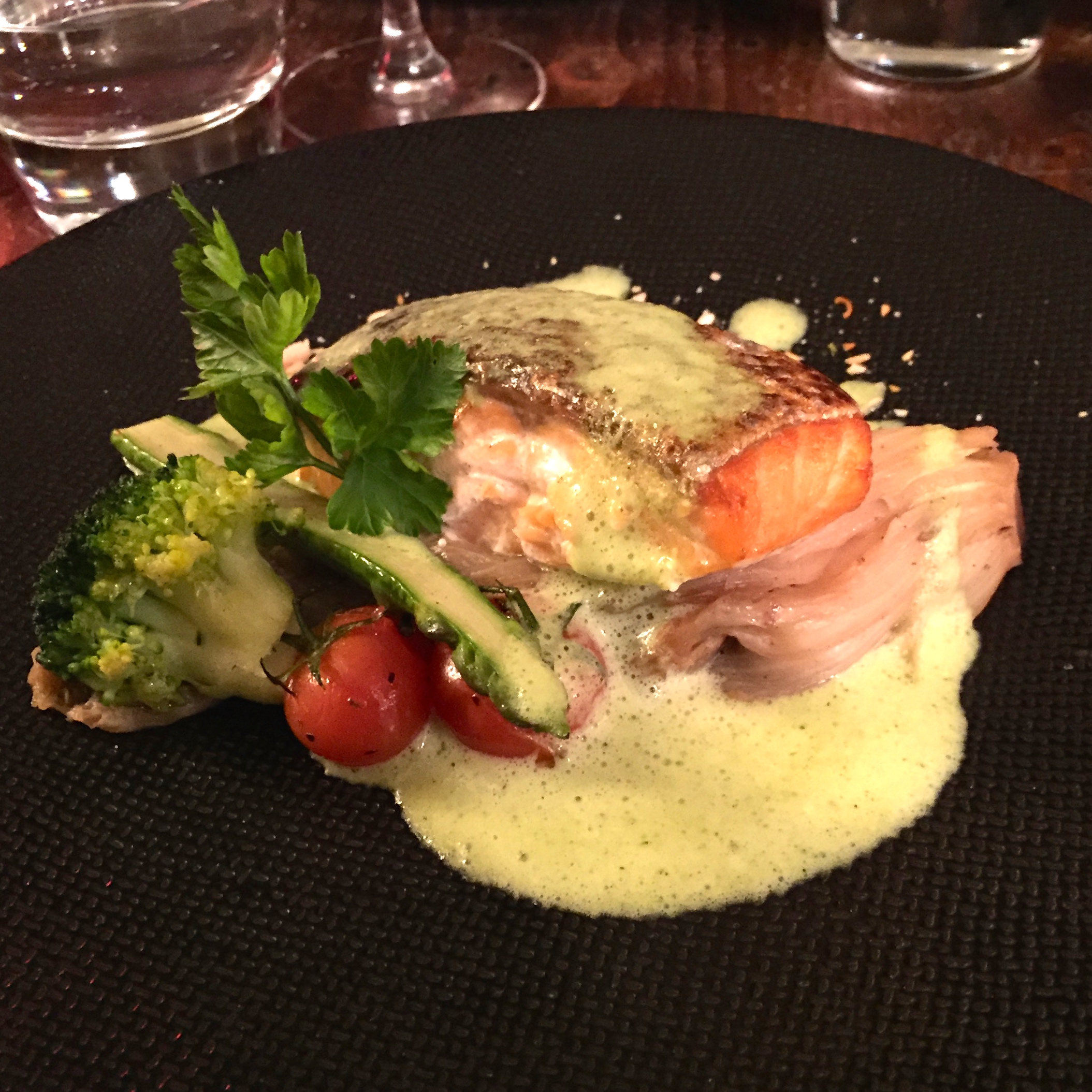
IMG_5478

Michael’s salmon was cooked to perfection with a vegetable he loved but couldn’t identify. We think it was endive.

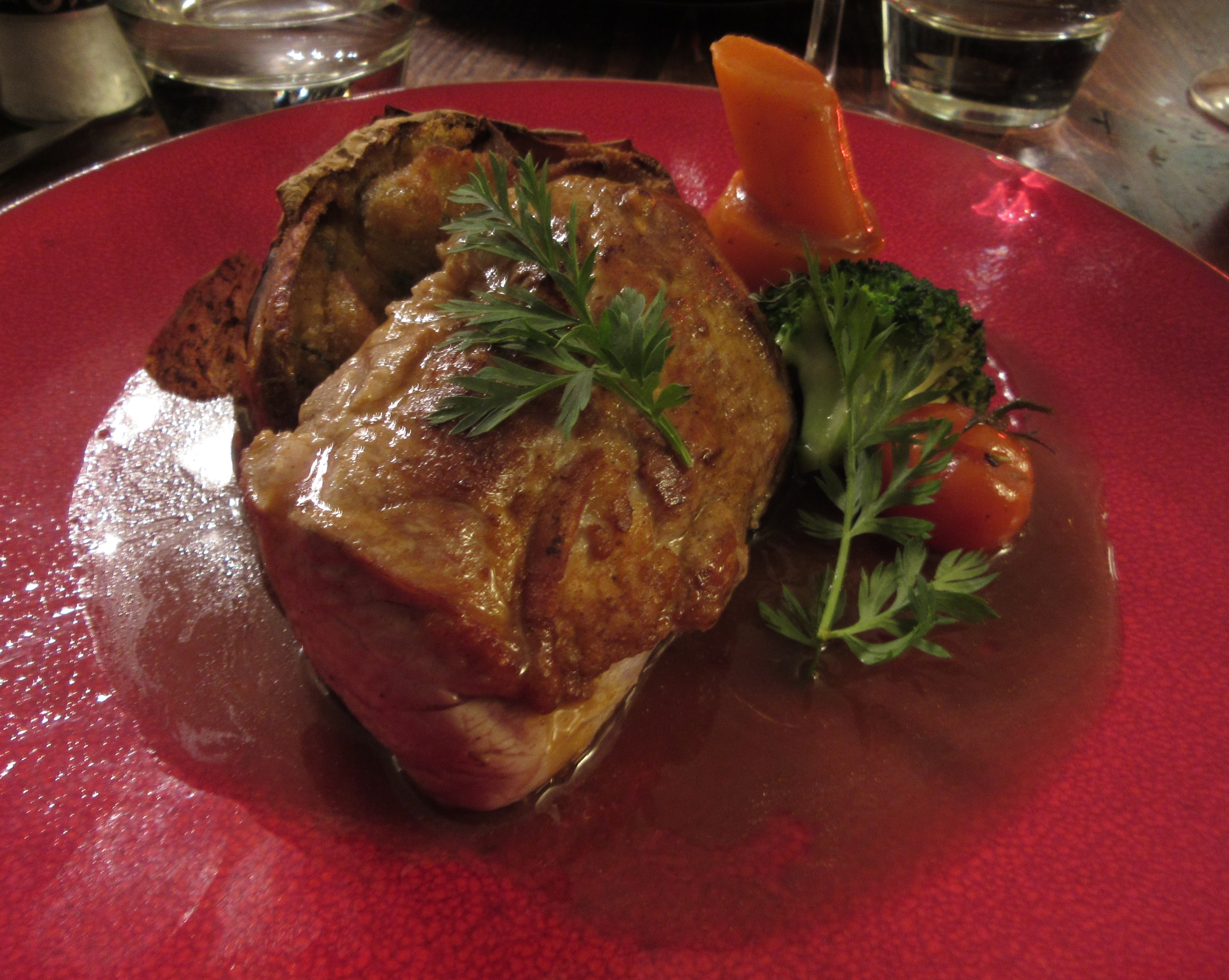
2015-04-08 041

Nancy’s filet du cochon was likewise delicious. We weren’t sure what cochon was and the waitress explained it by demonstrating a snorting animal. A pig!

For dessert we were invited to visit the patisserie at the front of the restaurant to select our pastries.

2015-04-08 043

This was recommended as “Number One,” the most popular dessert. The light cream, crispy pastry, and fresh raspberries explained its popularity.

IMG_5479

Inside is chocolate brownie and the best chocolate mousse ever, covered with a very dark chocolate ganache.

With a nice bottle of French rosé wine, the meal was perfect, one of our best in France.

We could easily stay in Saint-Rémy-de-Provence for a very long time. A year, in fact, would be great.


Posted in Smell the Roses | Tagged , , , , , , | 2 Comments

La Corrida d’Arles, definitely NOT a rodeo

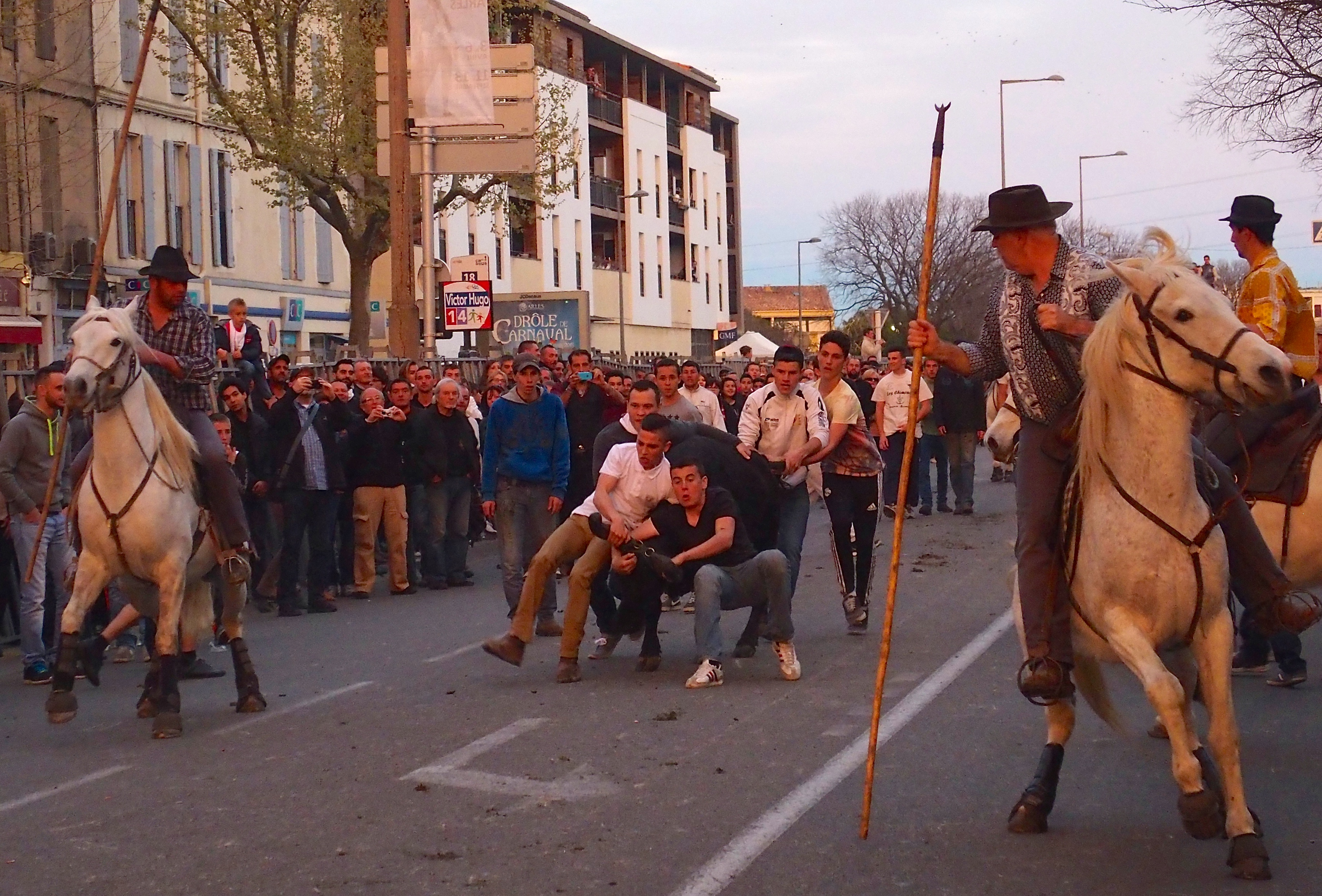
We happened to visit Arles at Easter weekend, just in time to experience the festivities of La Feria, the fair, with a highlight being La Corrida, the bullfight. Each day of La Féria de Pâques, Arles has a running of the bulls before and after the bullfight. Heavy barriers are erected along the blocked-off section of street, but this doesn’t stop large numbers of pedestrians from stepping inside.

OLYMPUS DIGITAL CAMERA

Running of the bulls? These are horses. Where are the bulls?

This is not like Pamplona where the large bulls that will fight in the arena are transported to the site. Instead smaller bulls are brought to run through the street one at a time for entertainment. Large white horses race back and forth multiple times on the route, five or six at a time. The bull is completely surrounded by the horses, so much so that it’s difficult to even see it.

OLYMPUS DIGITAL CAMERA

There is a bull in this photo. Really.
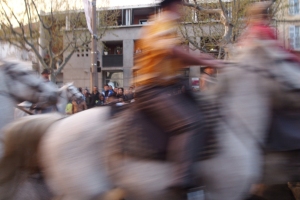
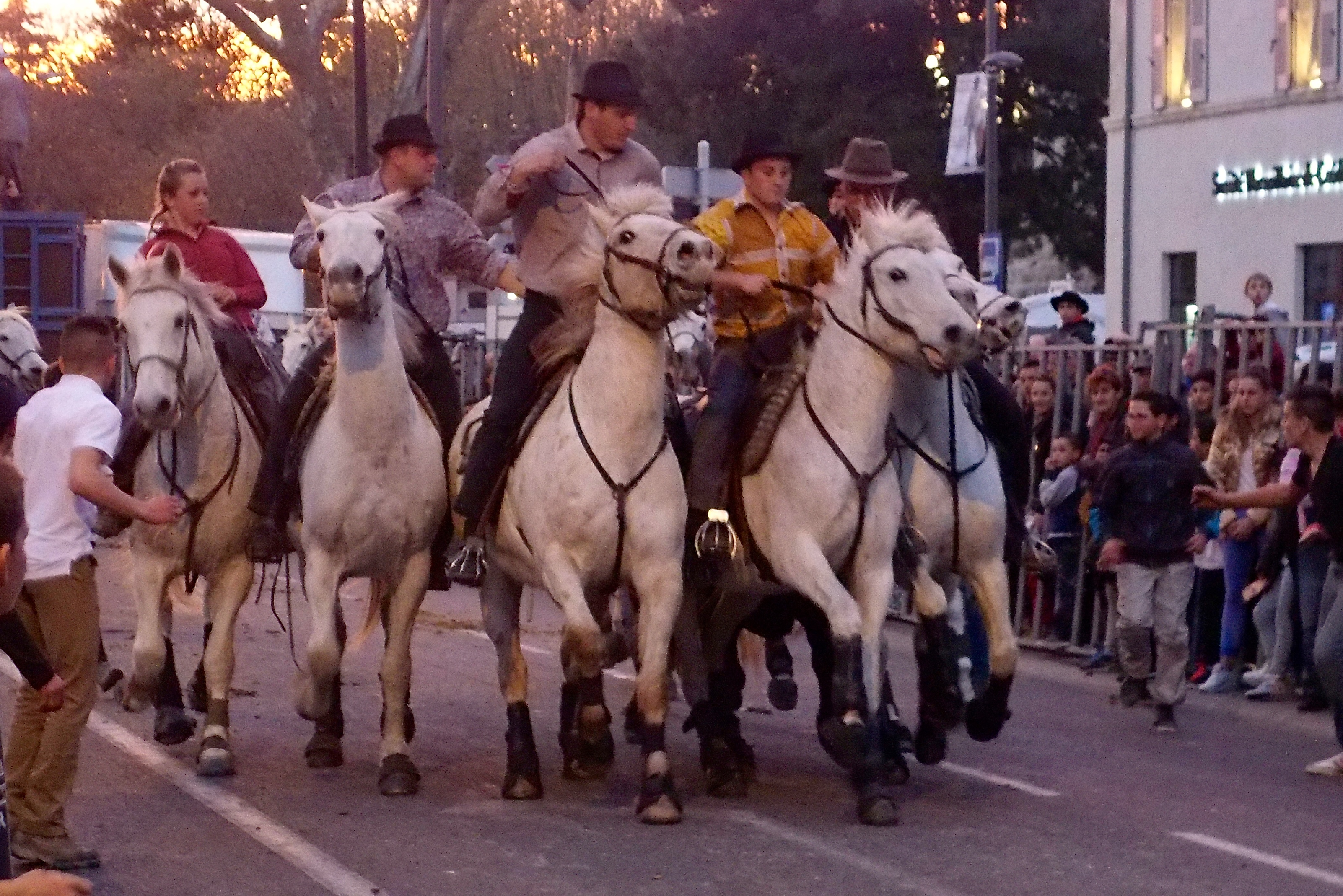
OLYMPUS DIGITAL CAMERA

This is what the horses look like as they race by. And yes, Michael was standing inside the barrier as he took this shot.

Young boys race after the cluster of animals, trying to grab the bull or its tail. The likelihood that the bull will escape is low, but the likelihood of being trampled by a horse is higher. Nevertheless, some of the kids were successful, bringing the bull to the ground…and ending up with manure-soaked shirts and bragging rights.
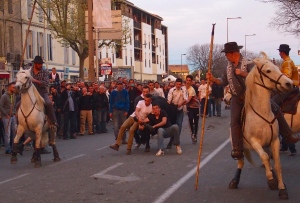
OLYMPUS DIGITAL CAMERA

Perhaps these boys will grow up to be matadors.

We weren’t quite sure what to expect inside the arena; some bullfighting is ceremonial, with non-fatal engagement between matador and bull. Spoiler alert: Not so in the bullfighting of Arles. There will be blood.

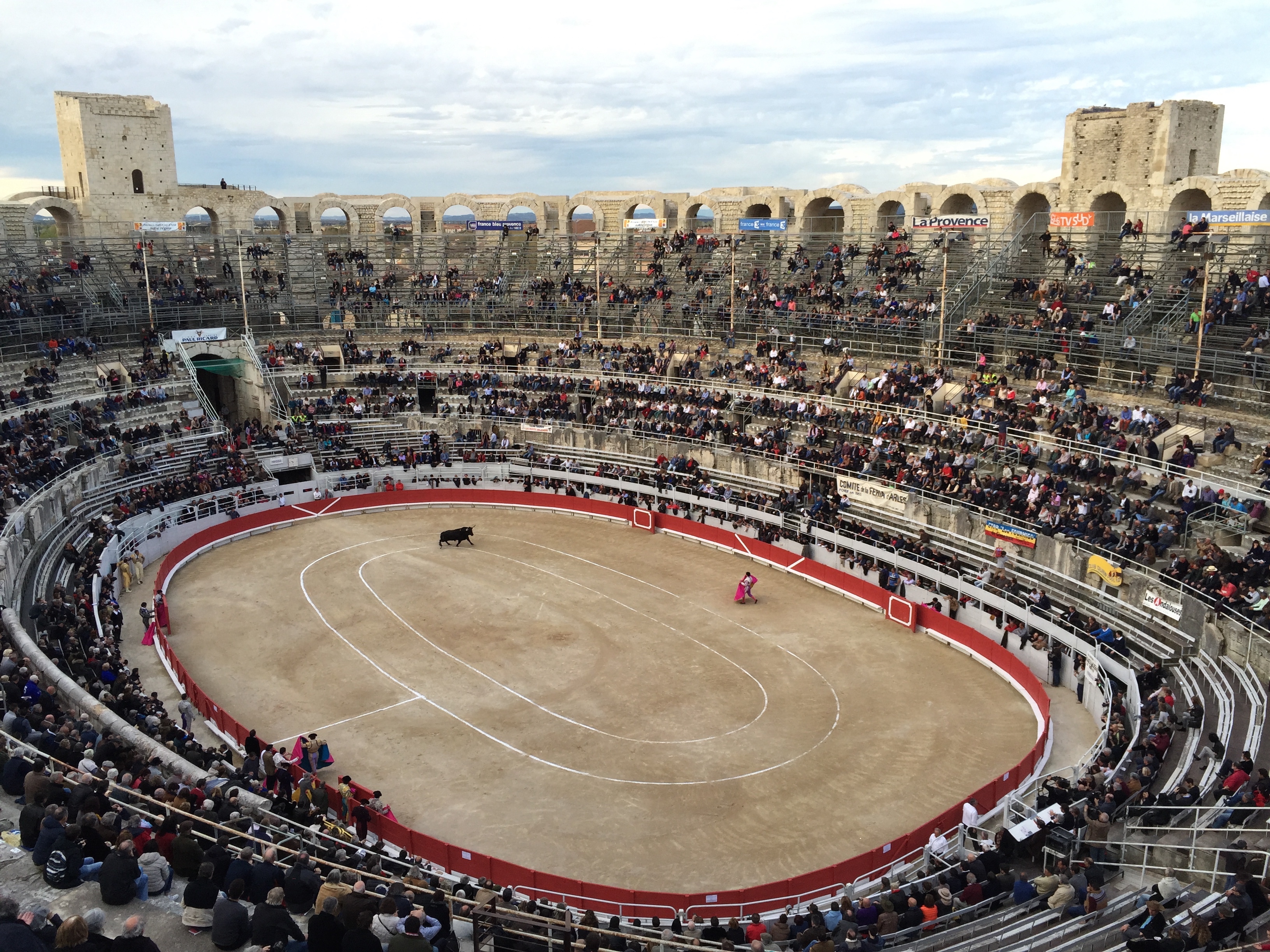
Arles is a very old city in Provence, established in 800 B.C. and taken over by the Romans about 100 B.C. Roman influence is very visible in the city’s architecture, notably the arena where the bullfighting takes place. Its arches are a bit Colosseum-esque.
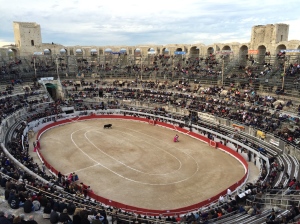
IMG_5353

Built in 90 A.D. the arena once hosted chariot races and gladiator battles (to the death). Now it has bullfights (also to the death).

The arena holds about 20,000 people, many seated on the same stone seats put in place in Roman ages. The audience is on the edge of these seats to see the excitement of the bullfight. La Corrida (Spanish for bullfight or run) takes place over four days. Red-jacketed band members play rousing songs, including Bizet’s Toreador Song from the opera, Carmen.

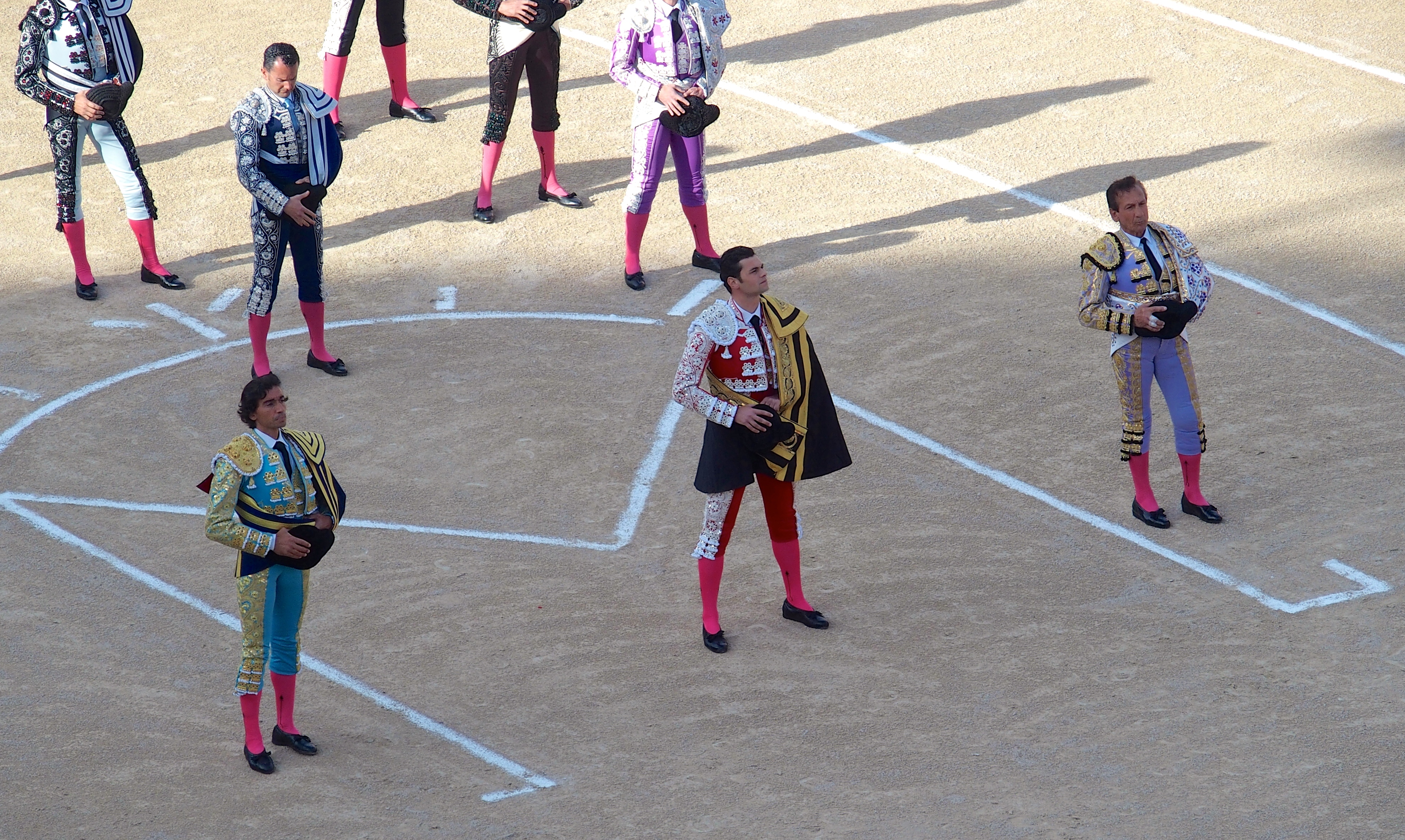
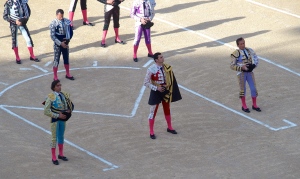
Among the matadors for the event we watched, Perez is only 24 years old while Frascuelo is 67.
OLYMPUS DIGITAL CAMERA

Friday’s three matadors: Curro Diaz, Roman Perez, and Frascuelo. The M on the ground for Matador?

After the processional beginning, the bullfighting gets down to business. A bull is released to run around the arena. These are not roping calves, but big muscled beasts with long sharp horns.
OLYMPUS DIGITAL CAMERA

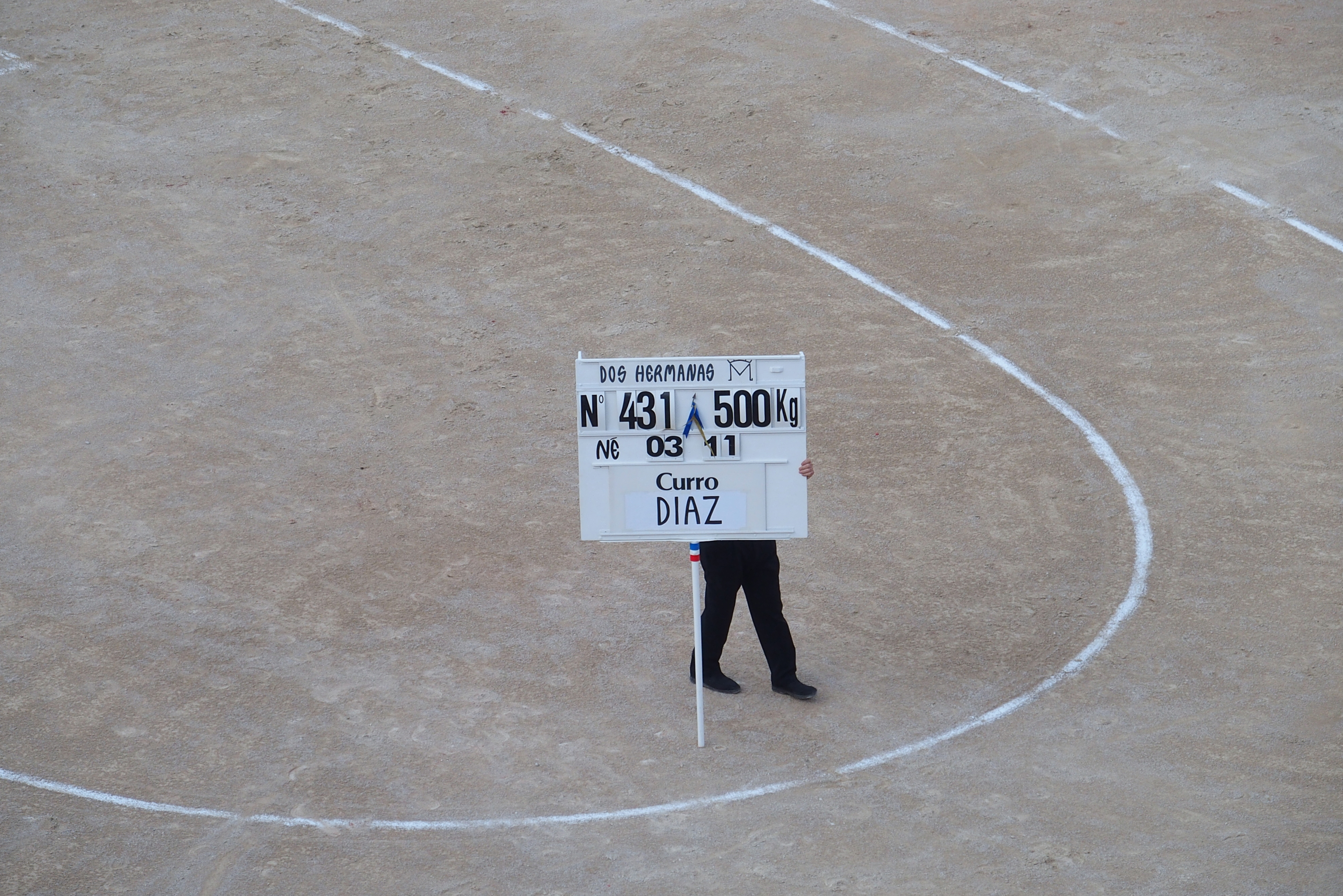
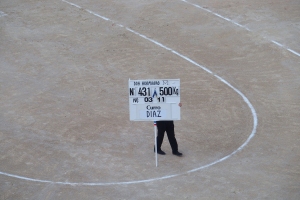
500 Kilos = 1,100 pounds. Diaz is the matador’s name. The bull is nameless.

Junior matadors step out from behind barriers and shout taunts to attract the bull to all parts of the giant field. A 1,000-pound bull can use a lot of energy running wildly for five or ten minutes. During this time, the bullfighters look a bit like circus clowns running around the outside of the ring and jumping behind the barriers.
OLYMPUS DIGITAL CAMERA

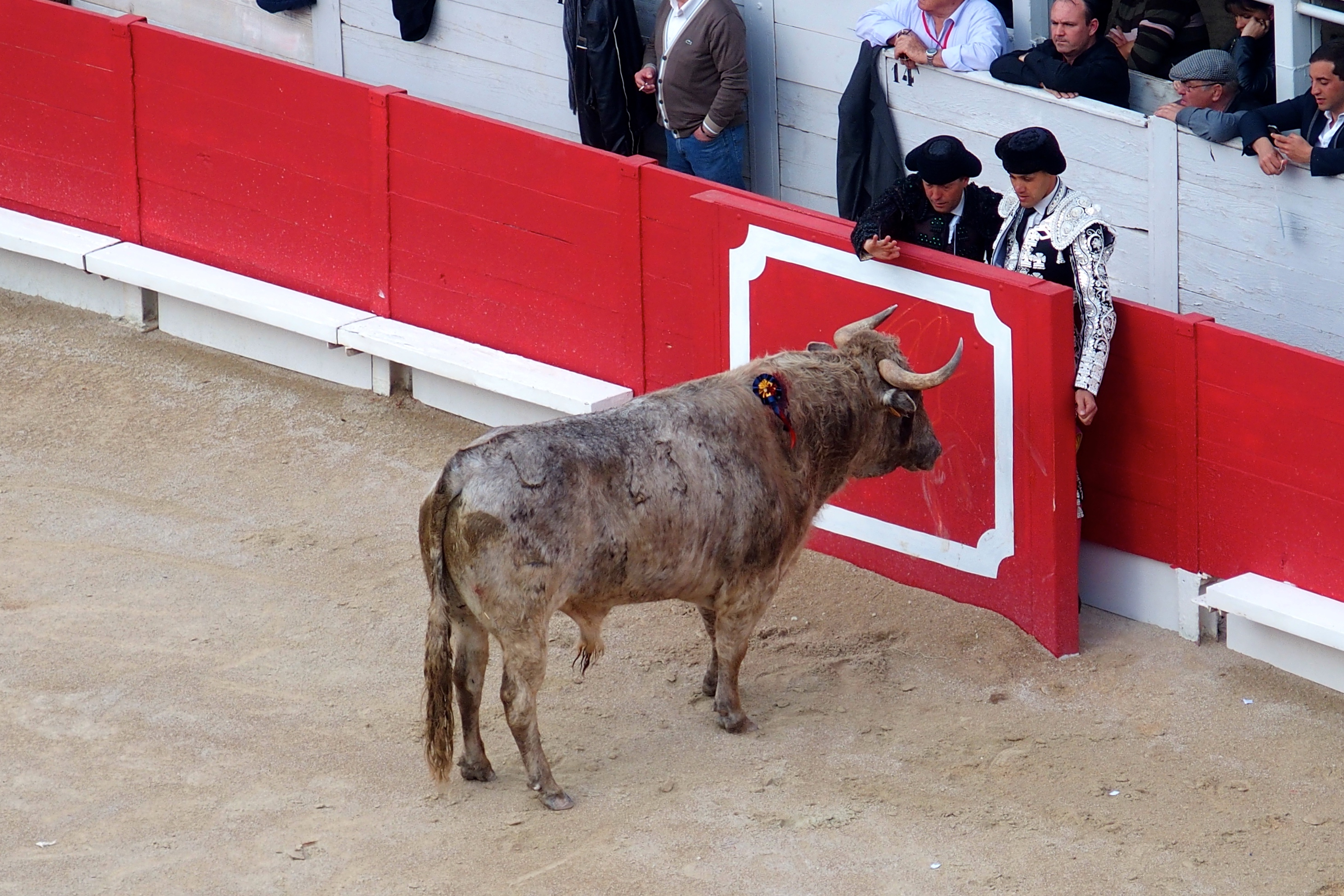
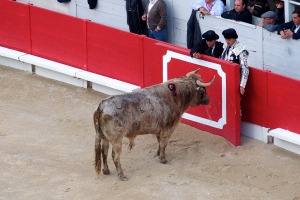
This bull is lively, angry, and brave, holding his head up proudly. If the matadors didn’t have the barrier to hide behind, they would be toast!

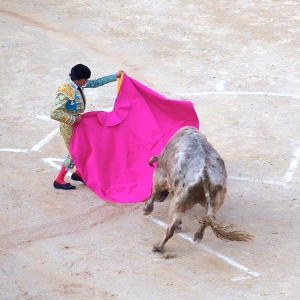
Soon the junior matadors venture farther out from behind their barriers. They use their large magenta and yellow capes to engage the bull to make a pass. The intent of this taunting and passing is to determine how brave the bull is. Sometimes the matadors themselves will participate in this phase so that they have first-hand impressions of the bull before they engage one-on-one.
OLYMPUS DIGITAL CAMERA

Here Curro Diaz participates in the warm-up activities.

OLYMPUS DIGITAL CAMERA

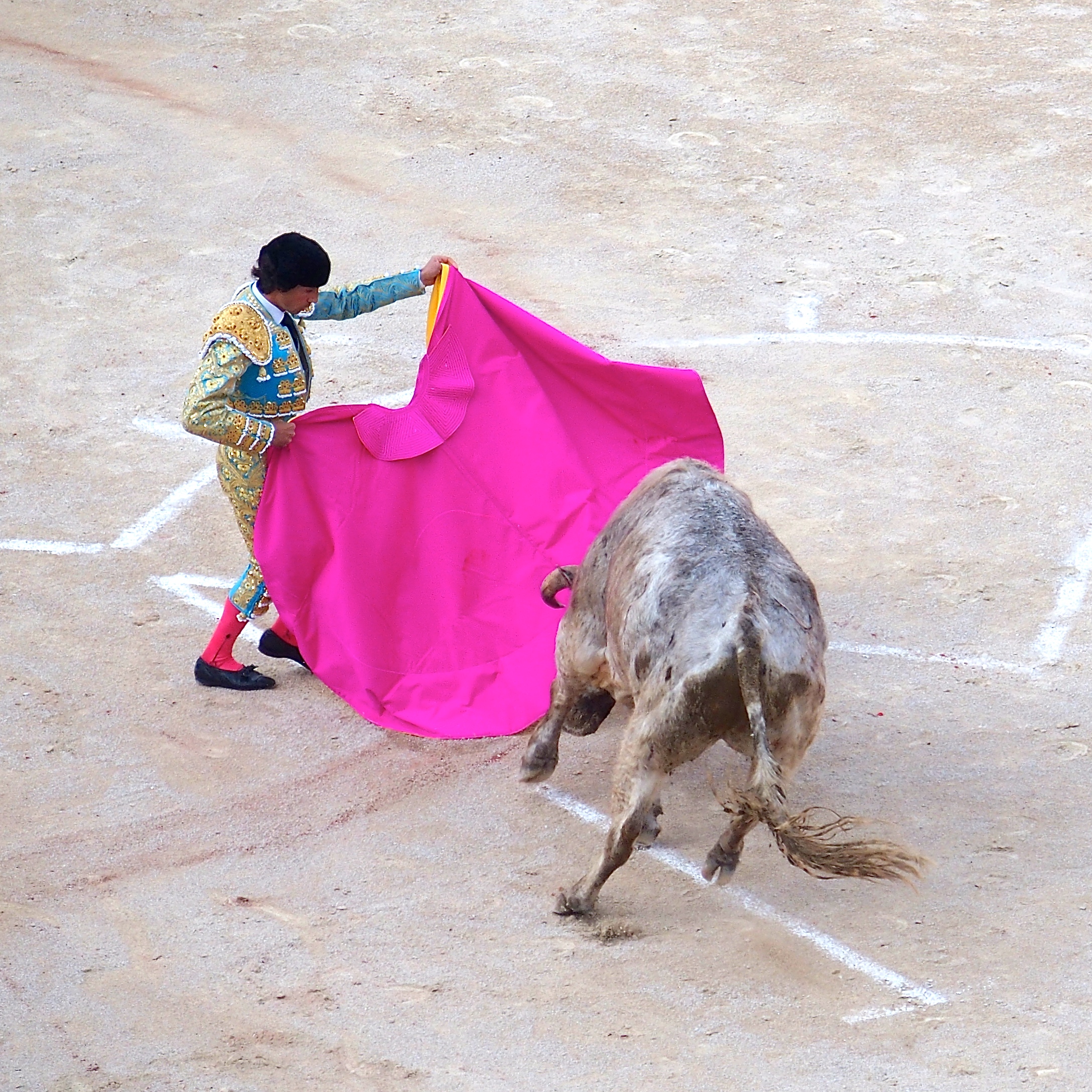
Roman Perez performs a pass to a bull.

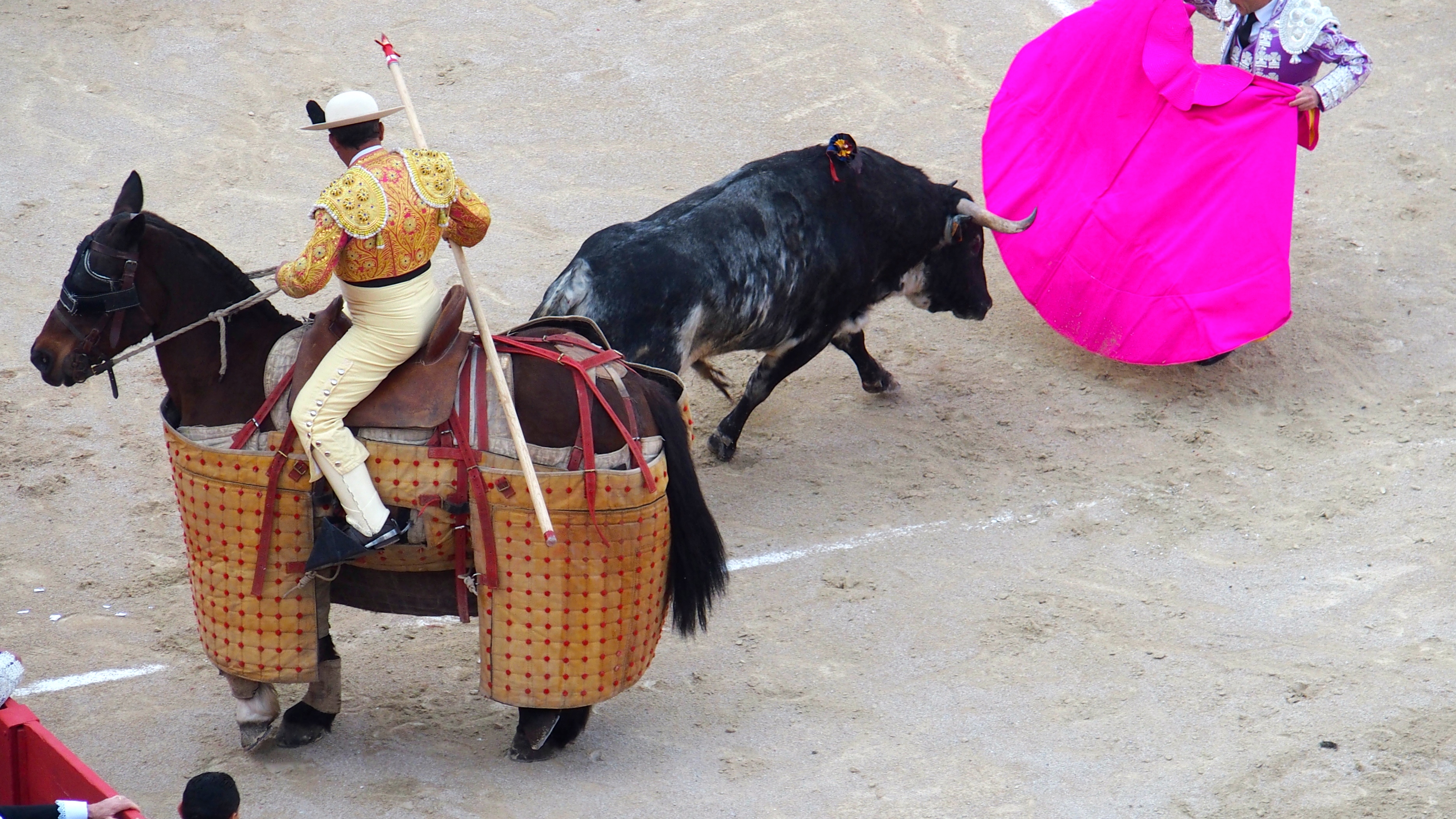
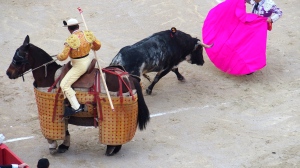
A bugle sounds and the first phase begins. A picador on horseback comes out with a long lance. His objective is to stick the point in the bull between the back and neck. A strategic placement can cause the bull to drop his head and tire more quickly. These horses basically stand still while the picador plans his attack.
OLYMPUS DIGITAL CAMERA

The horse stands calmly. He’s wearing blinders.

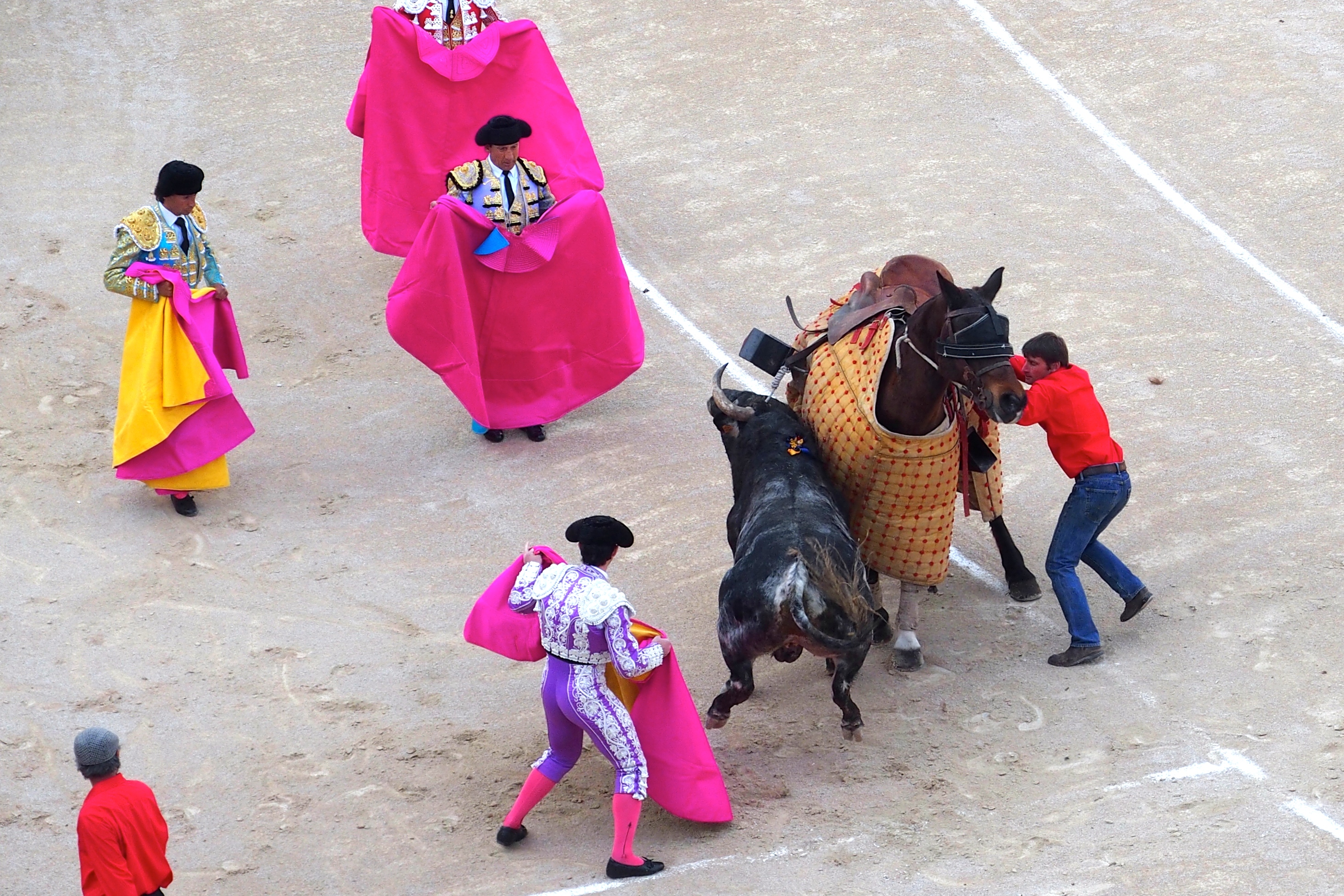
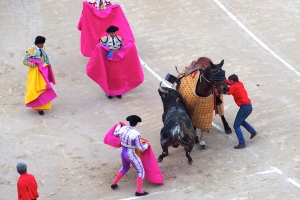
Sometimes the bull reacts quite violently, ramming head and sharp horns into the belly of the horse, thinking the horse is the cause of its pain. Now horses are equipped with peto coverings, which appear to be thick mattress pads. Through the 1920s, before the peto, the horses were frequently gored by the bulls and died. Sometimes more horses than bulls died in the multi-day events.
OLYMPUS DIGITAL CAMERA

One picador was jolted off the horse and escaped over the arena wall. A helper in red tries to rescue the horse, disengage the bull, and avoid getting gored himself.

We wondered why the helper wore red when he jumped into the arena to rescue the horse. Wouldn’t his red shirt attract the bull? It turns out that bulls are colorblind, so red is simply a color of tradition, not one that instigates anger.

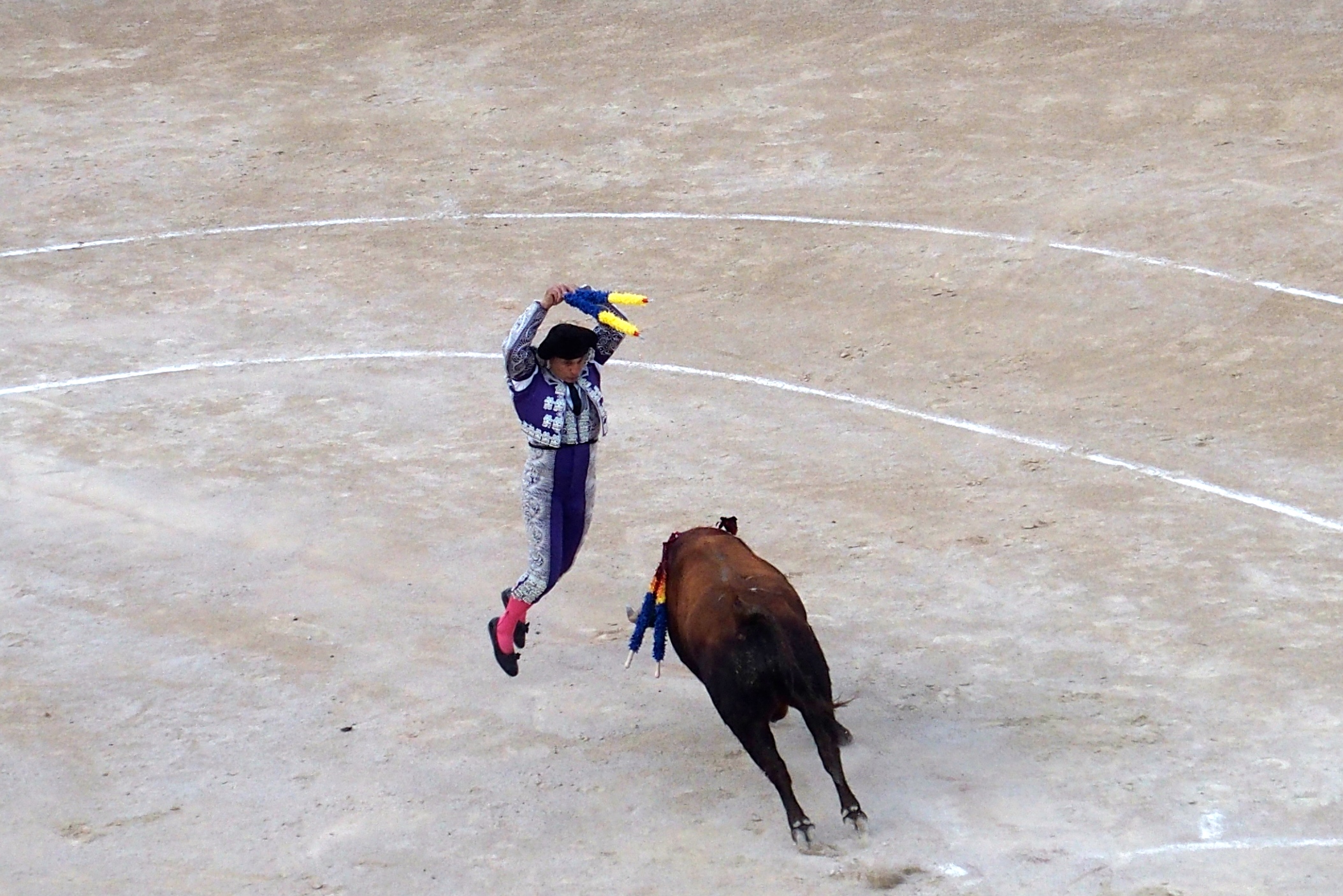
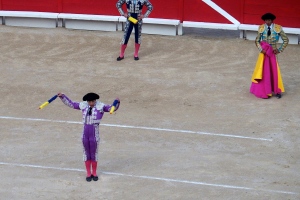
Another bugle sounds for the next phase. The bull is now tired and a bit slower. Three banderilleros hold their banderilleras in outstretched arms. They try to attract the bull and as it passes, they thrust these barbed sticks into the same vulnerable location at the back of the neck.
OLYMPUS DIGITAL CAMERA

In the banderillero phase, the torrero may stand on his toes and make mincing moves back and forth, unless, of course, the bull is charging. Then he hopes for distracting help from the others with their magenta capes.

After the wounds to his neck, the bull can no longer hold its head up. It charges with its nose to the ground and sometimes stumbles to its knees. Nevertheless, its half ton of momentum and sharp horns are still quite dangerous.

OLYMPUS DIGITAL CAMERA

Two banderilleras planted and four to go.

OLYMPUS DIGITAL CAMERA

This can’t be safe.

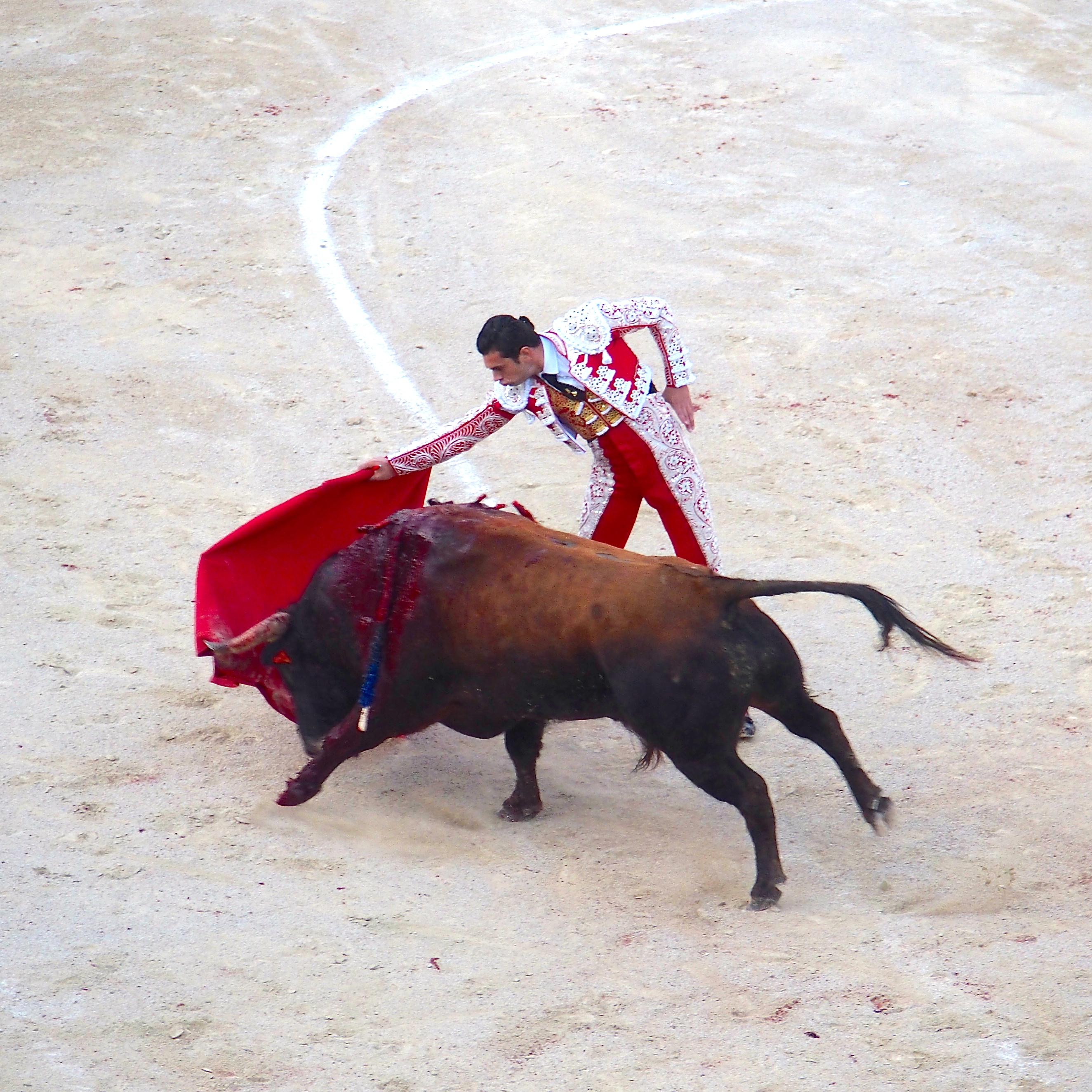
Another bugle and the matador steps into the arena alone with the bull. The matador now uses a red cape, much smaller, the better to draw the bull close, and he does so repeatedly. Perez, the youngest of the matadors we watched, demonstrated best (to our uneducated eyes) some of the art of bullfighting in drawing the bull very close and bending his upper body over the bull, sometimes with his back to the bull as it approaches.

OLYMPUS DIGITAL CAMERA

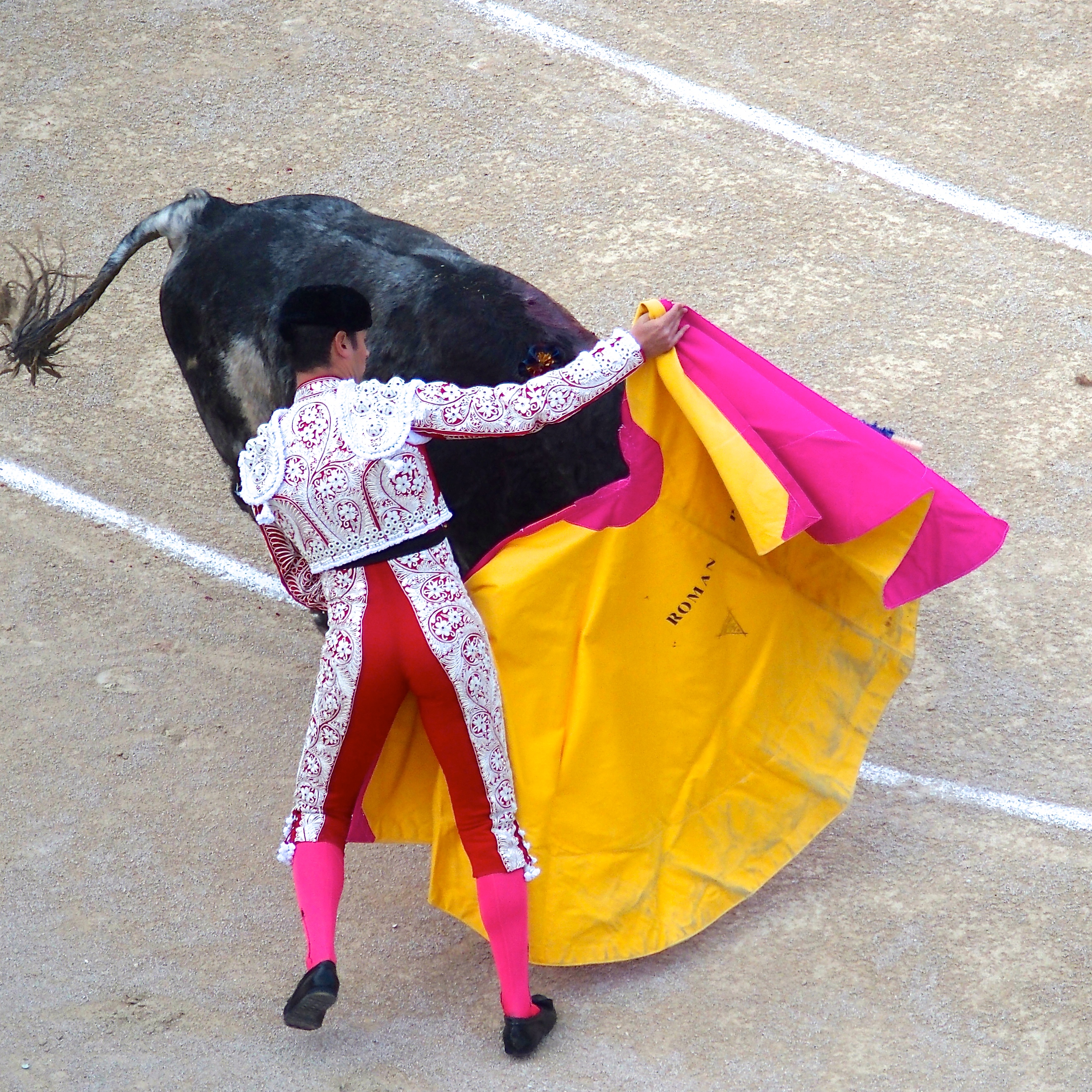
Roman Perez performs a “dance” with the bull.

After numerous passes, the tired bull simply has to stop to catch its breath. Then the matador turns his back on the bull and steps slowly away. Hemingway, who became a bullfight aficionado, described the matador’s are in The Sun Also Rises:

Each time he let the bull pass so close that the man and the bull and the cape that filled and pivoted ahead of the bull were all one sharply etched mass. It was all so slow and so controlled. It was as though he were rocking the bull to sleep. He made four veronicas like that … and came away toward the applause, his hand on his hip, his cape on his arm, and the bull watching his back going away.
— from The Sun Also Rises

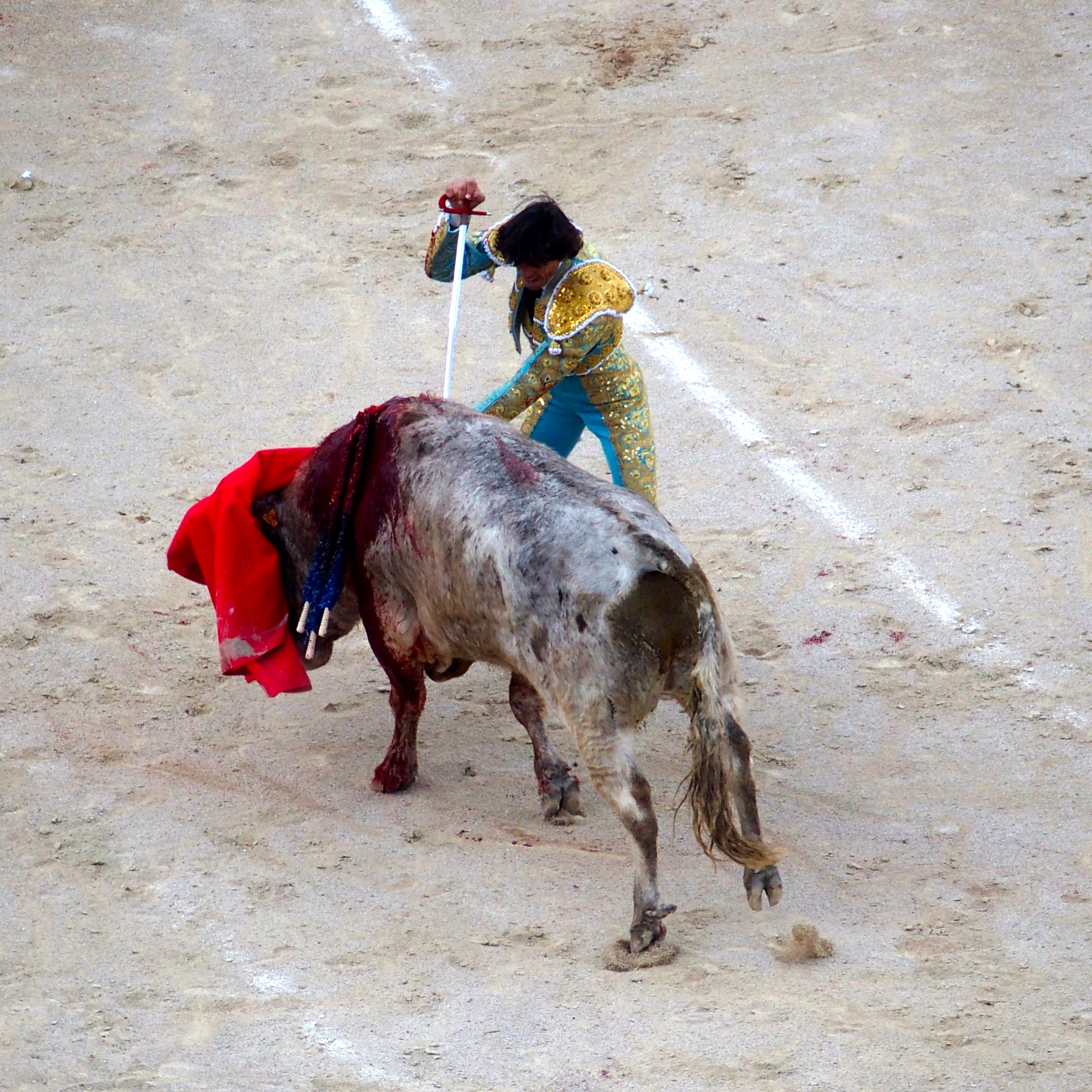
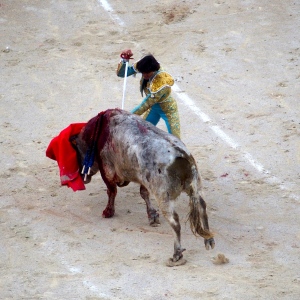
At this point, the bull is often too tired and weak from loss of blood to put up much resistance. The matador holds his sword to face the bull and draws it into one more pass. Then he sticks the sword into the bull, attempting to pierce its heart.
OLYMPUS DIGITAL CAMERA

The matador strikes the bull with the death stroke.

And then the bull just keels over with a few shudders and a collapse of its massive bulk.

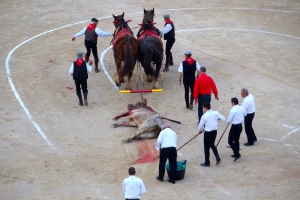
Two large horses come into the arena to pull the near-dead carcass off the field. Groundskeepers move in to clear away the blood and refresh the white markings.
OLYMPUS DIGITAL CAMERA

The end of the brave bull’s fight.

Each day three bullfighters battle two bulls each, with a double set on the final day. So 30 bulls appear between Friday and Monday and 30 bulls disappear to the butcher shop.

Is this sport or art or animal cruelty? Hemingway thought it was high art. French and Spanish advocates have indicated interest in having bullfighting identified with the UNESCO Intangible Cultural Heritage label, which would indicate the need for urgent safeguarding to be kept alive.

On the other hand, this kind of bullfighting  could be outlawed in France as in other countries to keep the bulls alive. We would vote for this choice.


Posted in Smell the Roses, Travel Journal | Tagged , , , | 4 Comments

Touring the Côte d’Azur

Postcard for friends and family: “Enjoying our travels along the south of France. Wish you were here.”

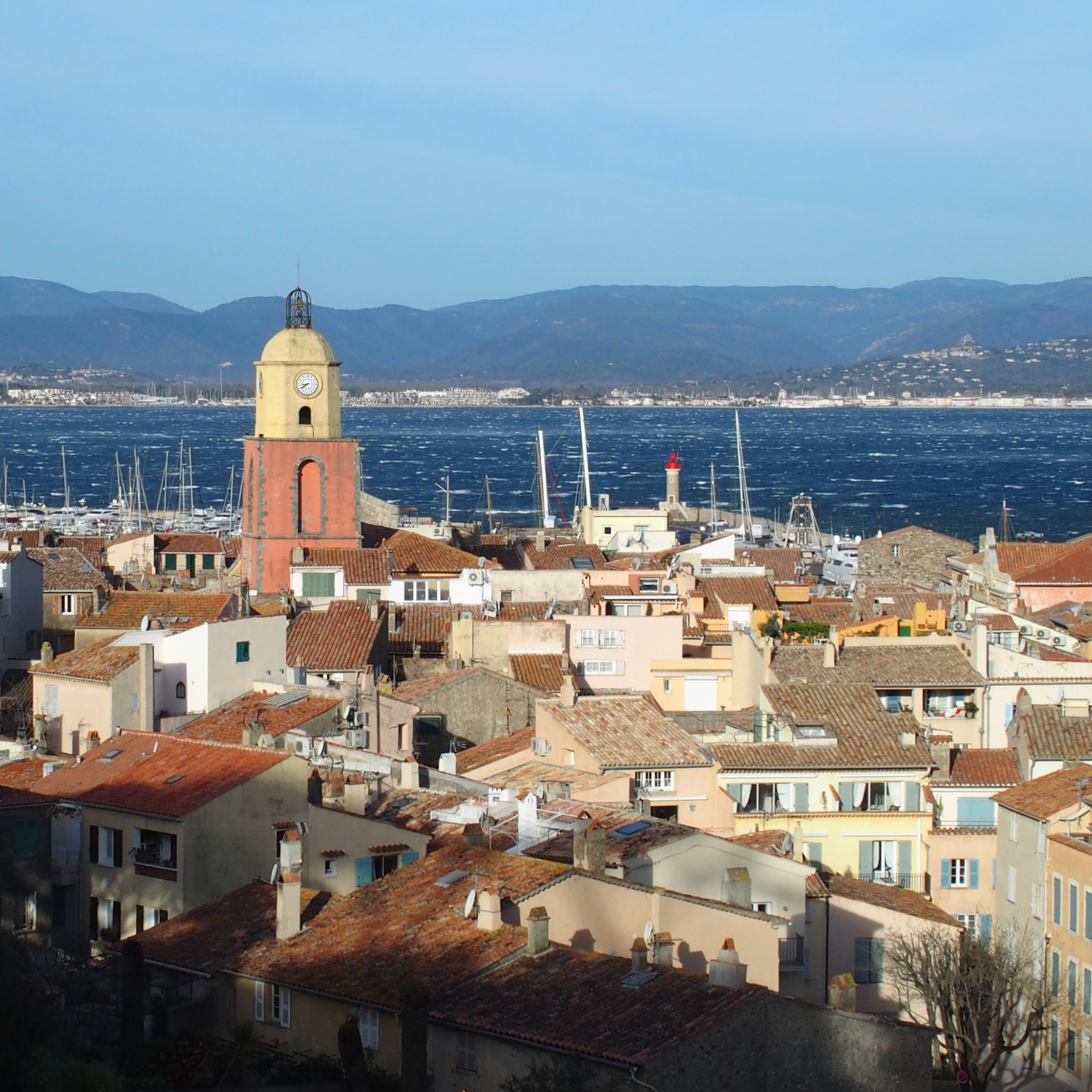
Our home base is Saint-Tropez. The town has a very well-known name, especially surprising considering it has a population of just over 5,000.

OLYMPUS DIGITAL CAMERA

Saint-Tropez has an old town with many buildings along very tiny streets packed on a peninsula jutting into the Mediterranean.

Google Maps led us near our airbnb apartment down streets so narrow that we thought we would get wedged in place. In fact, our “street” was actually a pedestrian alley. After we were settled in, we enjoyed looking out the window to see the restaurants below doing spring cleaning to get ready for an Easter opening. The alley became an al fresco dining location. All across the town people were cleaning and painting.

Public parking for Saint-Tropez is at the end of a long pier. Michael left the car there one night and found it covered with salt the next morning.

IMG_5325

View of Saint-Tropez harbor from the near end of the pier.

Who put the salt on the car? The mistral! This strong, cold wind is a frequent occurrence in late winter and spring. The wind blows from the ocean toward the Côte D’Azur and whips up waves on the bay and saltwater into the air.

OLYMPUS DIGITAL CAMERA

Mistral winds may be 25 to 60 miles an hour and sustained for days.

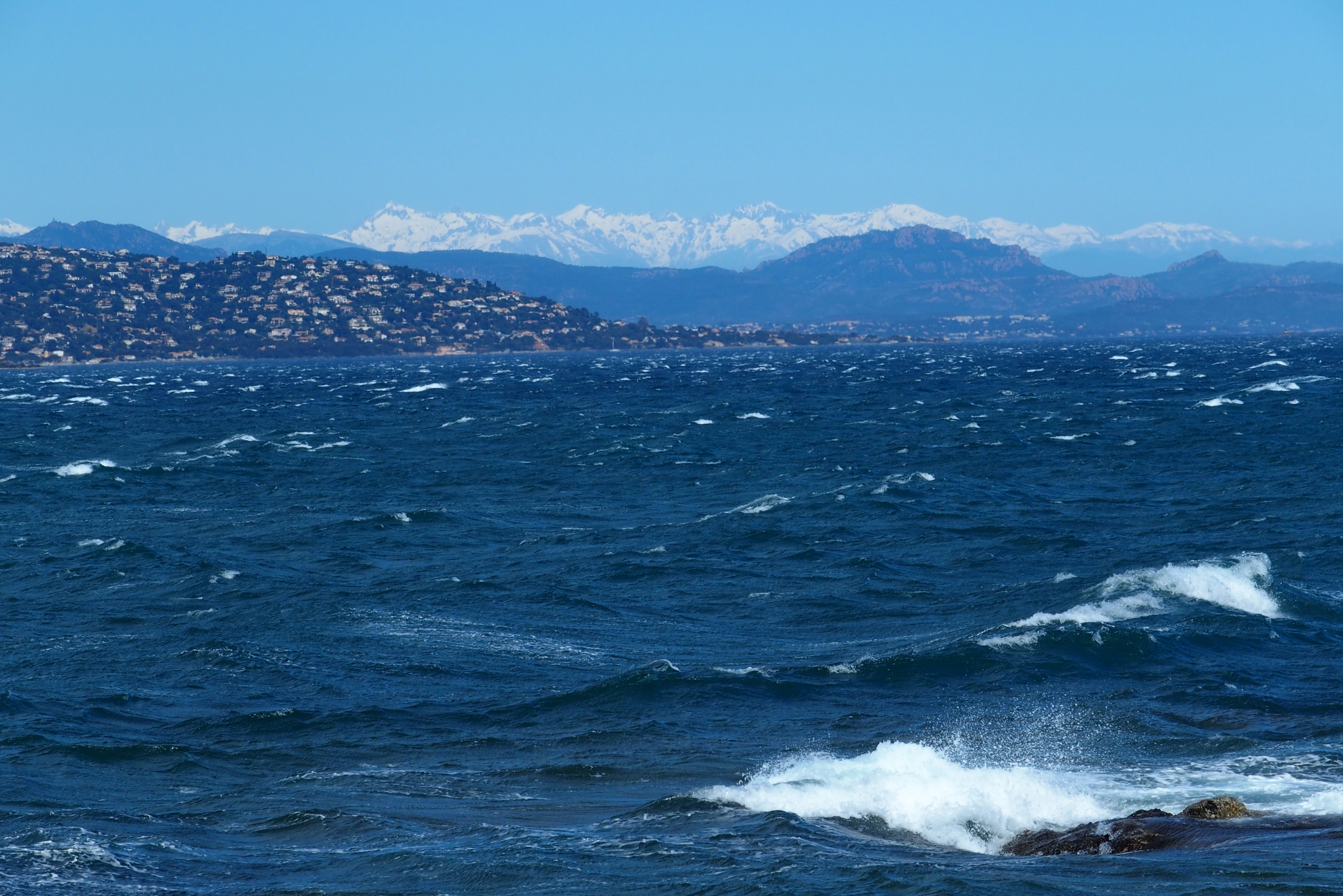
Across the Golfe de Saint-Tropez  (gulf, not golf) is the town of Sainte-Maxime, and beyond that are the mountains of the Verdon region.

OLYMPUS DIGITAL CAMERA

Cold wind over the waters of Saint-Tropez, and snow still on the mountains of Verdon.

OLYMPUS DIGITAL CAMERA

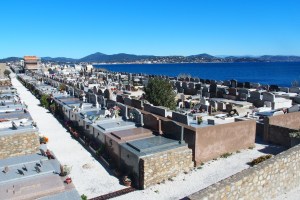
Cimetière marin de Saint-Tropez: Those no longer able to enjoy it have some of the best views from Saint-Tropez.

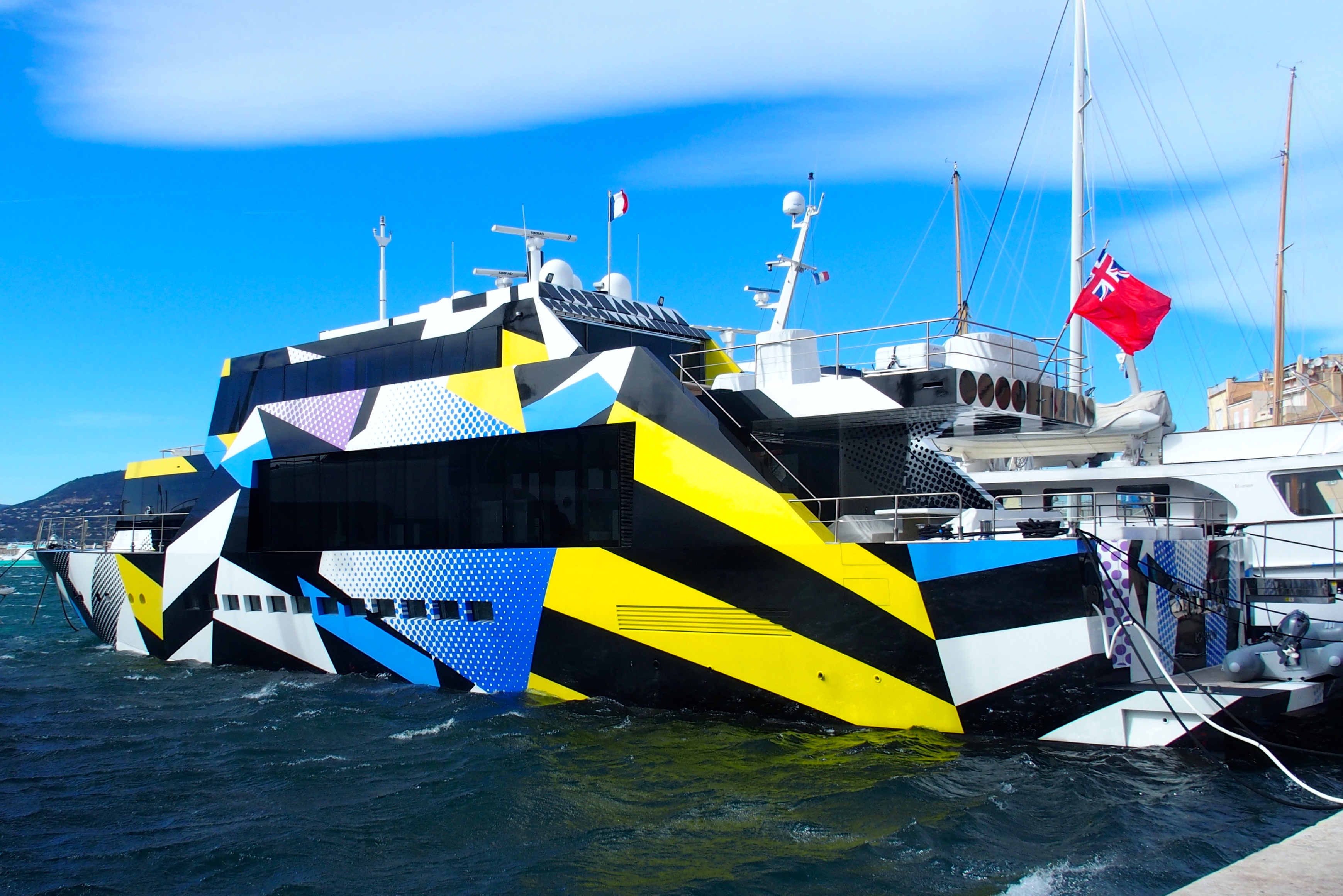
Although tourist season hasn’t officially started, the streets of Saint-Tropez are already crowded with both pedestrians and cars, making it even more difficult to drive in and out of the town. The solution? Use your yacht to avoid the crowds. Dakis Joannou, a Greek billionaire, owns one we saw in the harbor. Guilty is 114 feet long and painted in an outrageous contemporary art pattern inspired by military camouflage…or possibly madness.

OLYMPUS DIGITAL CAMERA

Guilty. Is it a yacht or floating art?

Those of us who don’t have yachts walk up and down the streets. In many of the shops we passed, we found images of Brigitte Bardot (or near lookalikes). In the ’50s, BB became a popular movie star. Her film “And God Created Woman” catapulted her to international fame and infamy as a sex symbol. She lived in Saint-Tropez for a number of years and has become one of the area’s favorite daughters. After she retired from film, she leveraged her celebrity to become an animal rights advocate and more recently an anti-Muslim activist. At 80, she’s still having an impact.

OLYMPUS DIGITAL CAMERA

Brigitte Bardot through the ages.

The Saint-Tropez population swells dramatically when summer arrives and hordes of celebrities and tourists come to the area’s beautiful beaches to work on their Saint-Tropez tans.

OLYMPUS DIGITAL CAMERA

Just south of the old town of Saint-Tropez is the beautiful Baie de Pampelonne, empty now, but it will be quite a different sight in a few months.

This spot has an interesting small-world connection. “And God Made Woman” was filmed very near here. After the film became popular, the area known as Tahiti Beach became a topless beach (and eventually clothing optional). Rudi Gernreich, a popular swimsuit designer in the early years of SI Swimsuit edition, was one of the first to create topless swimwear with his monokini (basically briefs and thin suspender-like straps. beware: R-rated!). Back in the ’50s and ’60s, Gernreich’s swimwear was being manufactured by Harmon Knitwear in Marinette Wisconsin, just across the river from Menominee Michigan, Nancy’s hometown. From the wholesomeness of Midwest USA to the toplessness of Mediterranean shores. Who knew?

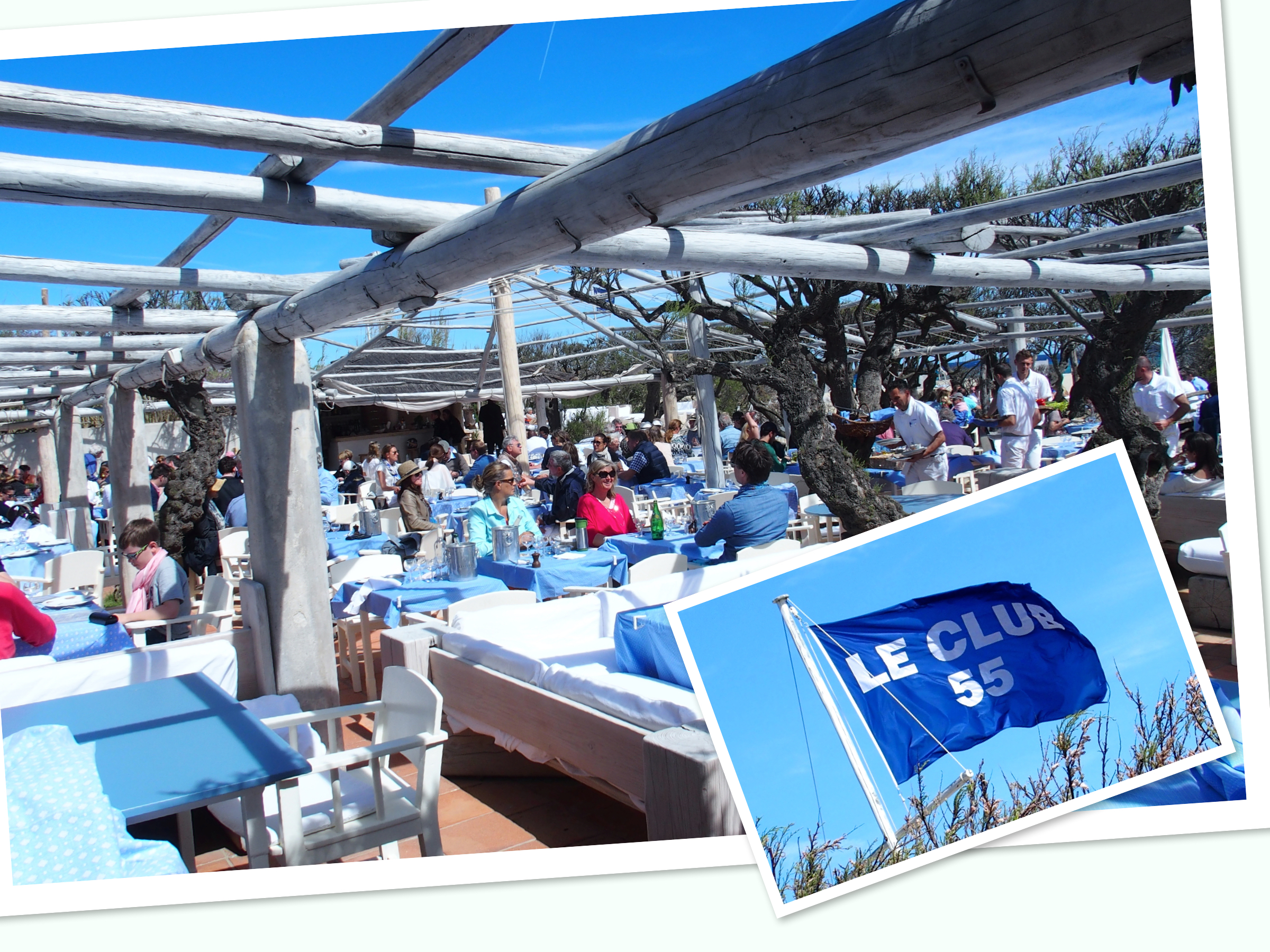
So when Kathy and Lynn visit us in a couple weeks, we will visit Pampelonne Beach. The ladies will be wearing brand-new blue shoes…and perhaps nothing else! Right, Kathy? Actually we will be returning to a “tres chic” spot, Le Club 55. This restaurant was created in 1955 to serve the crew working on Bardot’s movie and has grown in reputation since then.

Club 55

Le Club 55 is THE place to be seen on Pampelonne Beach. We have reservations! Wear blue.

OLYMPUS DIGITAL CAMERA

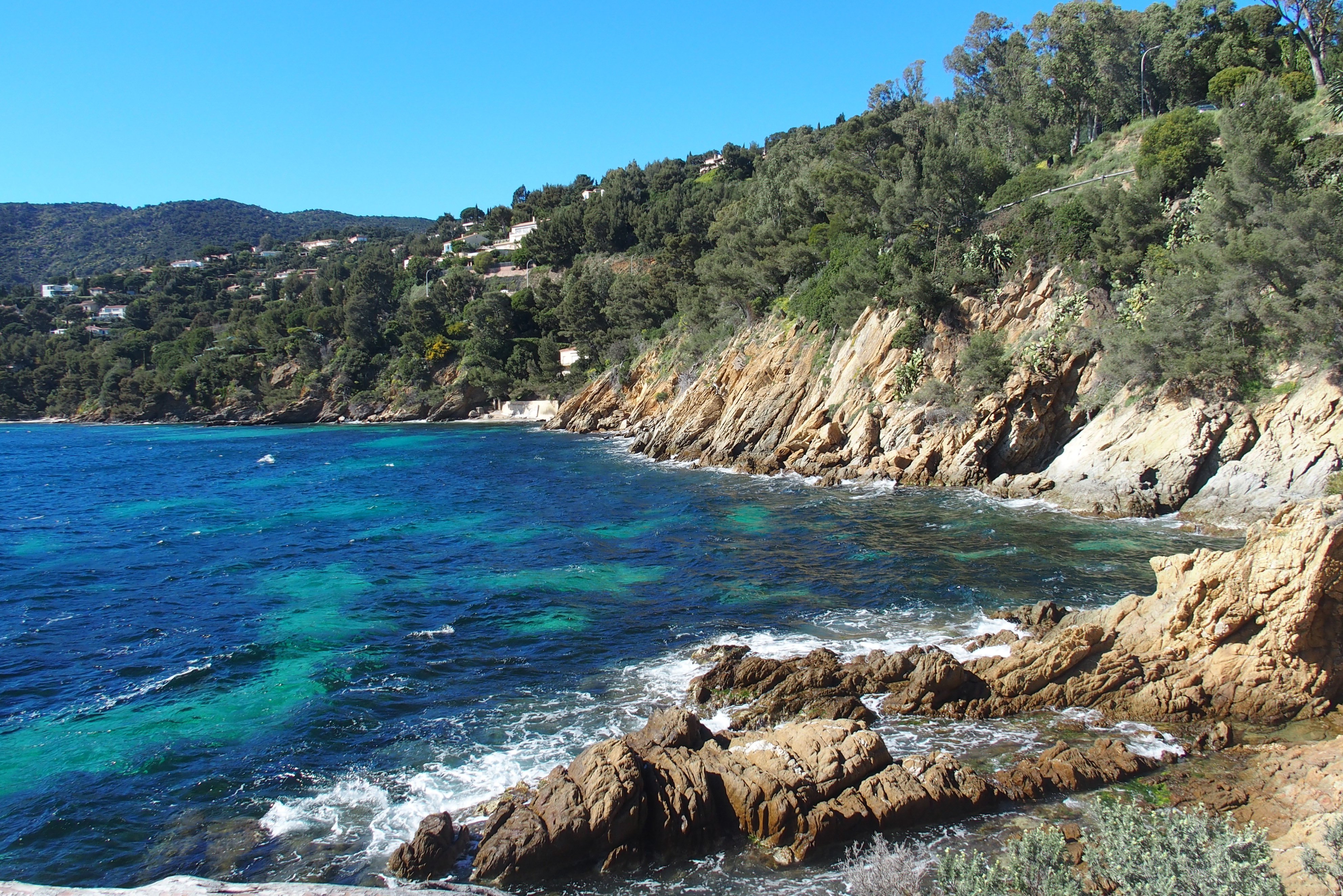
Away from the beaches, the rugged coastline is just beautiful.

OLYMPUS DIGITAL CAMERA

Inland, the grapevines are starting to show their first shoots.

IMG_5344

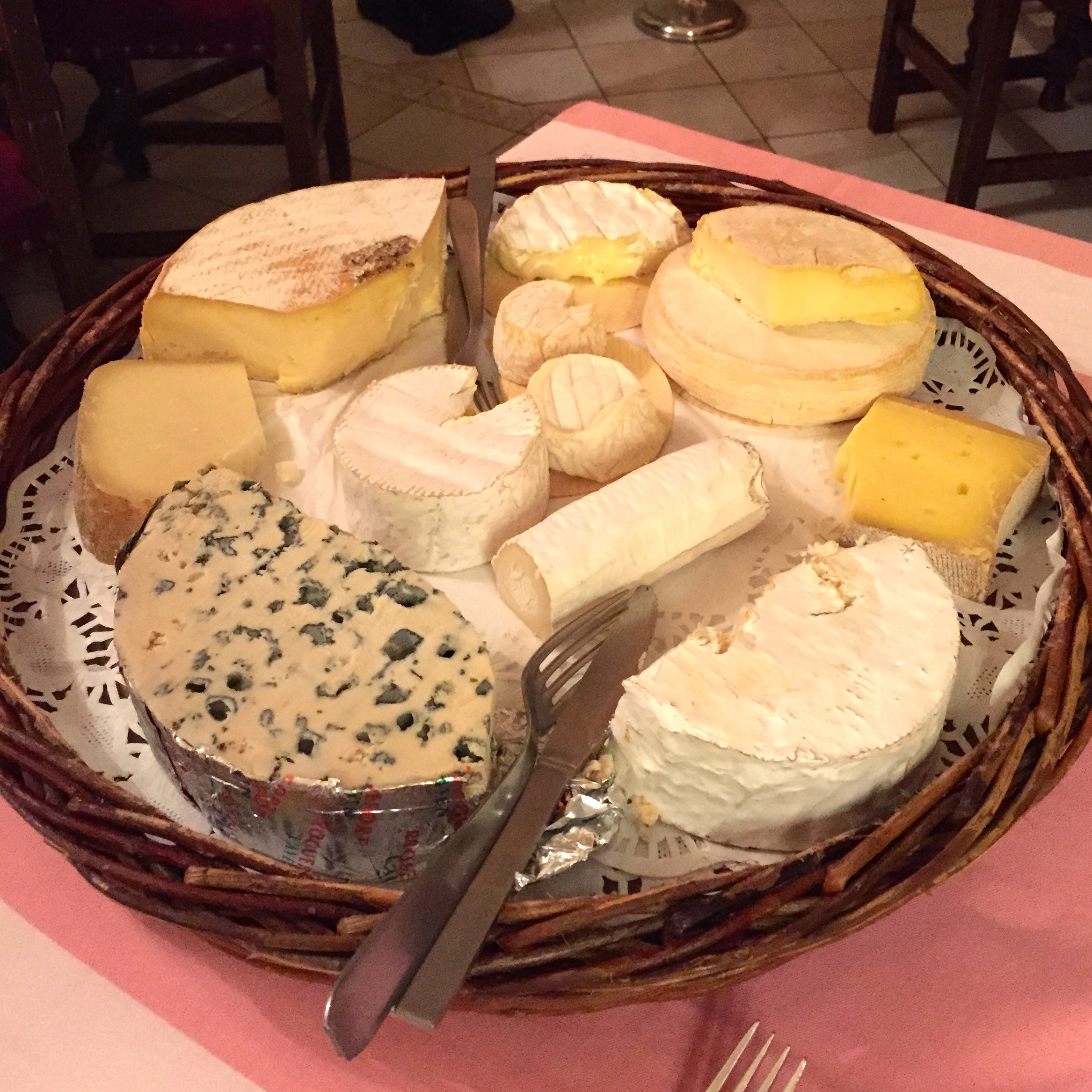
And the cheeses are always delicious. (Family style at l’Auberge de la Mole)

Next we’re leaving the coast and heading inland…to the heart of Provence.


Posted in Travel Journal | Tagged , , , , , | 1 Comment

Another Day, Another GREEK Salad

In the US, we eat Greek salads. They usually have lots of lettuce, a few bits of tomato and cucumber, an olive or two, red onion, and some crumbles of feta cheese.

Here in Greece we eat GREEK salads.

IMG_5004

The tomatoes are luscious!

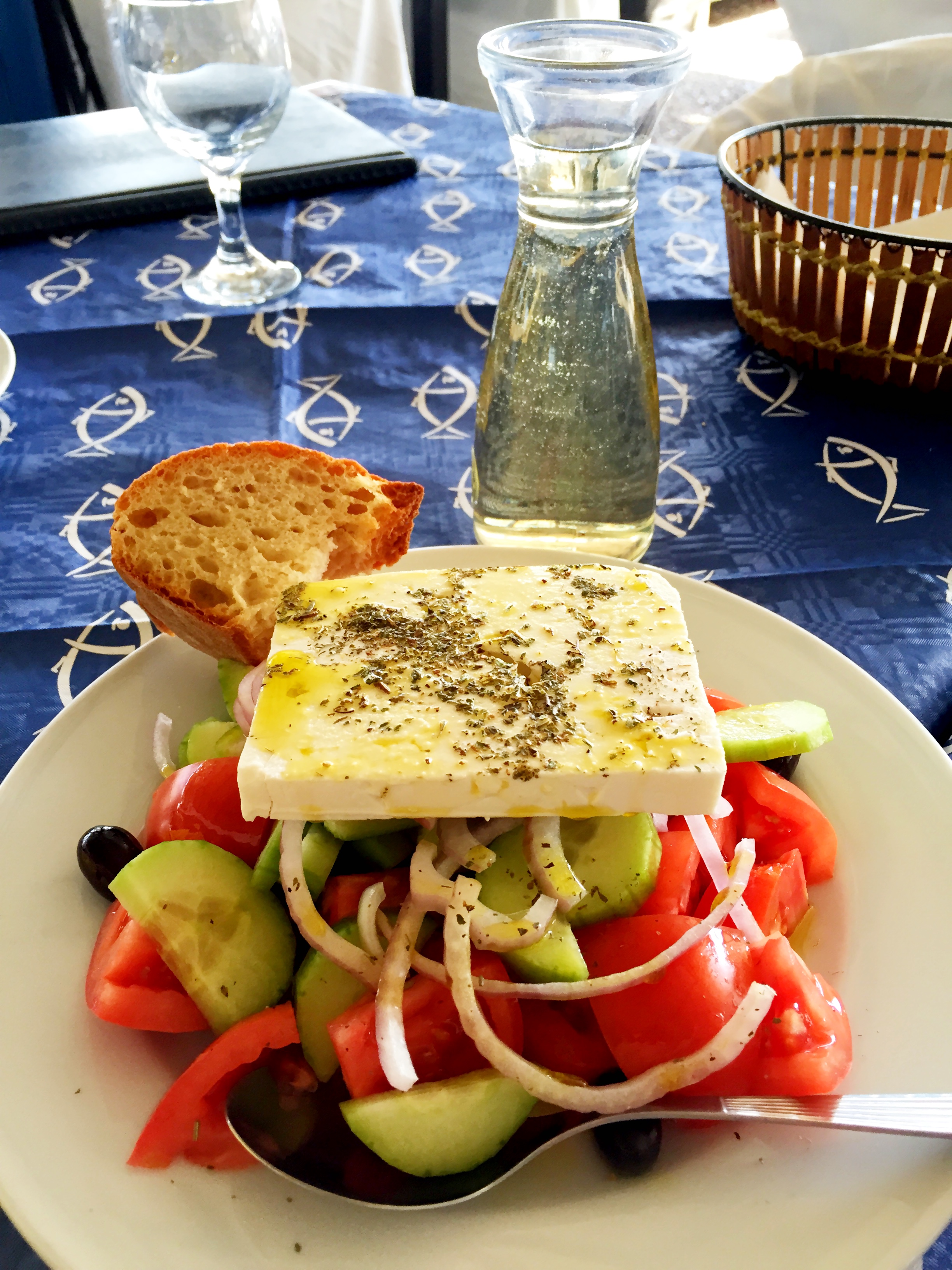
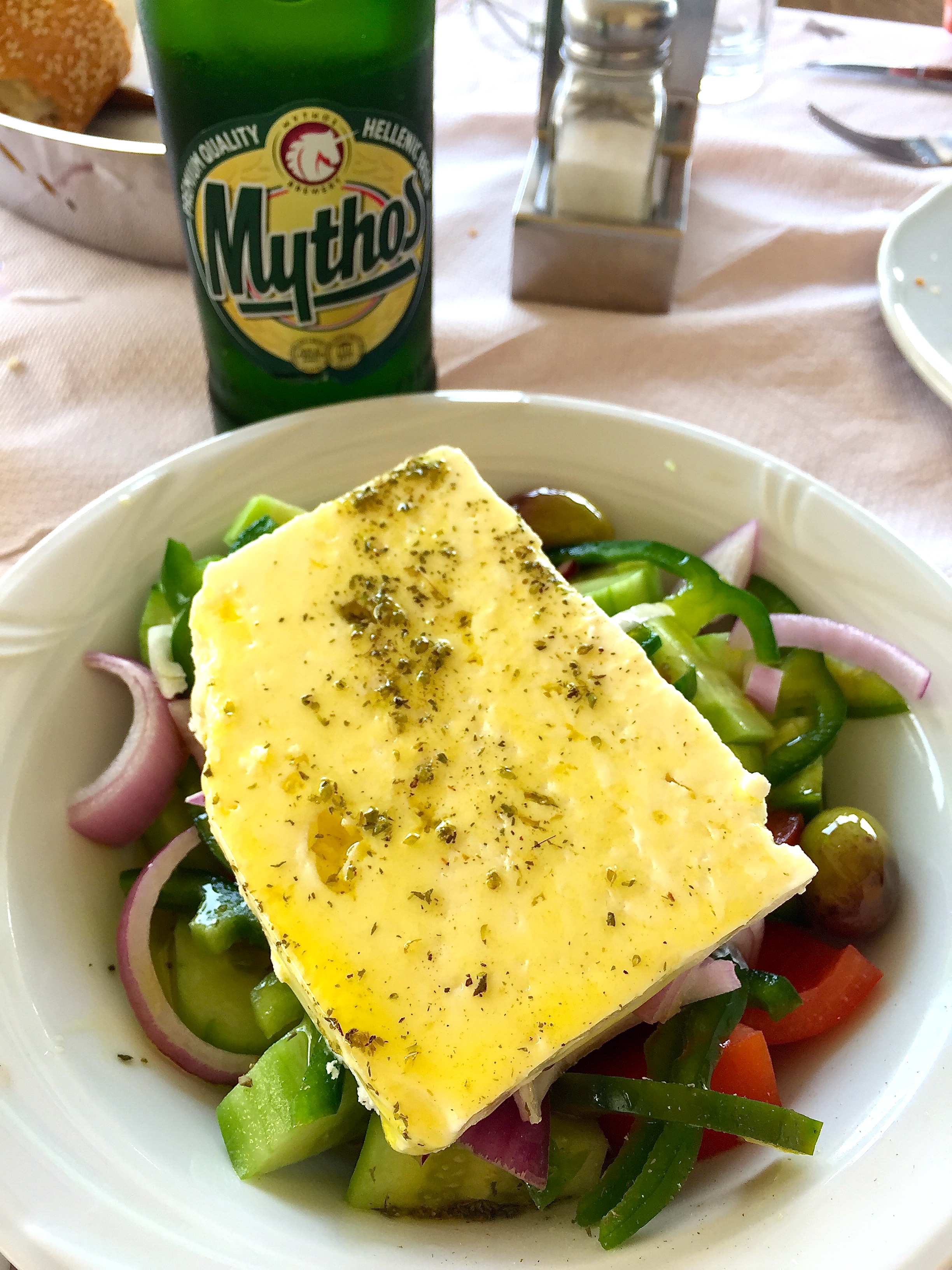
Where’s the lettuce? A GREEK salad doesn’t have lettuce! It has tomatoes (lots of them!), cucumbers, peppers, olives, red onions, capers, feta cheese, lots of olive oil, and oregano.

IMG_5155

Oregano adds nice flavor.

We ordered the salads with white wine, no winery identification or even type of wine, just white wine, bulk or barrel. And it was good, light and dry.

IMG_5038

White wine and crusty bread add a nice touch.

It seemed like the amount of feta got bigger and bigger with each salad.

IMG_5176

And lots of olives and capers!

IMG_5089

Did we say LOTS of feta?

There wasn’t a lot of variation (Why mess with success?) One had yellow peppers instead of green. One had white onion instead of red. A couple had no capers. (What? No capers in my Greek salad?!) The olives varied most of all, from Kalamata to green to very briny brown ones to speckled. Mostly the feta got bigger and bigger.

IMG_5128

This one was solid tomatoes under the huge amount of feta. Probably three or four tomatoes in one salad.

And we varied our drinks too. White wine of course.

IMG_5048

This was the only salad served with pita bread.

Greek Mythos beer.

IMG_5182

There is so much olive oil you don’t need extra for dipping your bread.

Greek Alpha beer.

IMG_5250

This one came with a Greek Alpha lager on ice in a plastic bag.

Even an Indian restaurant had a Greek salad of sorts. The raita was the chunkiest we’ve ever had, basically a Greek salad drenched in yogurt.

IMG_5254

We had the raita with our samosas for dinner and had a legit Greek salad for lunch.

The amazing thing about all these salads (besides their exquisite fresh taste) is the price. These were generally about 6 to 7 Euros, so less than $8US. And they were so large, the two of us couldn’t always finish them. Great leftovers for breakfast and then a new salad for dinner.
OLYMPUS DIGITAL CAMERA

Our very first GREEK salad at the great Lontos restaurant in Thissio (Athens). Cheers!

Ten days in Greece and a GREEK salad every day!

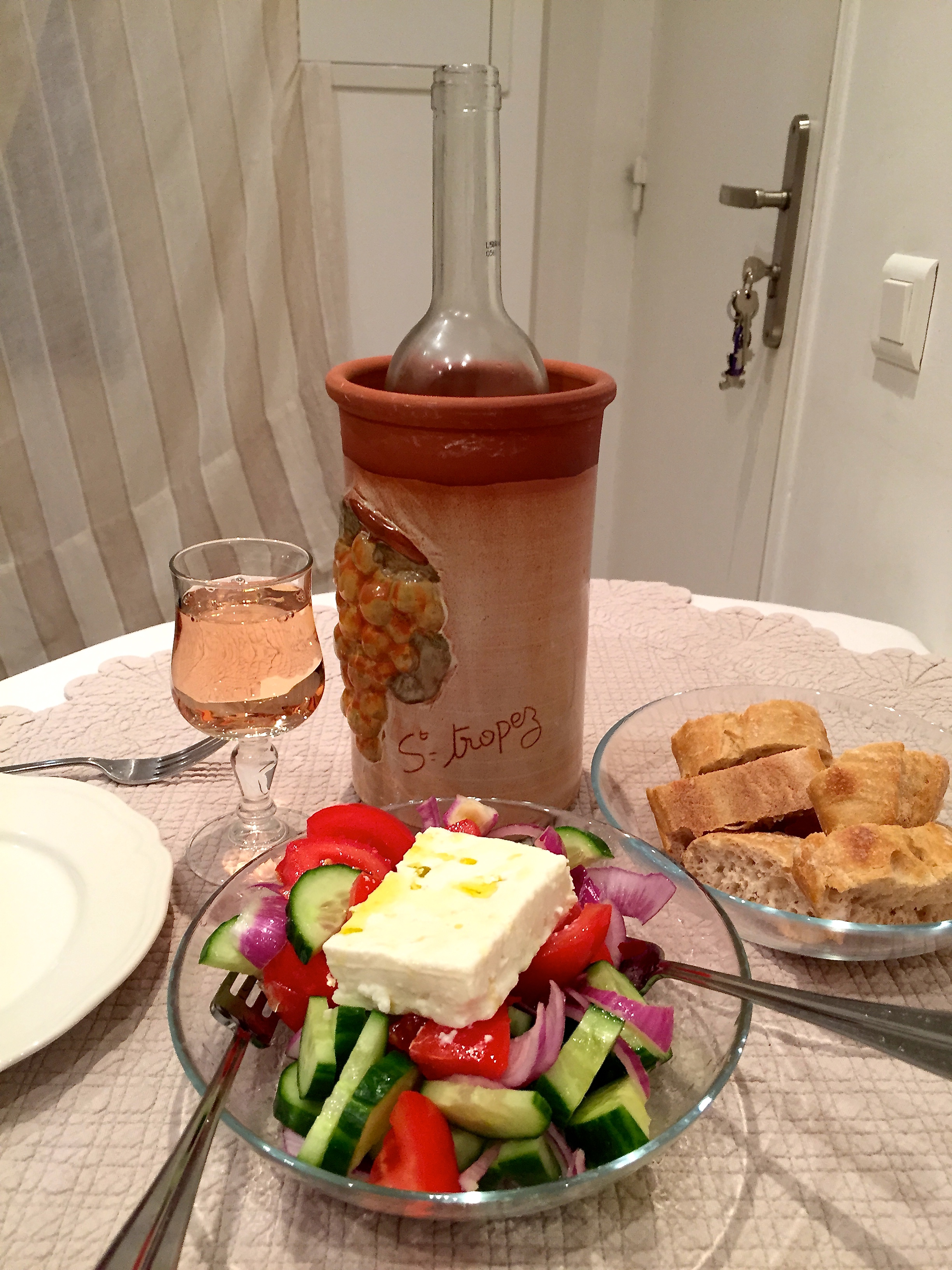
Off to St. Tropez, France. Our first meal was, you guessed it, a GREEK salad, homemade in our apartment in the old town.
IMG_5319

We brought a little bit of Greece with us to St. Tropez.

αντιο σας (goodbye) to Greece. Bonjour a France.


Posted in Smell the Roses | Tagged , , , | 2 Comments

Hydra: donkeys and cats and goats, oh my!

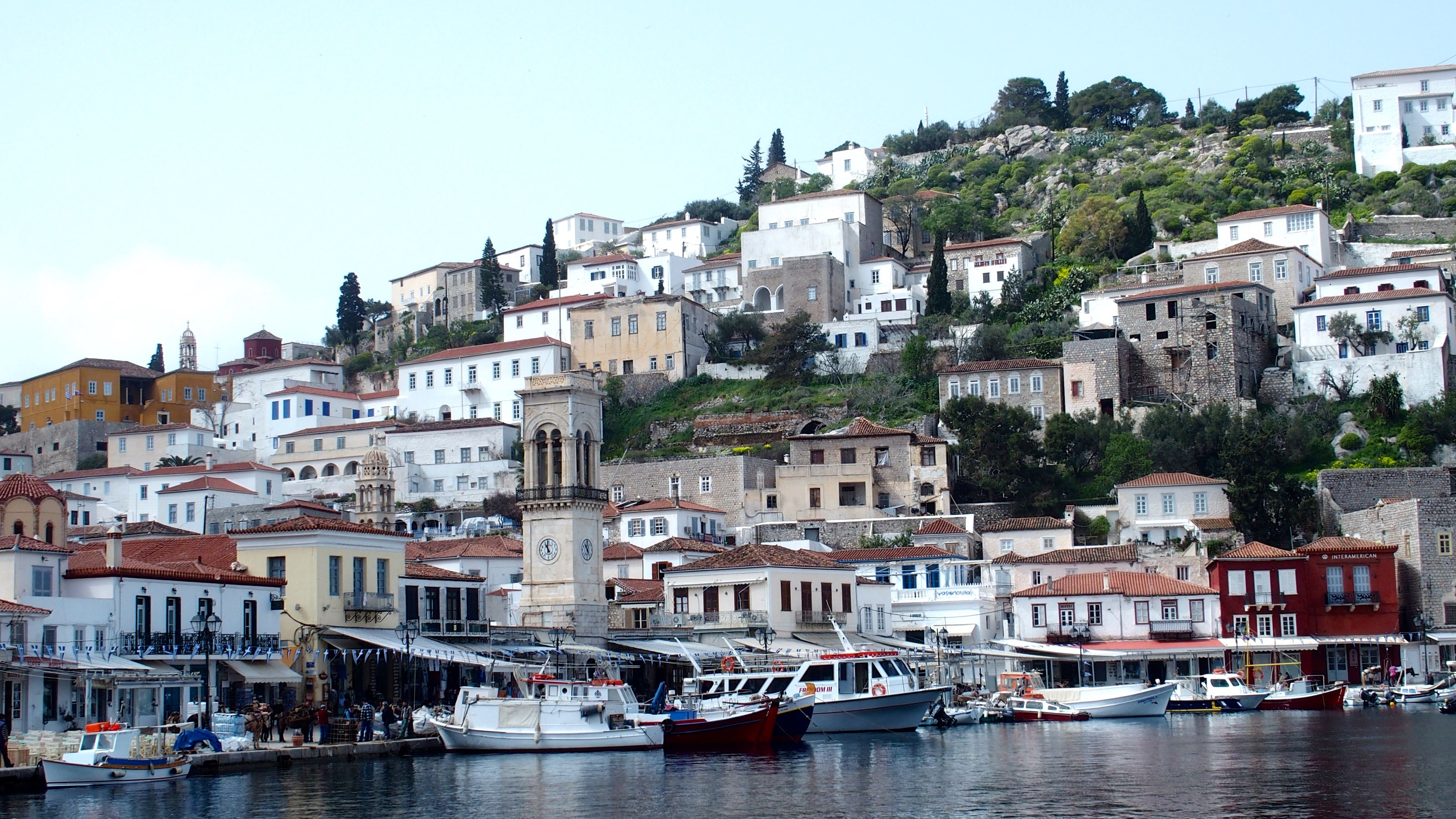
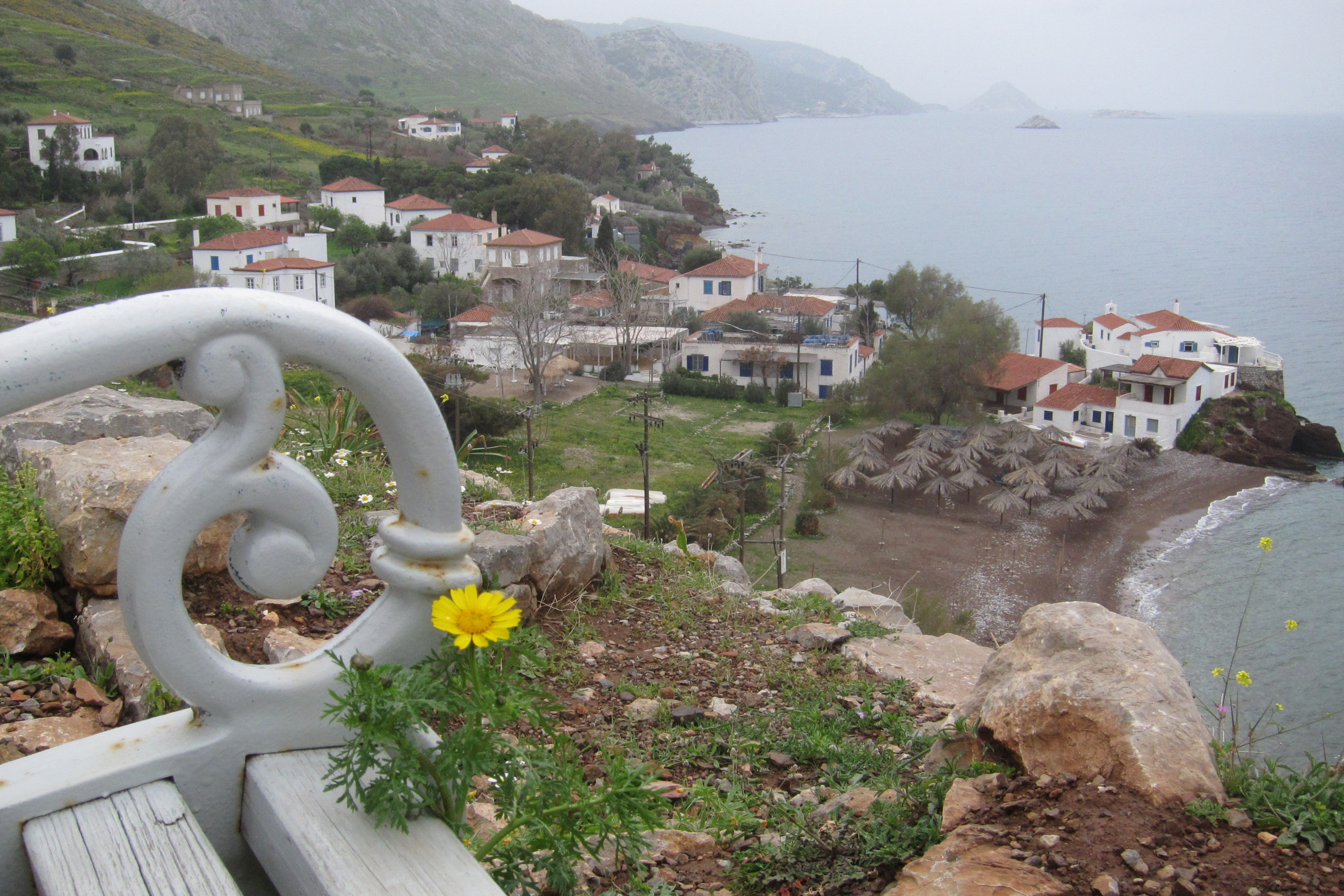
We wanted to visit at least one of “the Greek Isles” so we went to Hydra, an island off the southeastern fingers of the Peloponnese peninsula. The town at Hydra port has old buildings made of stone, plaster and stucco, all tightly packed together along the hillside around the harbor.

OLYMPUS DIGITAL CAMERA

Ahh, Hydra!

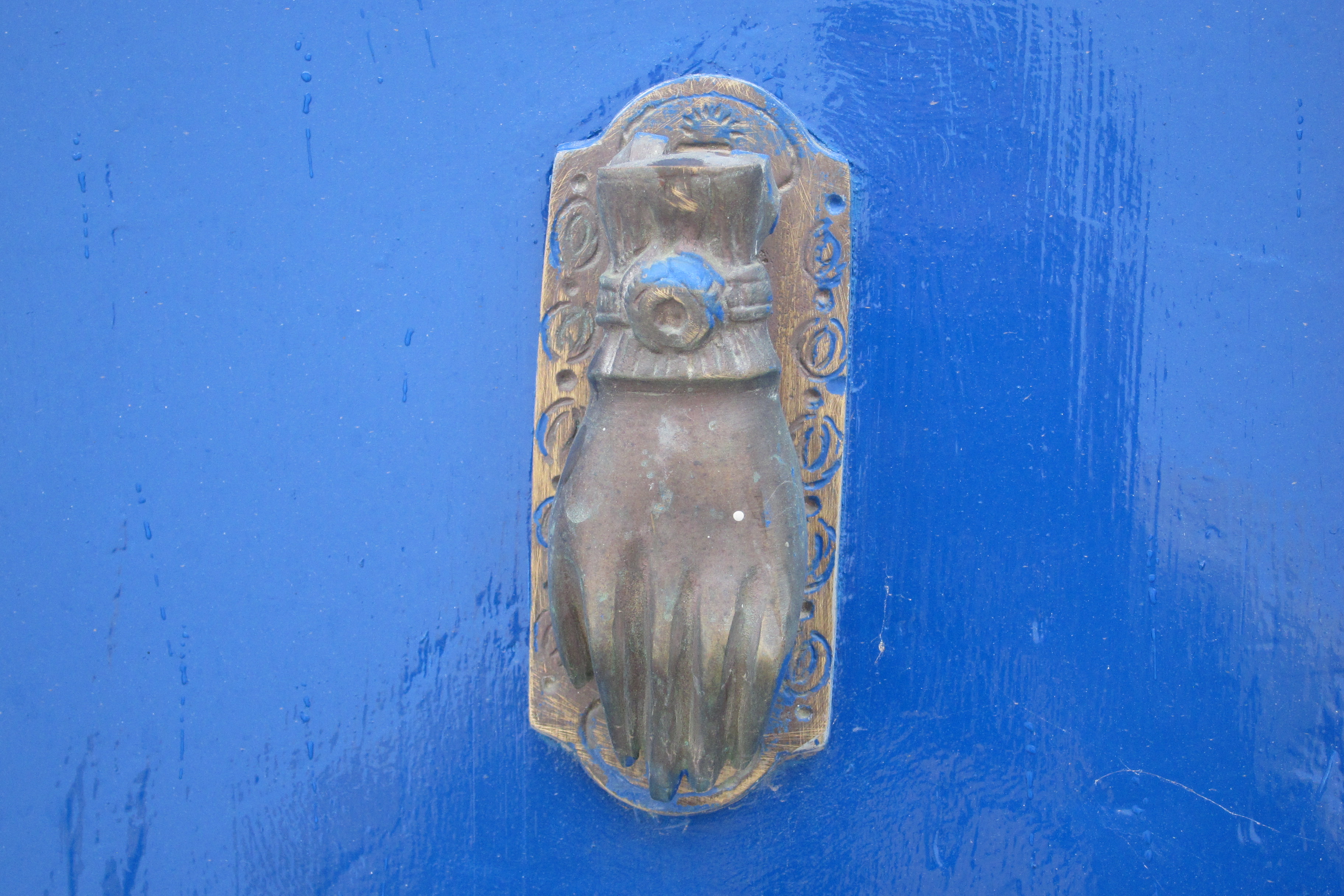
Knock Knock. Who’s there? Hydra, pronounced EE-drah, not HIGH-drah. Its colorful doors have beautiful old doorknockers. Many are in the shape of hands.

2015-03-26 155

Hands are for knocking.

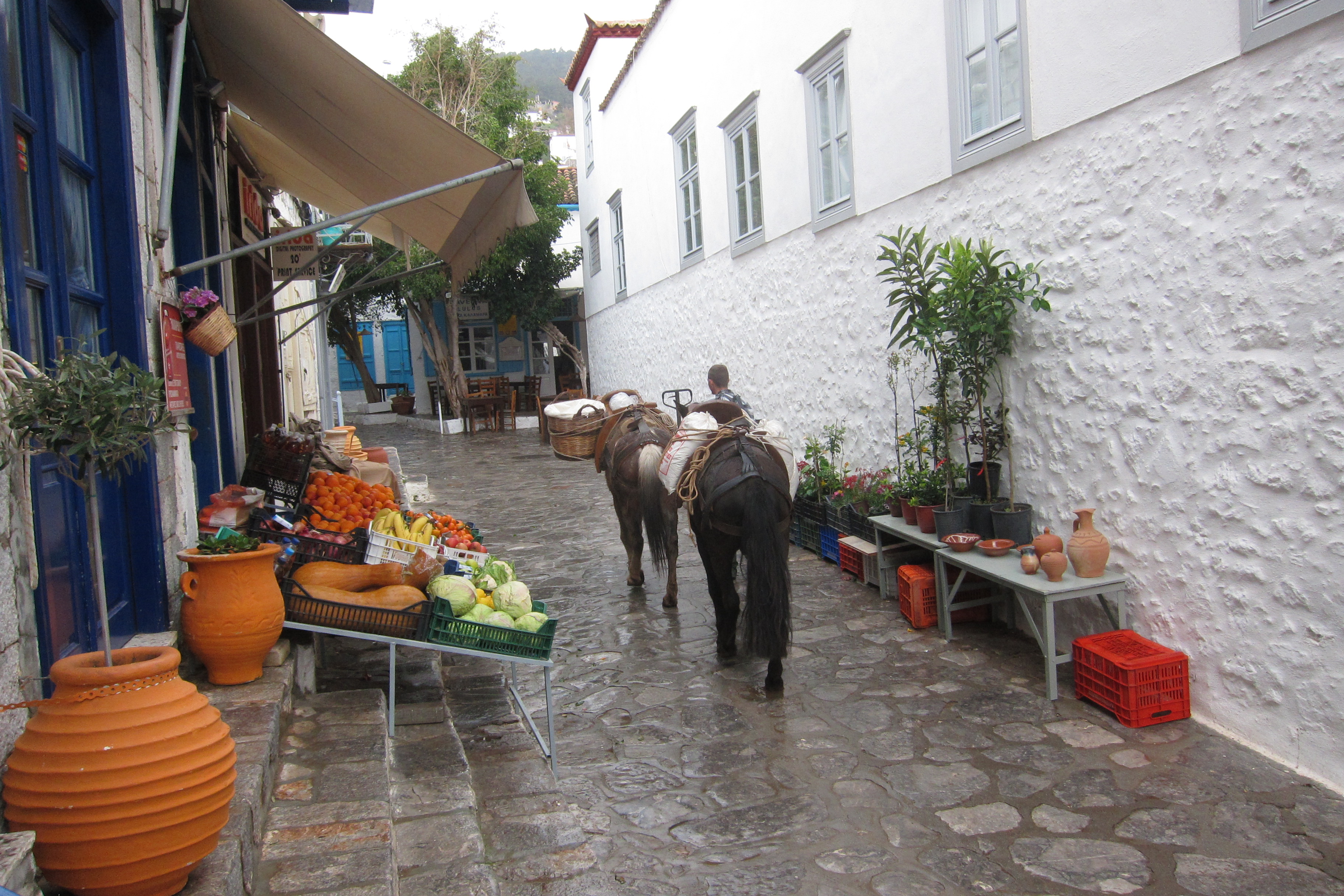
On our rainy March trip, we had the impression that the island’s population, highest to lowest, was cats, people, donkeys, dogs, garbage trucks (2), and no cars. The 1,900 people who live here were mostly inside while the cats and donkeys ruled the island.

OLYMPUS DIGITAL CAMERA

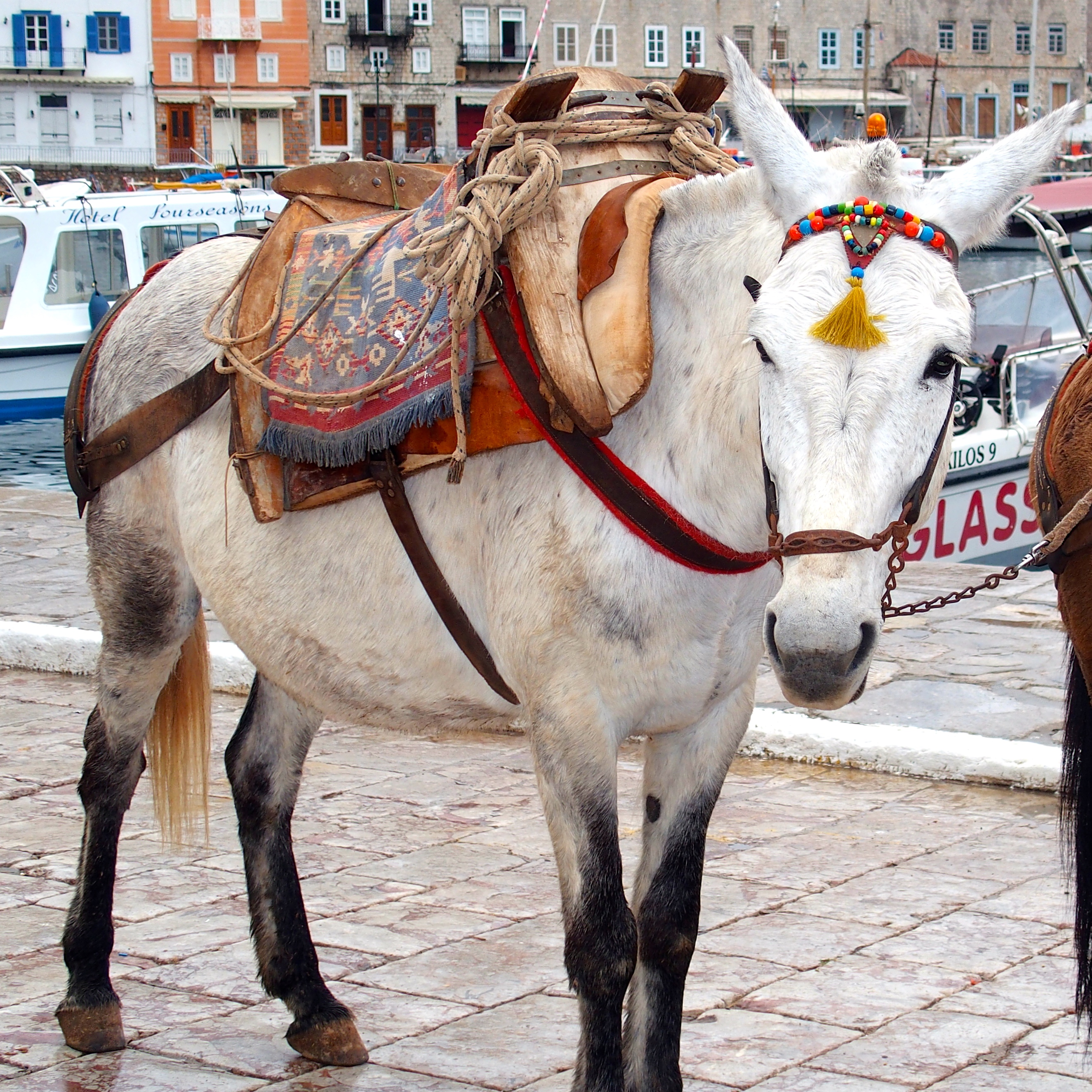
“Look at the cute donkey. What a great photo op.”

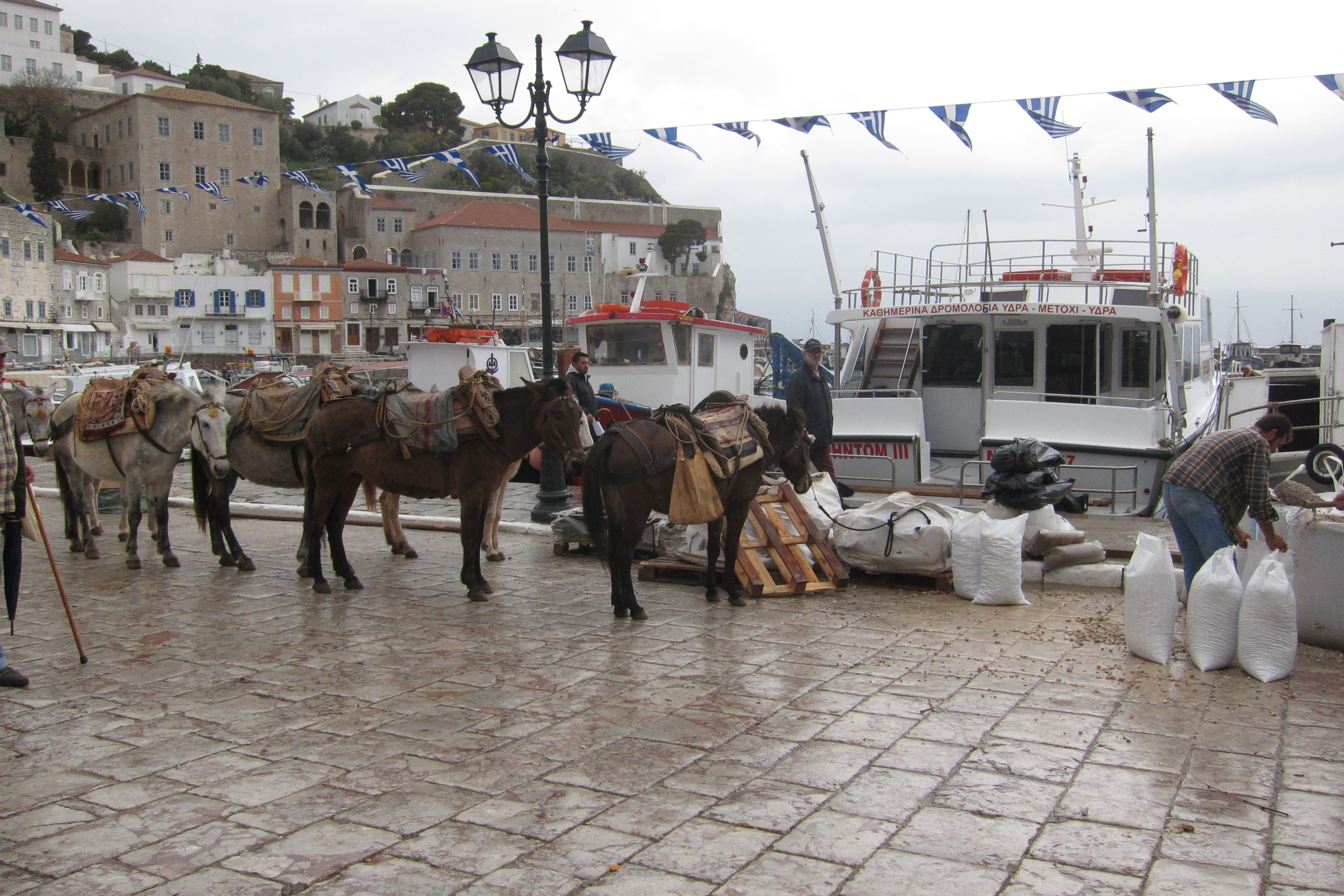
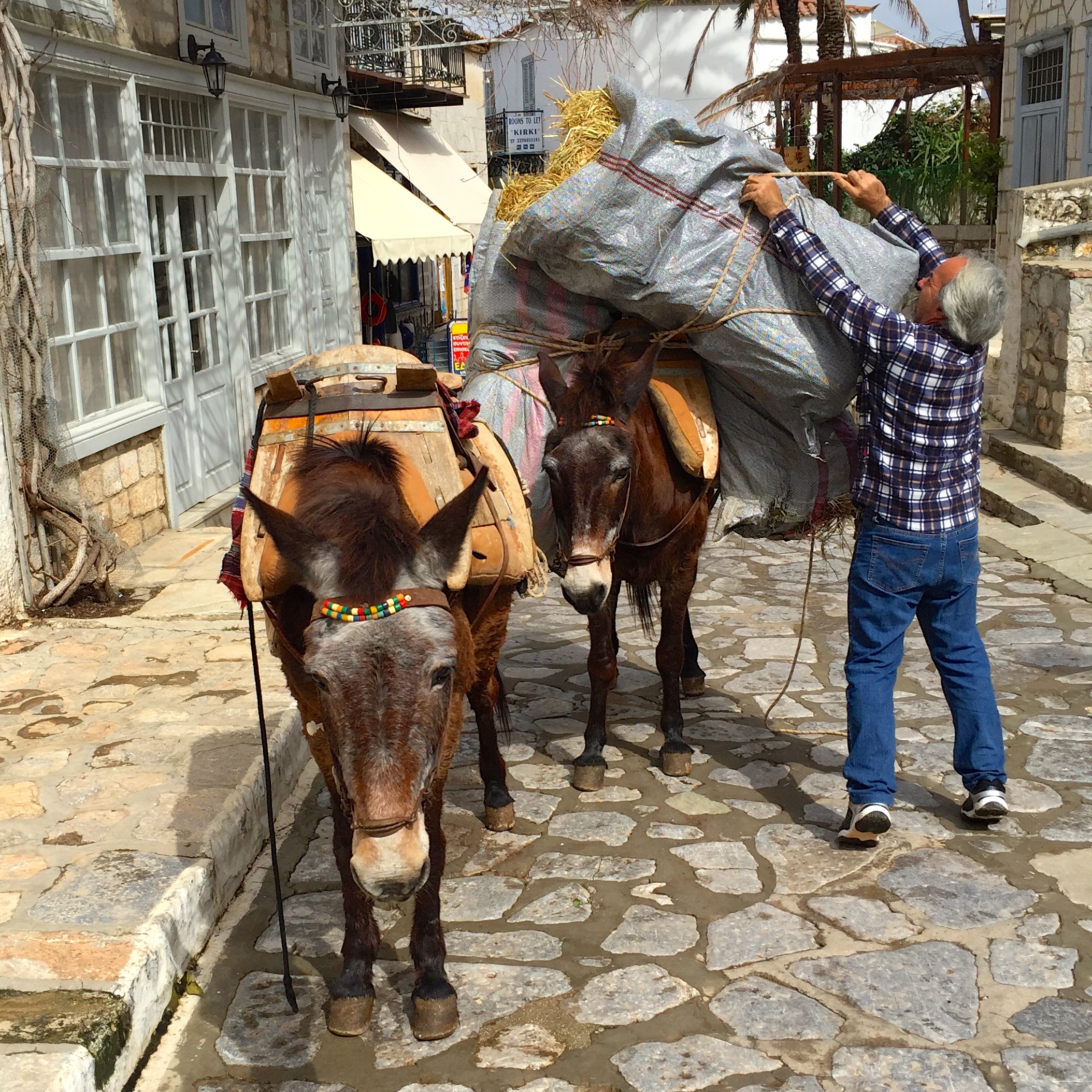
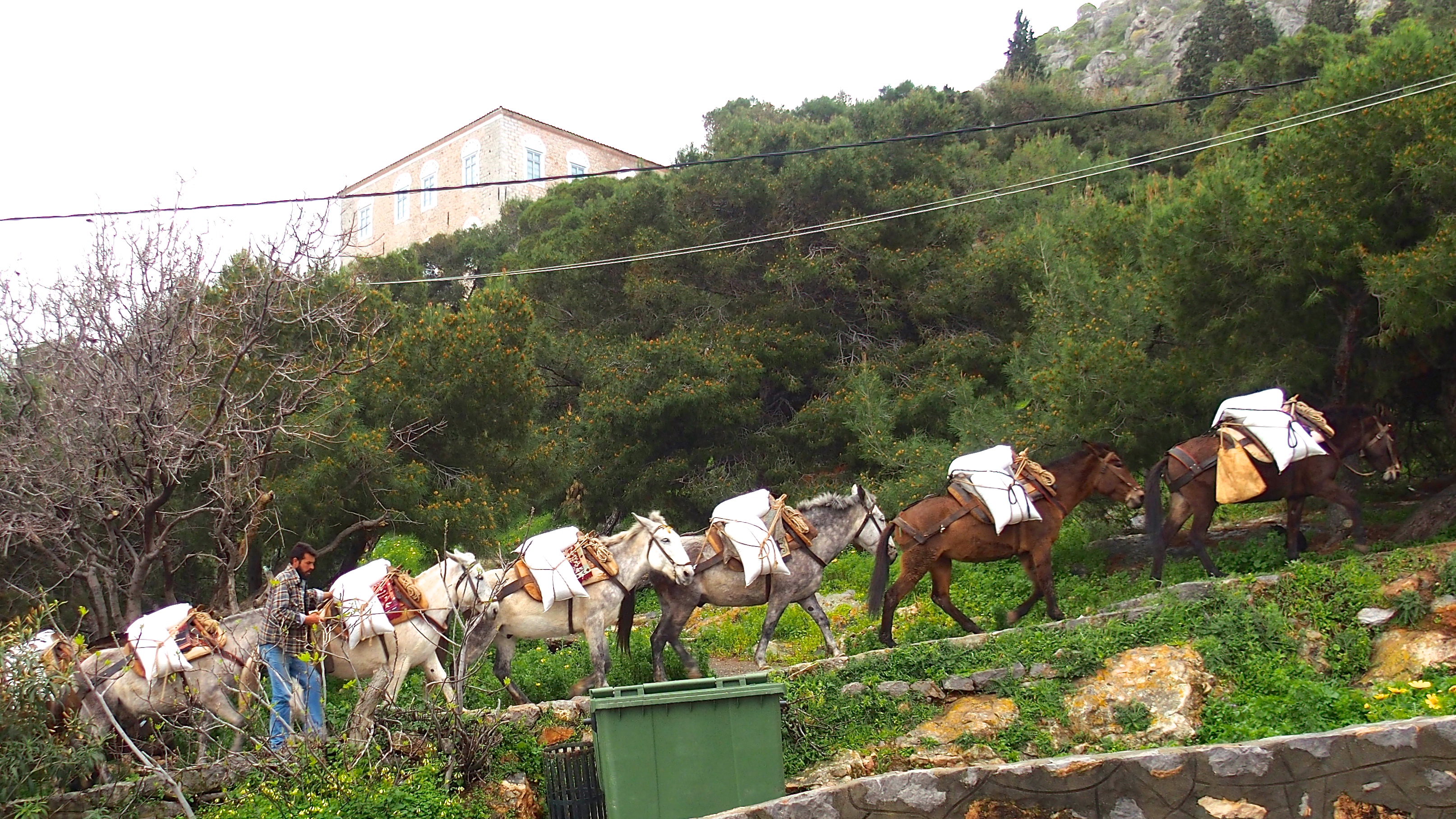
Actually, each morning, donkeys line up at the wharf like longshoremen waiting for their daily work assignments.

2015-03-26 005

The name “beast of burden” fits these donkeys.

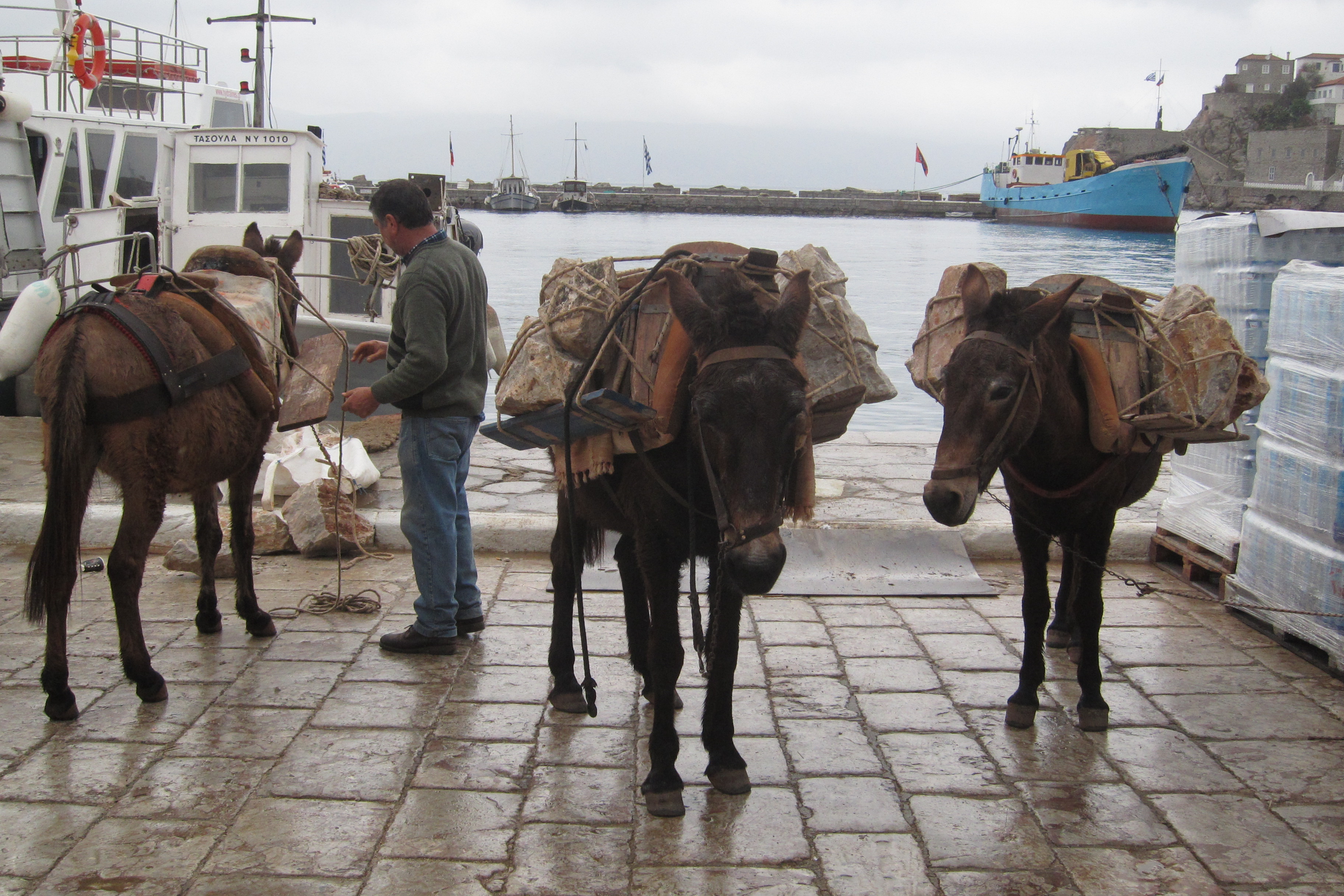
They are loaded with all kinds of materials to deliver to other parts of the island. Since there aren’t any cars, donkeys provide the brute strength to carry heavy loads of building materials like large rocks and sacks of cement.

2015-03-26 012

The rocks have been carefully selected and tied on to create a balanced, but heavy load.

2015-03-26 017

Manpower is still needed to adjust the rigging. Not that it takes any weight off the donkey’s back, but it probably stabilizes the load to prevent spills.

IMG_5186

Is this the bundle of straw that will break the donkey’s back? Hope not.

OLYMPUS DIGITAL CAMERA

This procession is hauling bags of gravel to pave a walkway.

The harbor is filled with fishing boats and water taxis that take people around to the beaches elsewhere on the 20-mile-long island.

2015-03-26 031

Masses of yellow fishing nets just waiting to be used…or untangled first.

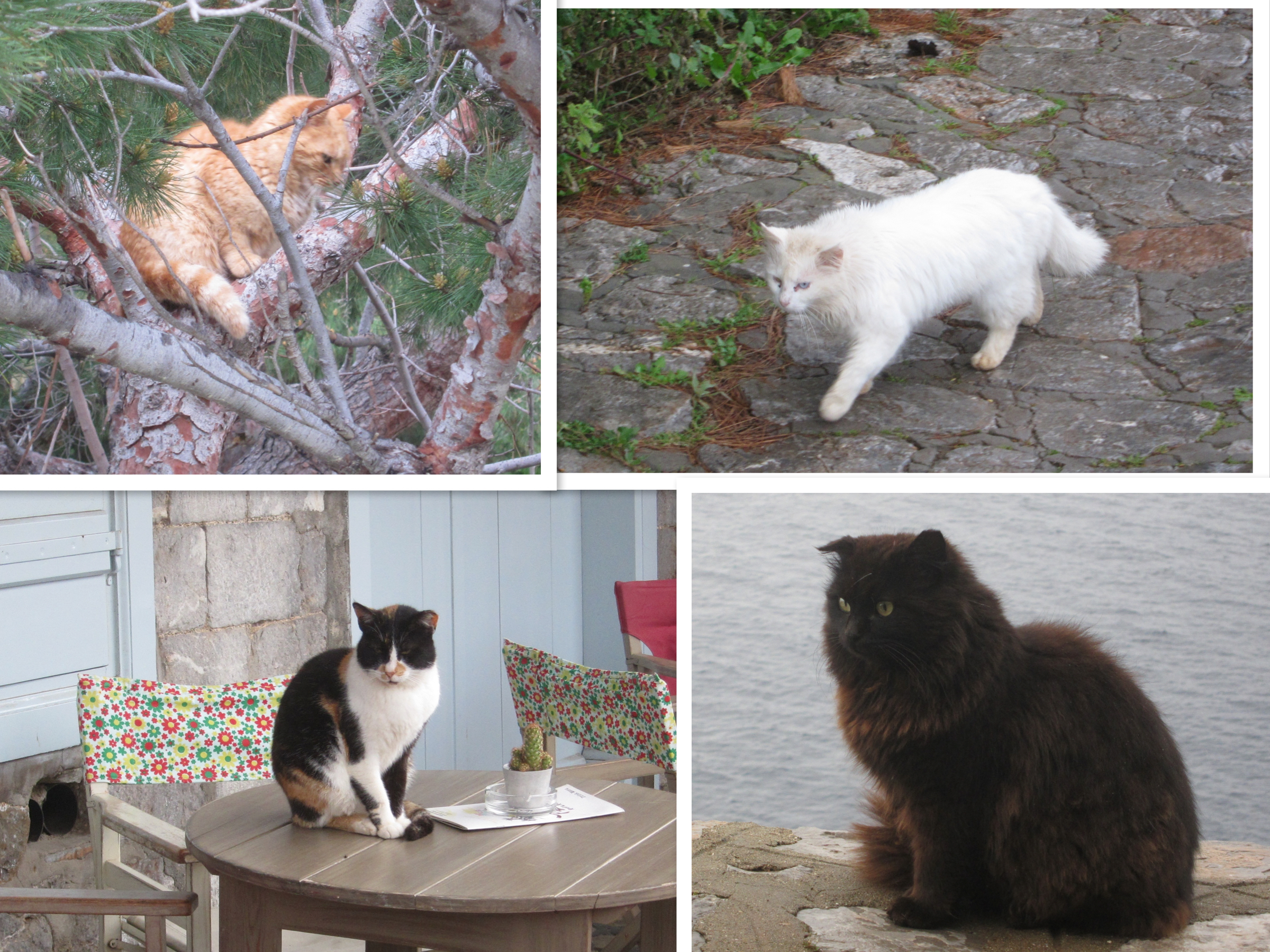
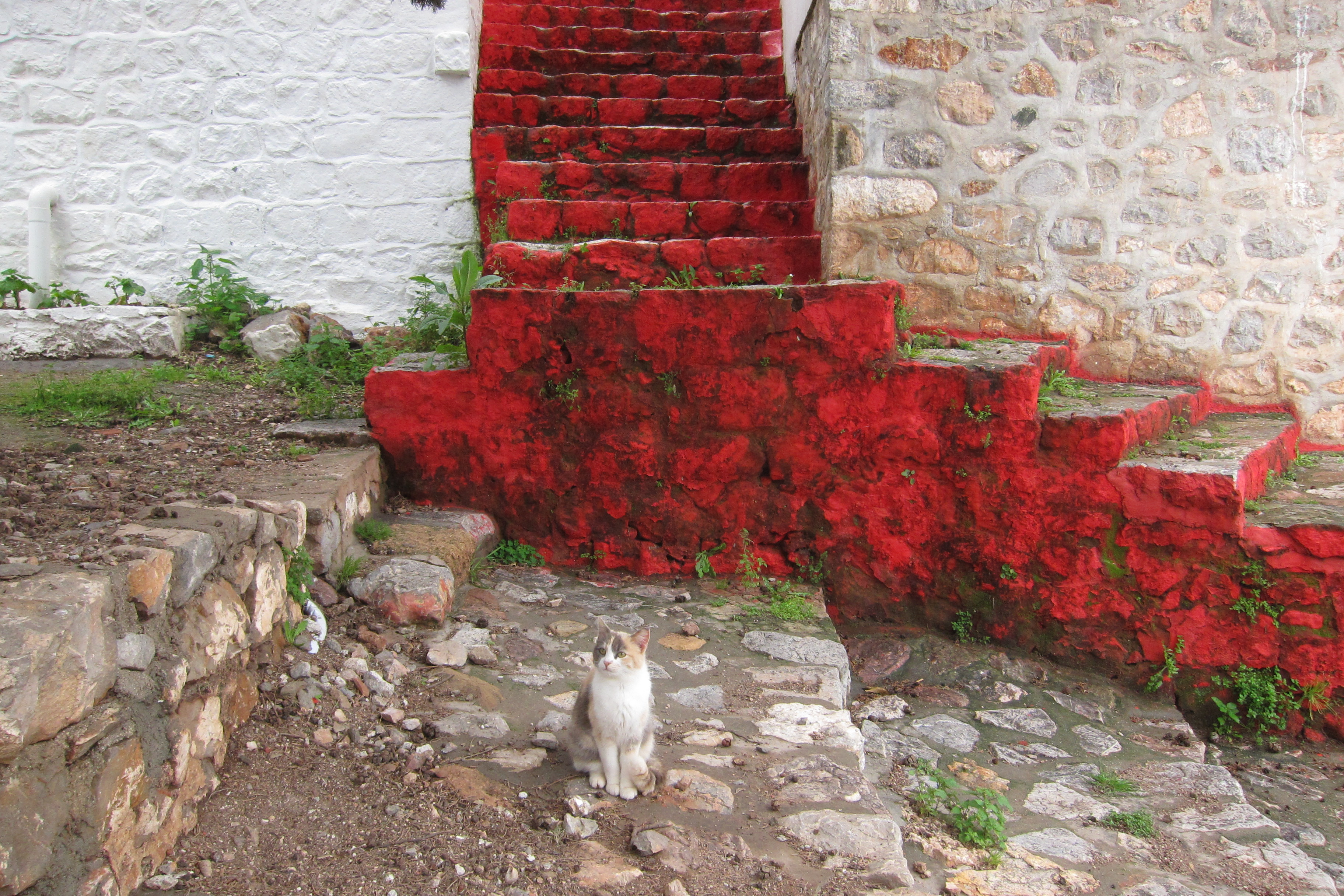
The cats come in all shapes and sizes.

Cat pics

In trees, on the paths, at the restaurants, on the seawall.

2015-03-26 149

Even camouflage.

The narrow streets in the hilly town are roughly paved with large stones. The donkeys navigate them quite easily. Cars would never fit. When it rains (and it did!) these streets become rivers. We had to walk through three inches of water when we went uphill from a restaurant to our hotel.

2015-03-26 003

Dry now, but when it rains, there is nowhere to escape the flood.

2015-03-26 151

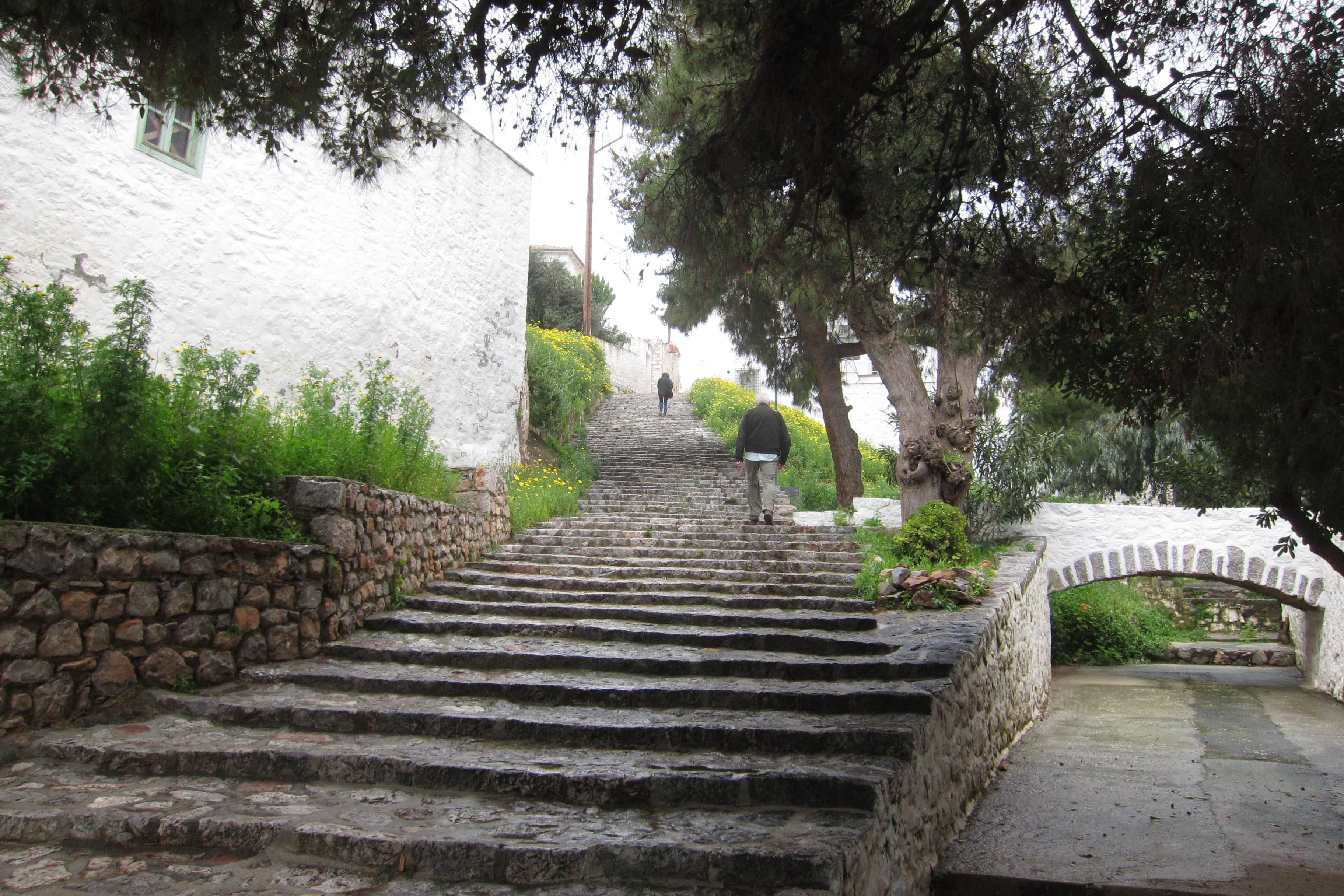
Many of the “streets” marked on Google Maps are actually stairs.

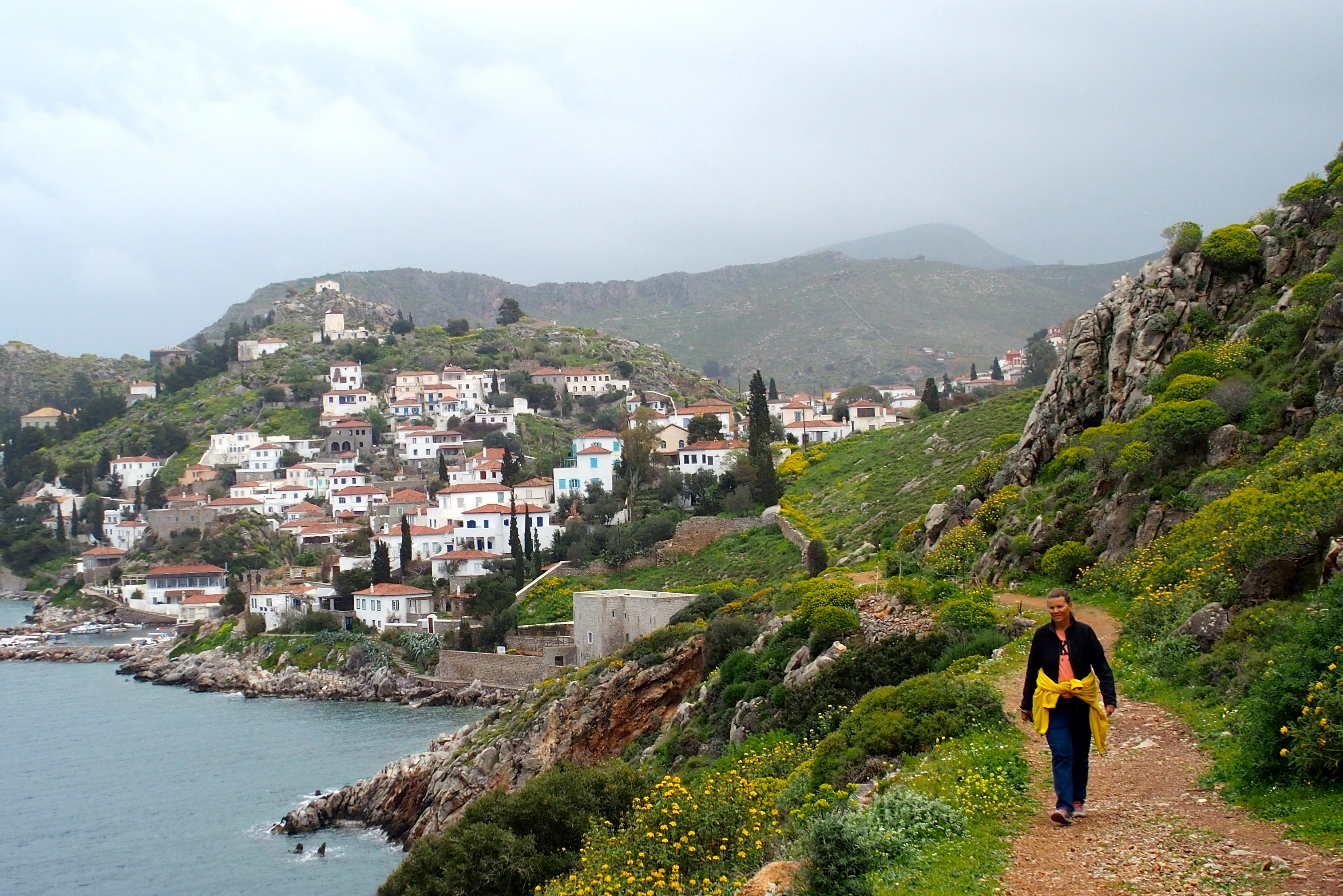
Elsewhere on the island the streets turn to  rocky trails.

OLYMPUS DIGITAL CAMERA

Beautiful, peaceful walks with hillsides covered with wildflowers.

2015-03-26 101

By summertime, the beach umbrellas will be spruced up and the beach will fill with tourists enjoying the sun.

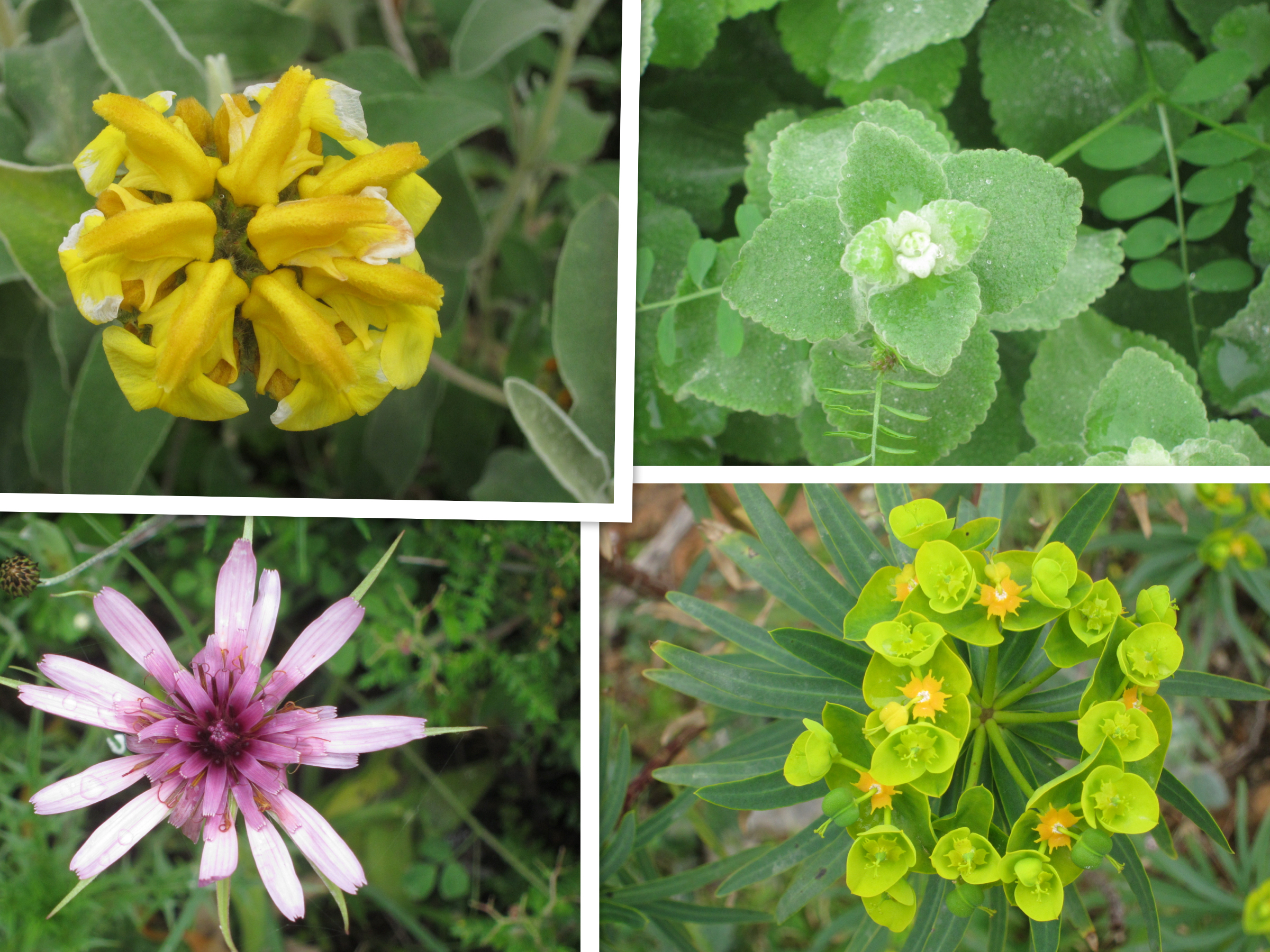
Hydra Flowers

The spring flowers are dazzling…

Hydra Flowers 2

and endless in colors and shapes.

Ahh, Hydra!

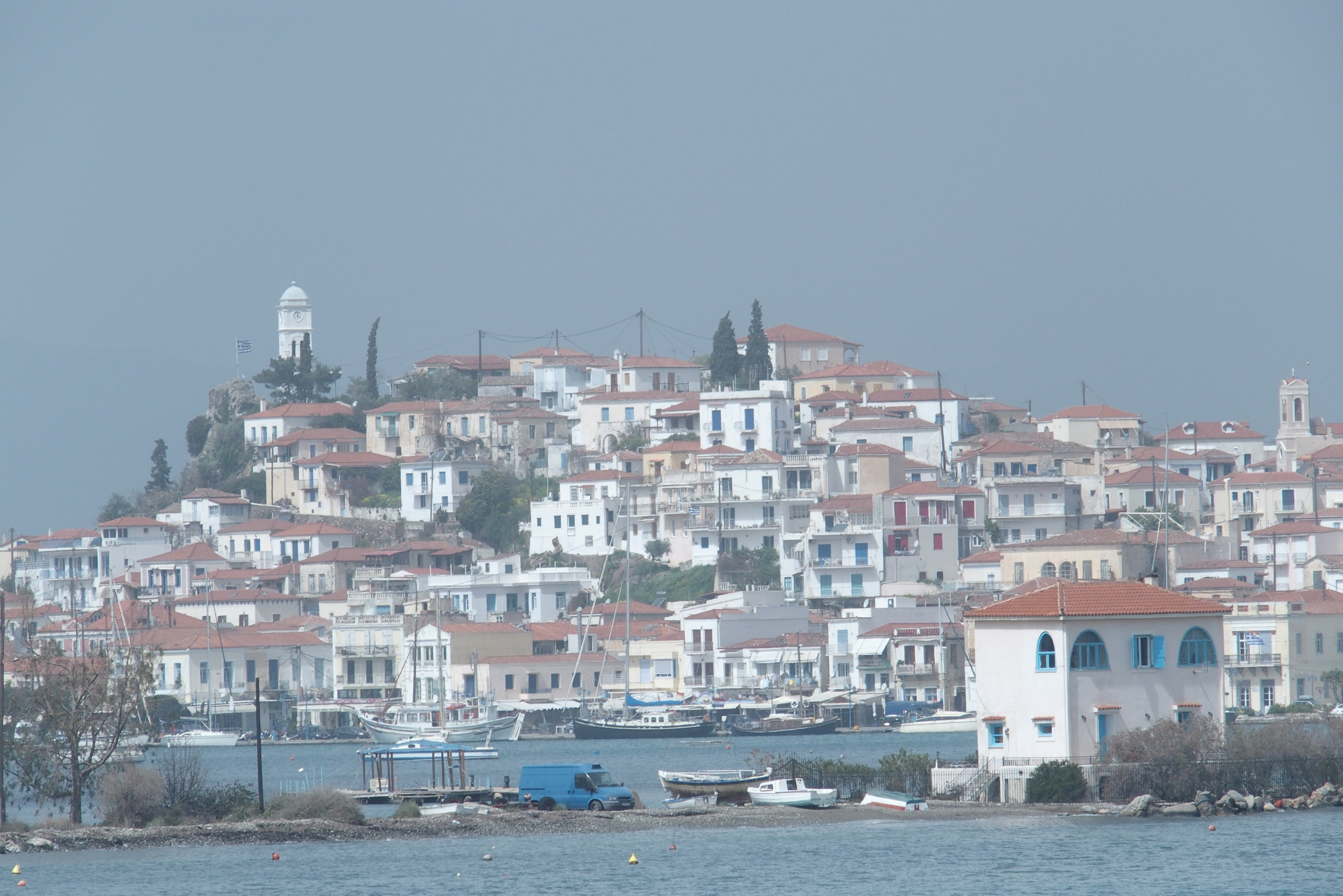
Before leaving the Peloponnese, we stopped at one more island, Poros. We took a 1Euro ferry ride across for a nice lunch. There is also a much larger car ferry, making this area not as peaceful as Hydra.

OLYMPUS DIGITAL CAMERA

The island of Poros has been inhabited for over 3,000 years. The clock tower is from 1927.

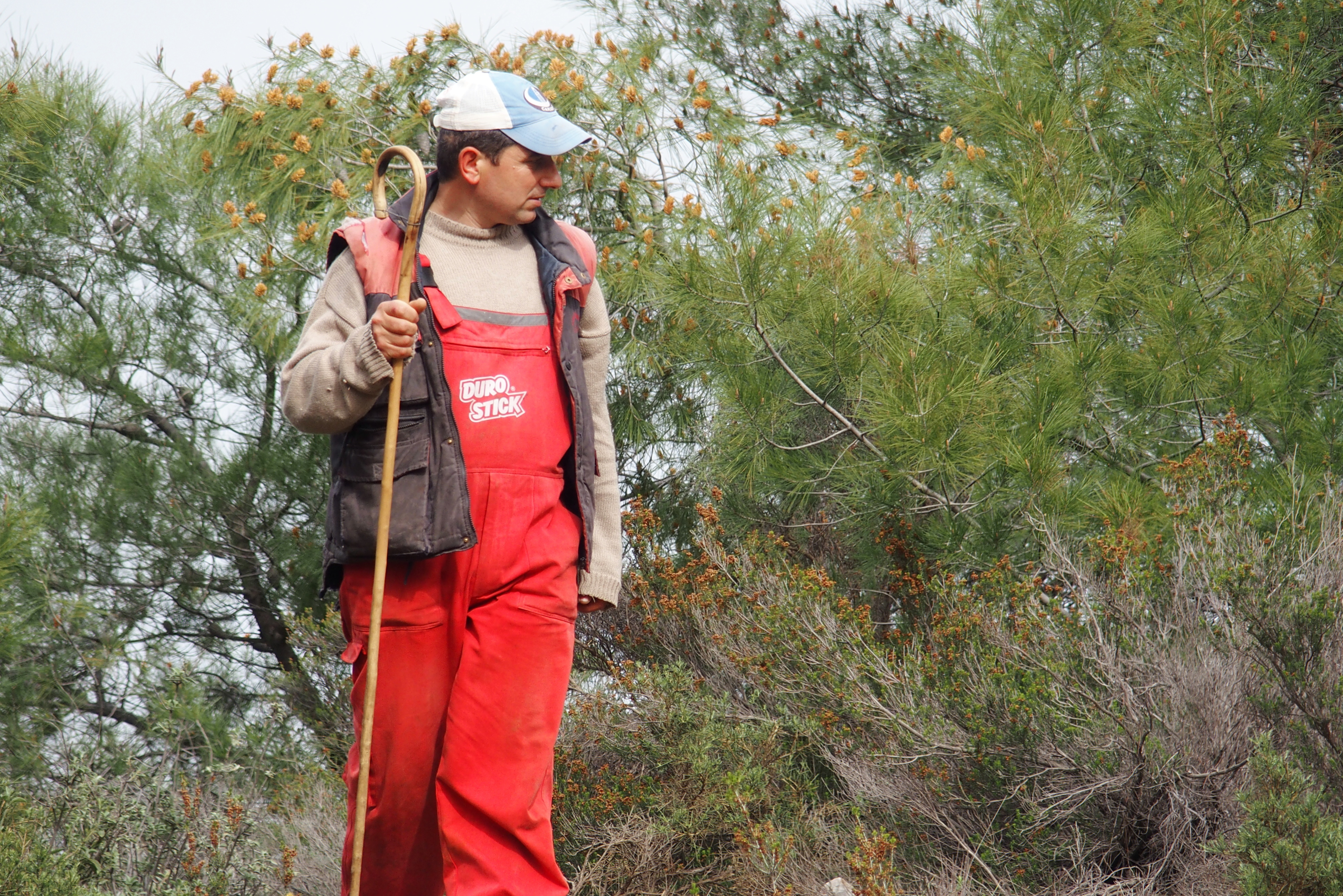
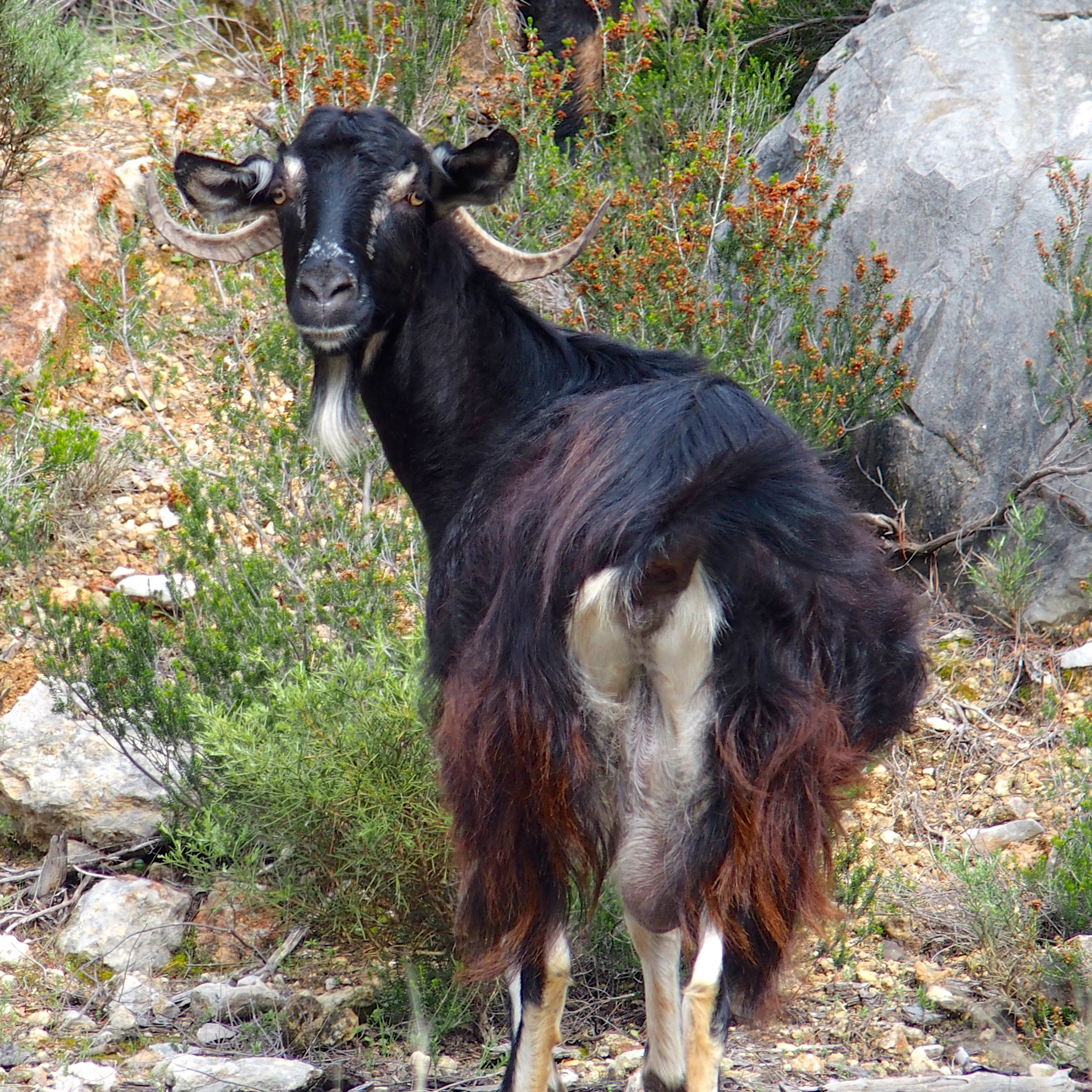
On our way back to modern Athens we had to slow for an animal crossing, just like in the movies.  A goatherd had about 30 nimble goats scrambling over a small hill and down into a valley. His sheepdog didn’t seem to have any effect on the herd, but they seemed to listen to the goatherd. He yelled as one of the goats strayed onto the road and the goat did an about-face immediately.

OLYMPUS DIGITAL CAMERA

A modern-day goatherd with an ancient-style staff.

OLYMPUS DIGITAL CAMERA

Only distracted for a short time by the cars, this goat was back on the hillside faster than you can say “bahhh.”


Posted in Travel Journal | Tagged , , , , | Leave a comment

Nafplio and the Peleponnese

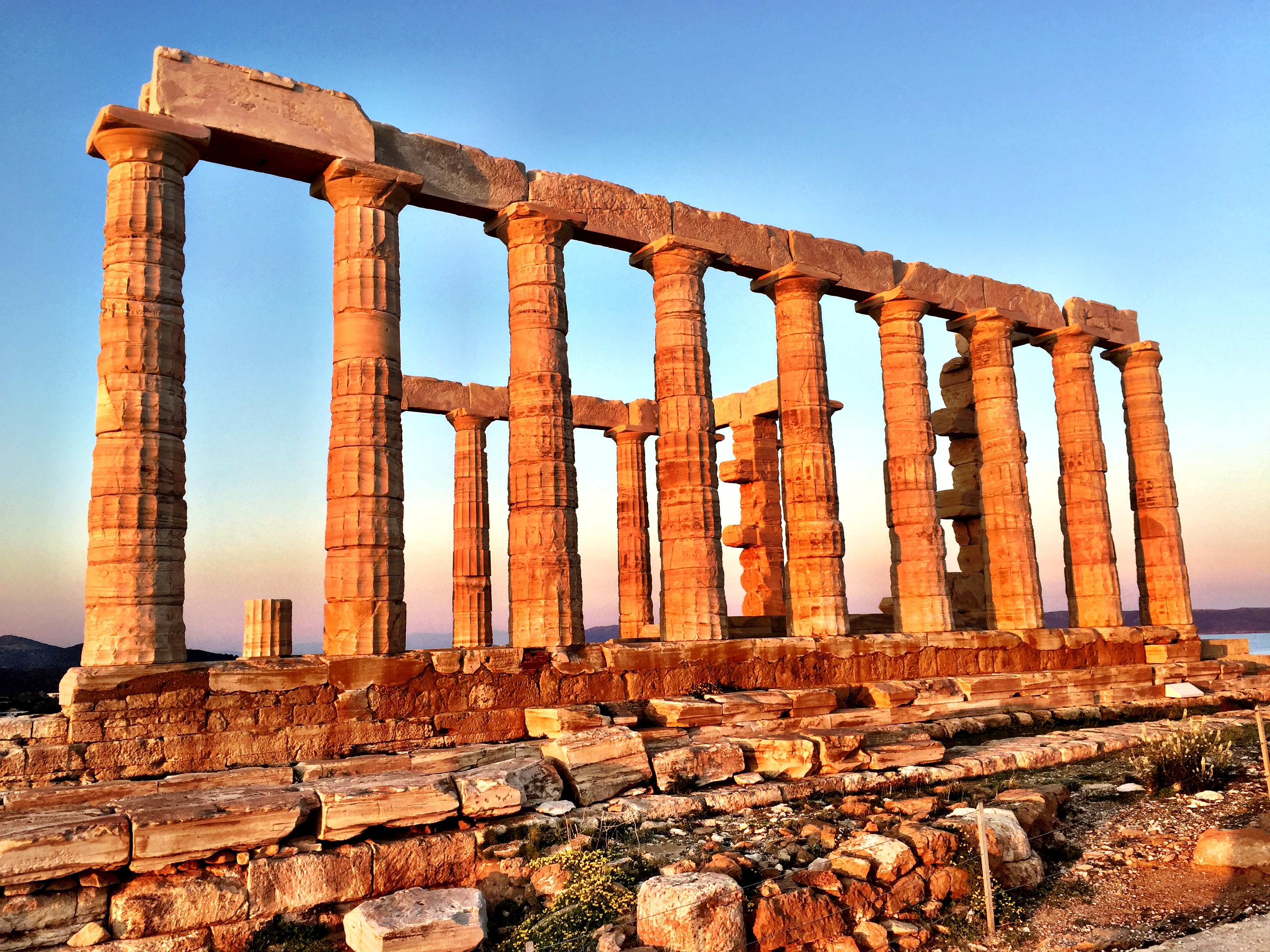
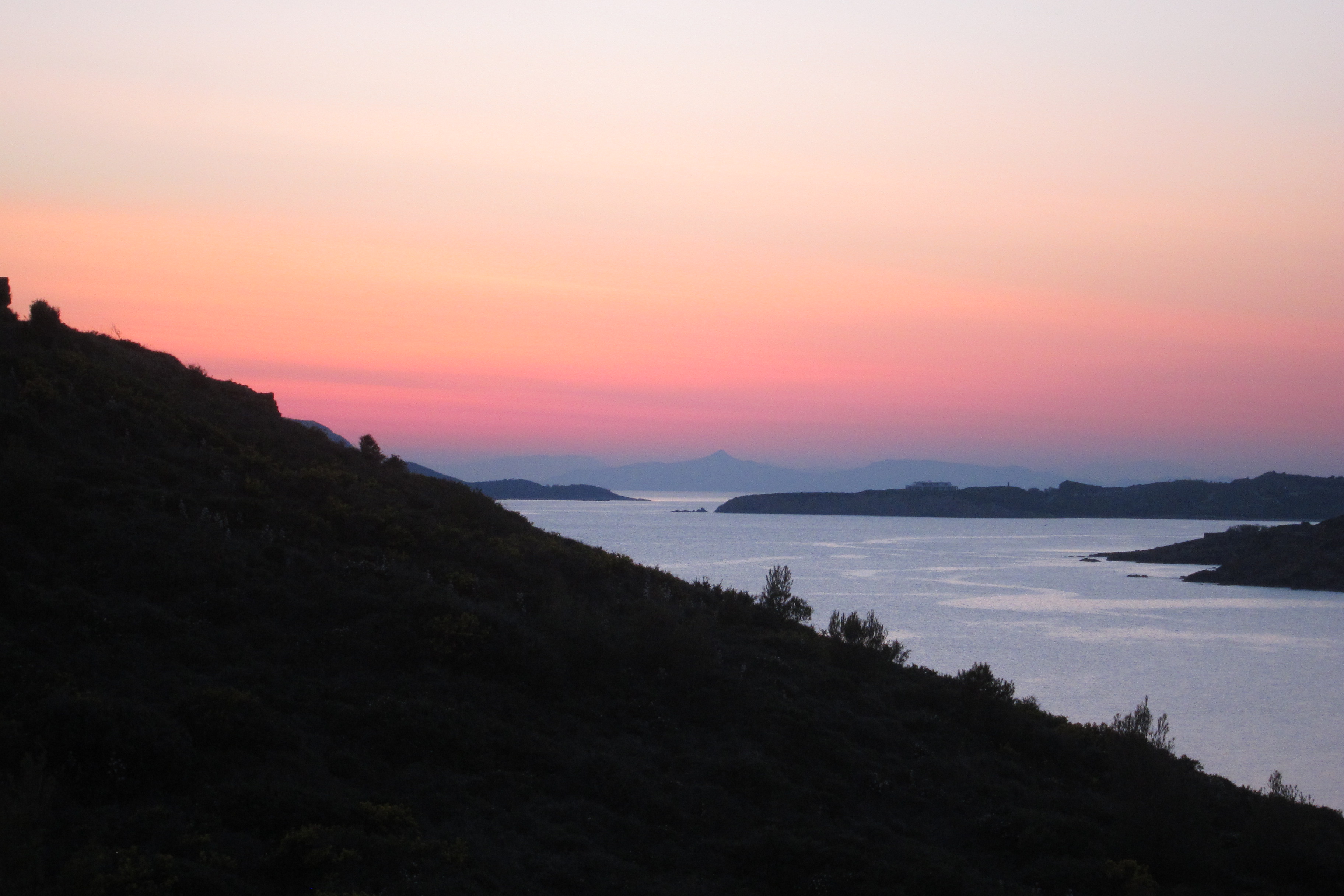
Our next stop in Greece was Cape Sounion, where we caught a sunset over the Aegean. Here on a headland surrounded by the sea on three sides is the Temple of Poseidon, built in 440 B.C.

IMG_5042

These Doric columns have been in place for nearly 2,500 years.

Legend says Aegeus, a king of Athens, stood on the headland watching for the return of his son Theseus  who had traveled to Crete to kill the Minotaur. We already know from seeing the statue in Sydney’s Hyde Park that Theseus was successful, but Aegeus incorrectly interpreted his son’s returning black-sailed ship as signaling death. He jumped to his own death in the ocean, earning that body of water the name of the Aegean Sea.

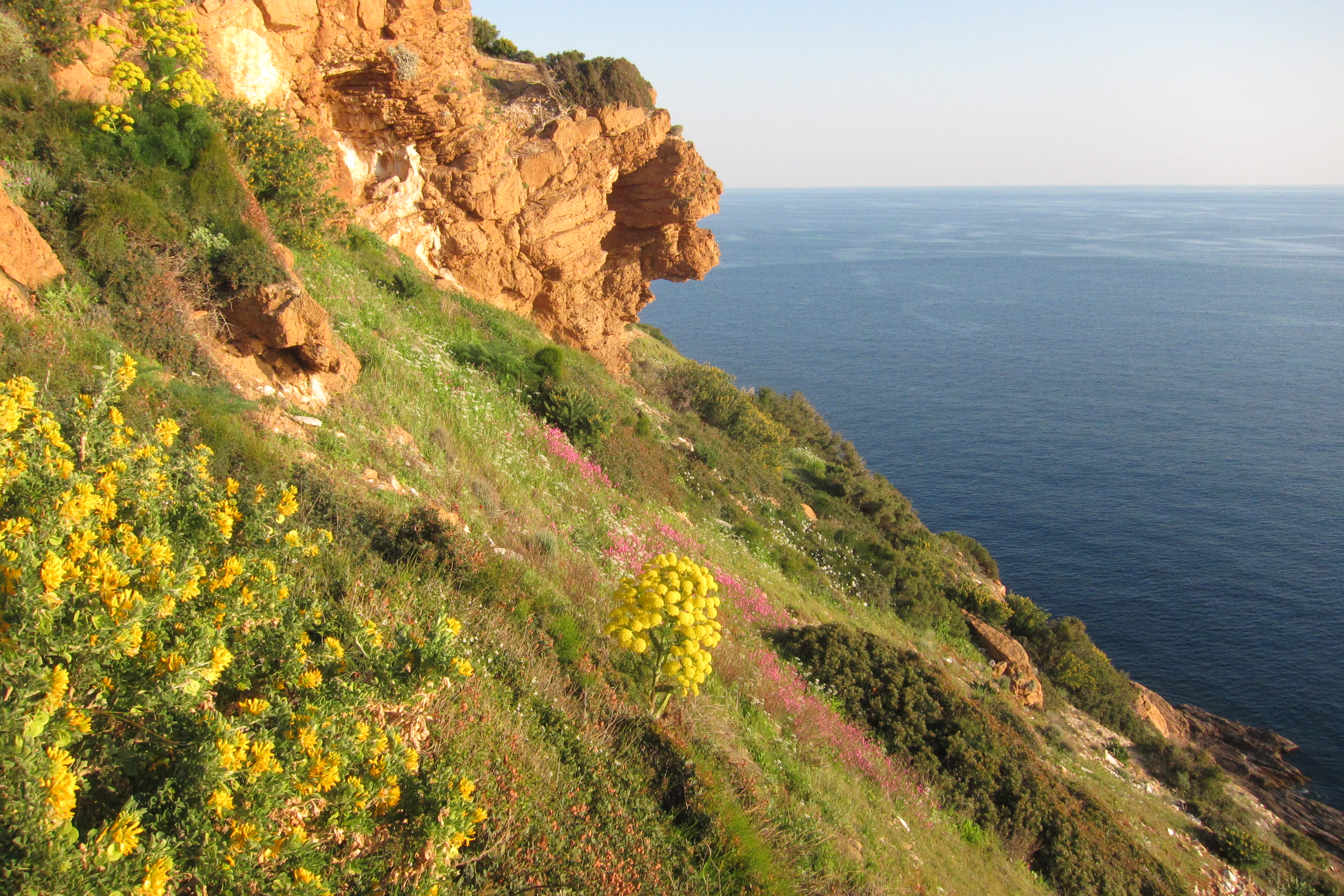
We’re not archaeologists, but we have a new theory. Aegeus did not jump to his death. Instead, he stared in disbelief at the black-sailed ship bearing bad news and was turned to stone in horror at the bad news. His visage remains on the rocky cliff. If only Theseus had stuck to the plan and hurled white sails to signal that he was successful.

2015-03-21 012

Another old man of the mountain. Lots of spring flowers popping out all over Greece.

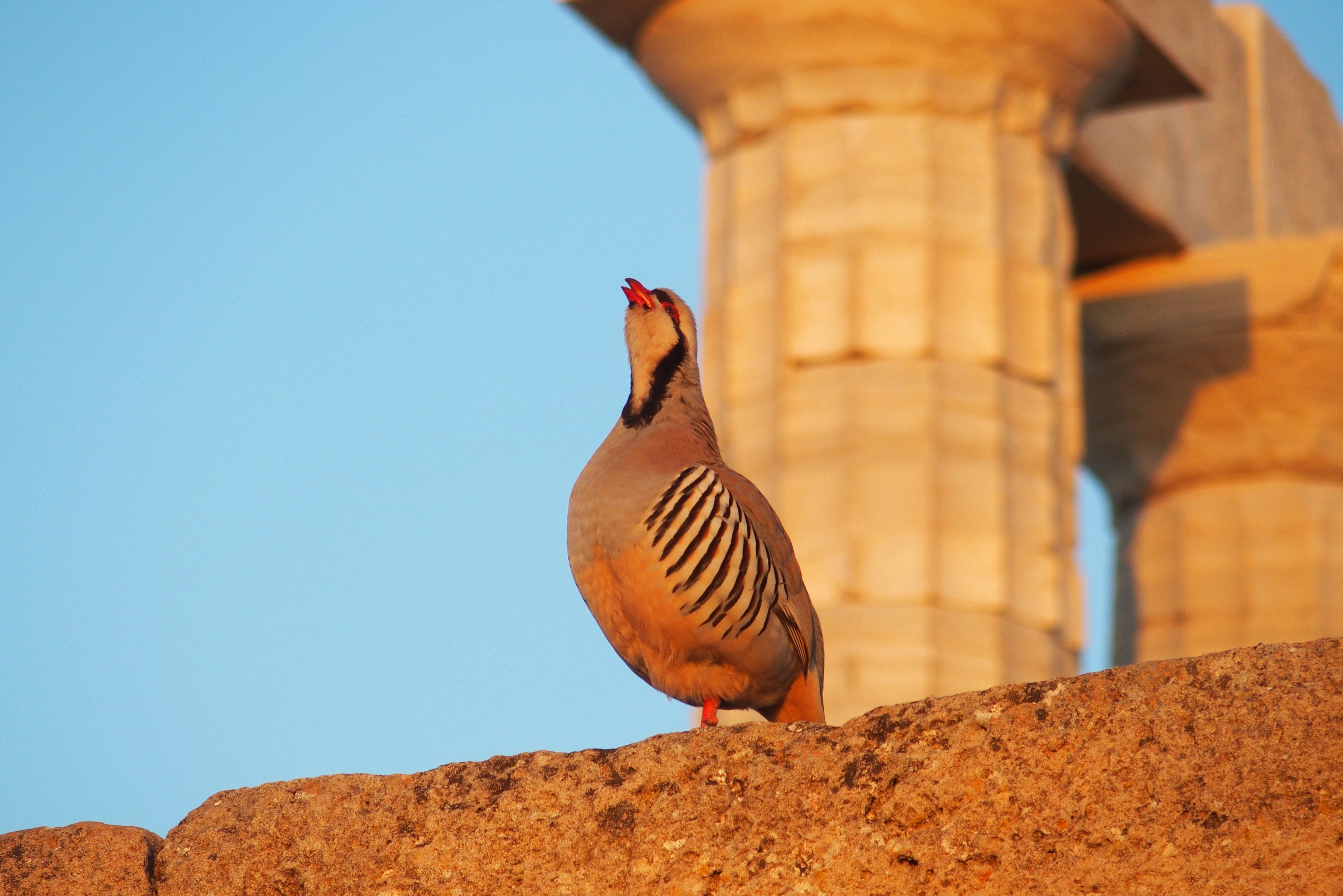
OLYMPUS DIGITAL CAMERA

A chukar partridge at Sounion is crooning at the sunset. Stories say this bird is in love with the moon.

2015-03-21 075

So ends another beautiful day in Greece.

We had a very strong recommendation to visit Nafplio from Liz and Jesse (this is where they were engaged in October 2014) so we followed through. We planned a one-day stay and ended up spending three.

2015-03-20 015

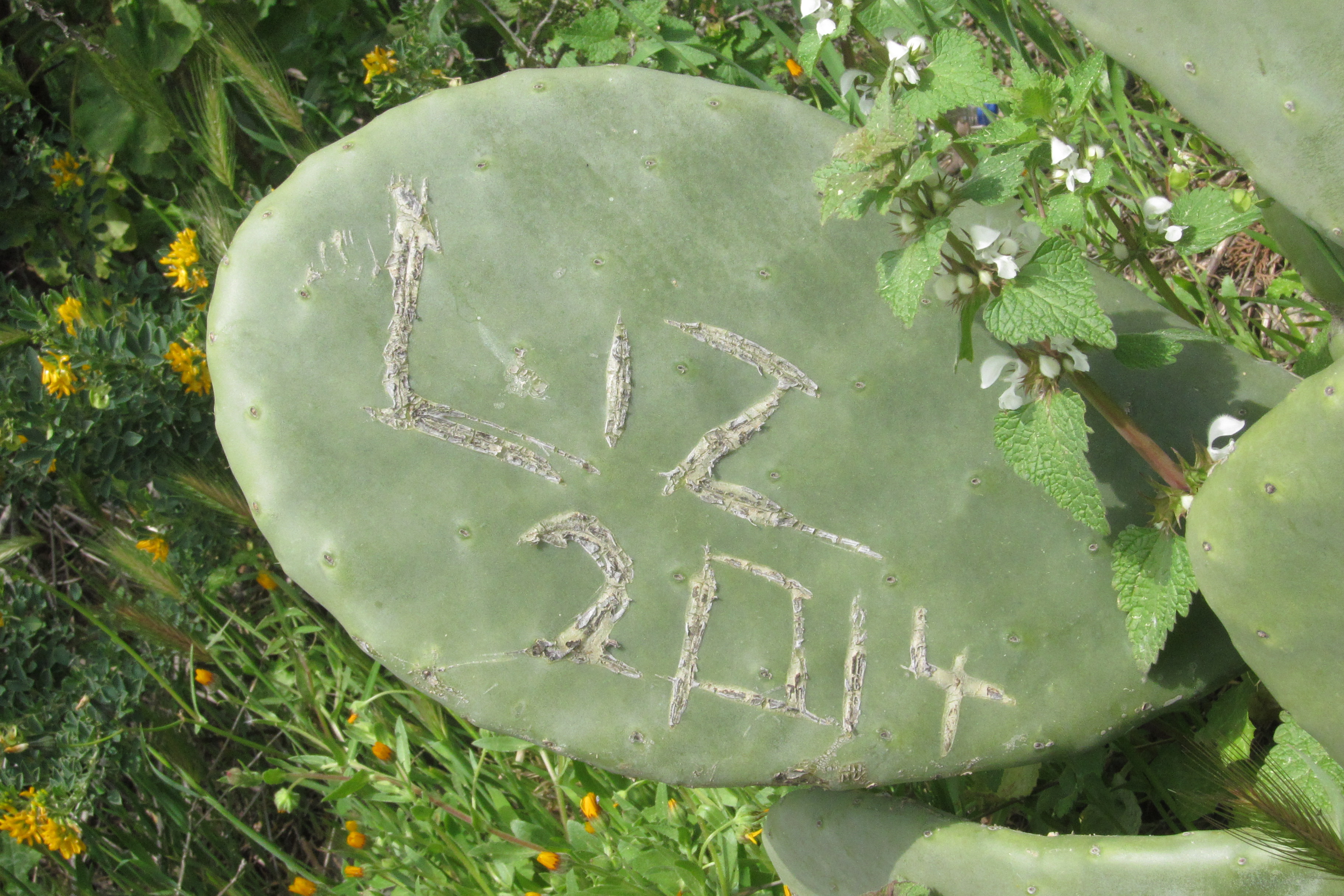
Greece has lots of cactus and lots of graffiti. We don’t think our Liz is the one who combined the two here.

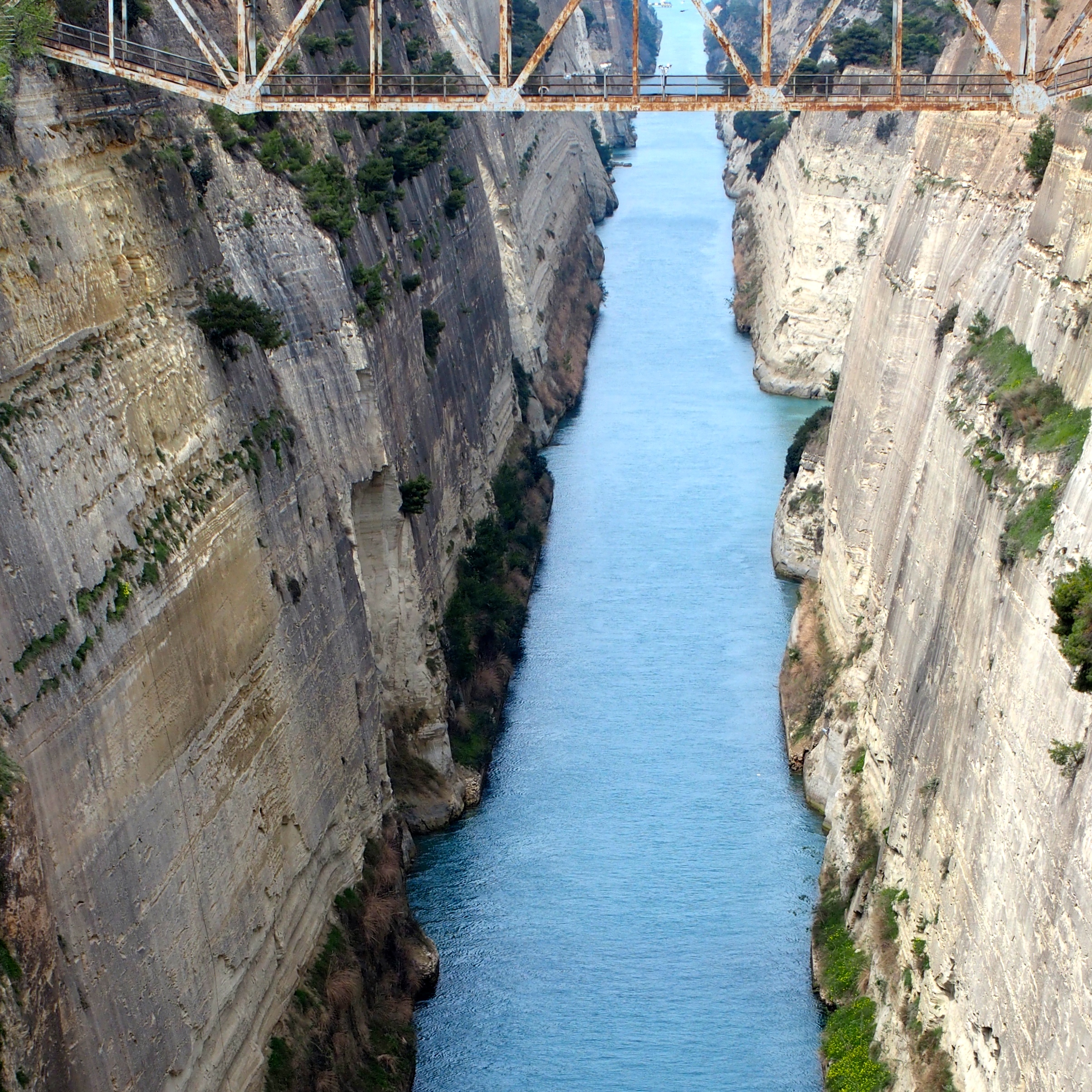
Nafplio is on the Peleponnese peninsula, which could be described as an island since the primary access to the area is by crossing the canal at Corinth. (Remember the Corinthians from your 5th-grade history lessons?) Nero actually broke ground to build a canal here in the first century A.D., but he was distracted by his fiddling and affairs of state and never followed through.

OLYMPUS DIGITAL CAMERA

Despite the cold, overcast days when we passed over the canal, this was a popular spot for bungee jumping!

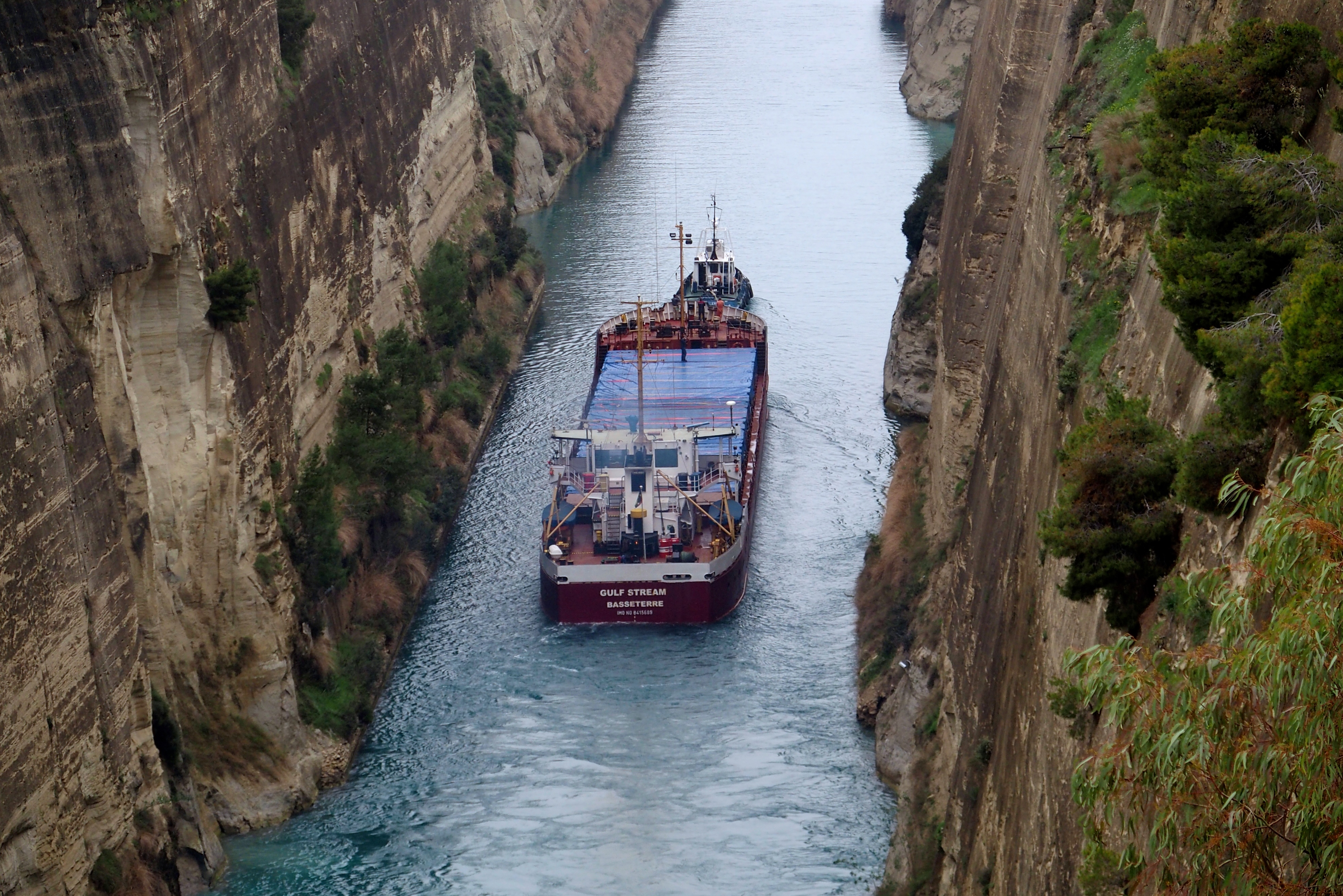
The canal walls are very deep (about 300 feet) but the canal itself is only 70 feet wide. Many modern boats would get stuck in this channel if they tried this shortcut.

OLYMPUS DIGITAL CAMERA

The canal still makes a good tourist cruise. It’s only about 4 miles long and lockless.

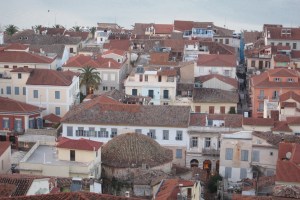
Beyond the canal, Nafplio is on the coast of the Argolic Sea. It has a delightful old town with narrow streets, many too small to drive a car through. (We’re finding small canals, small streets, and small hotel rooms to be common in Greece.)

2015-03-22 067

Our hotel is somewhere in this collection of old buildings.

IMG_5086

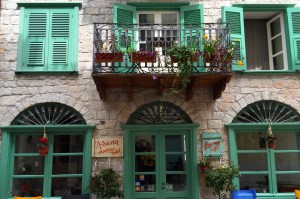
The Adiandi, a very nice boutique hotel close to the harbor.

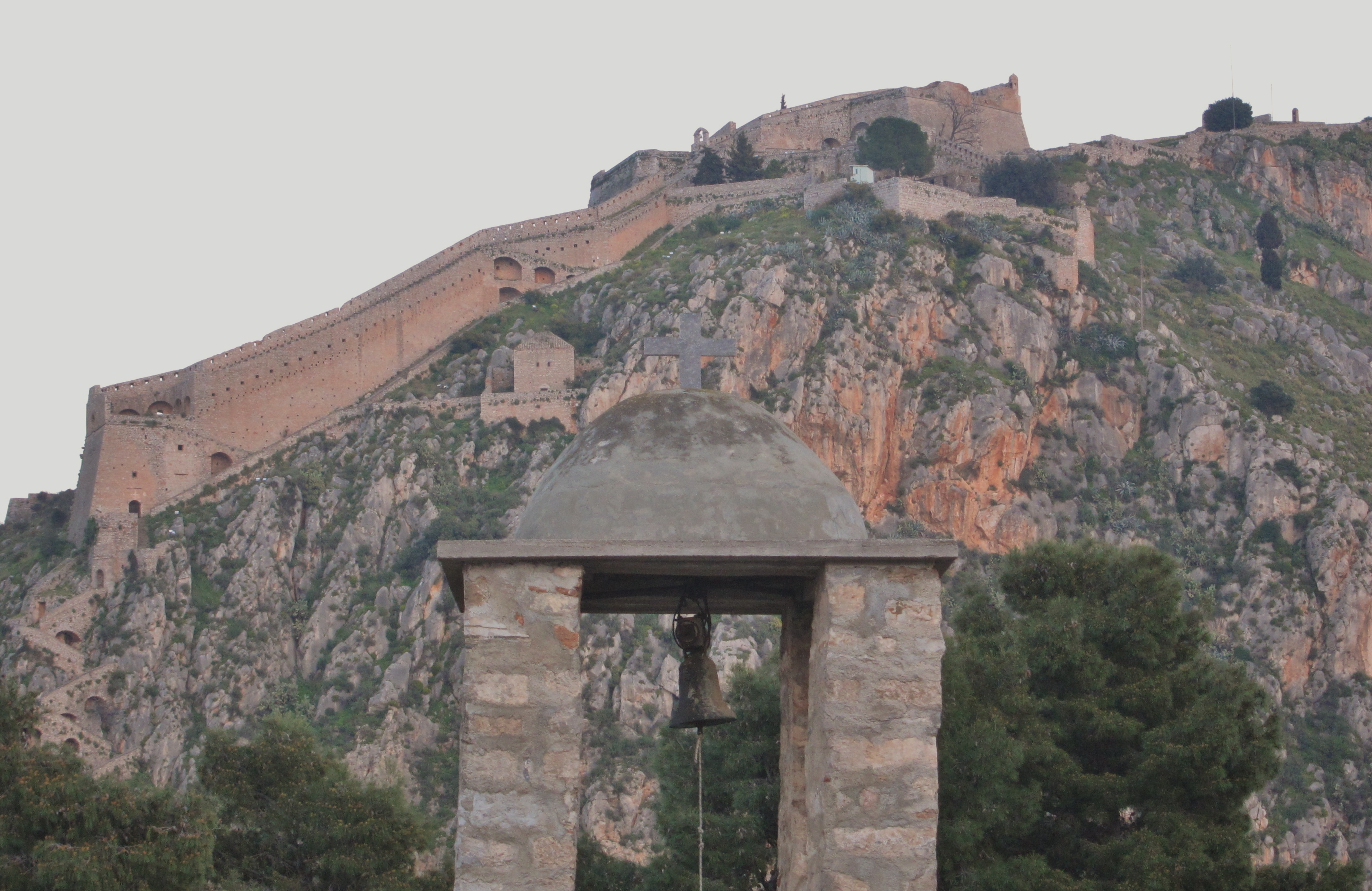
The highlight of the area is the Palamidi Fortress overlooking the city. It was built by the Venetians in the 1600s.

OLYMPUS DIGITAL CAMERA

Nearly 1,000 steps from the town to the top of the fortress.

Over 400 years old and still safe to climb on (we hope).

2015-03-22 025

These may be the final steps to the top.

2015-03-22 022

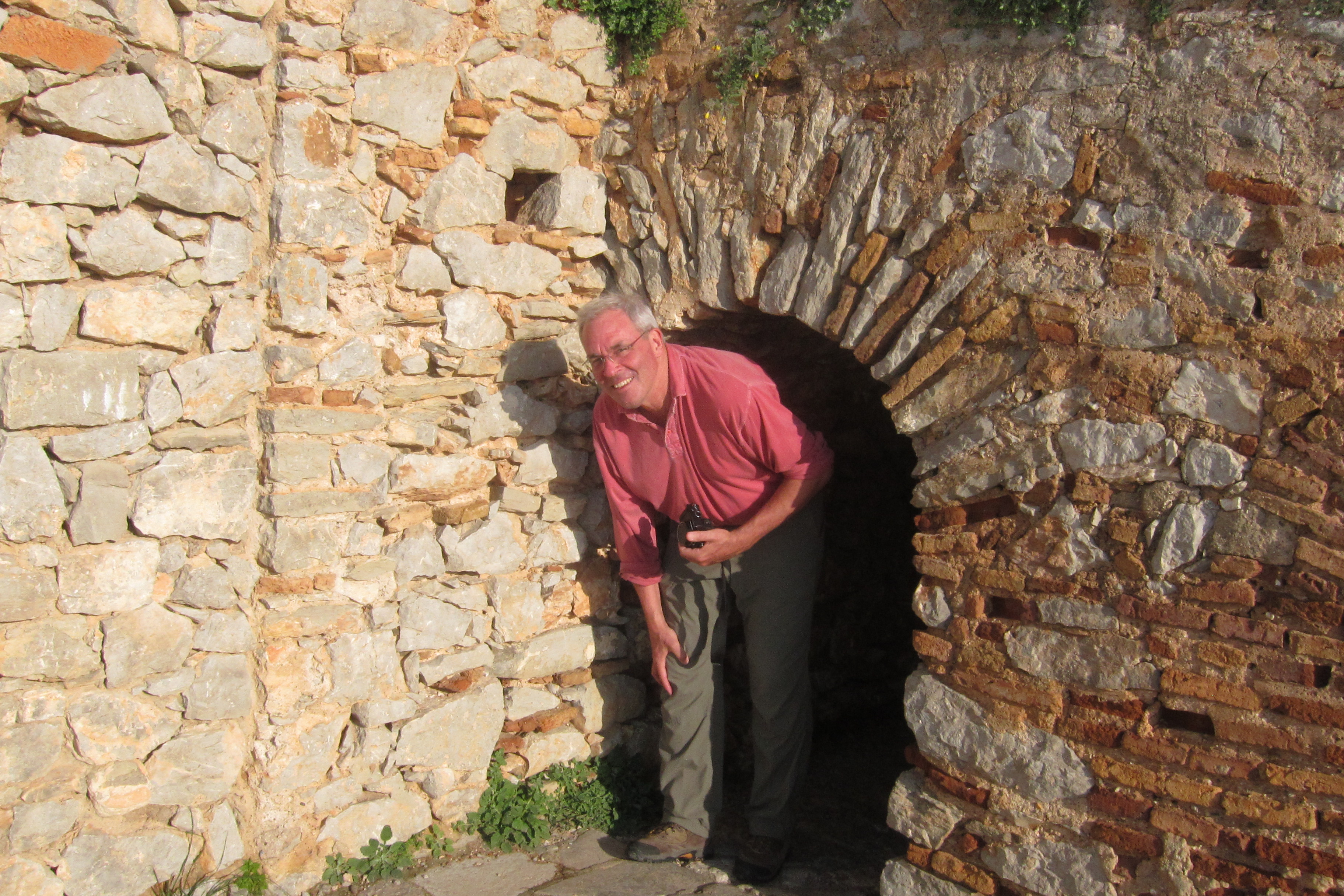
We liked the arches built into the walls separating the bastions. Some were large…

2015-03-22 026

and some were small.

It was at this castle that Liz and Jesse were engaged. We looked on the exact same view that they had on their visit and sent them mental congratulations. It’s a beautiful spot for an engagement.

2015-03-22 033

Looking out over the hillside.

We were too early  in the year to try swimming or sunning on Nafplio’s beaches, but still enjoyed the sea views.

2015-03-22 053

Things are very calm now in the off season.

2015-03-22 072

View of the long path to the fortress, this one from ruins of an old church.

OLYMPUS DIGITAL CAMERA

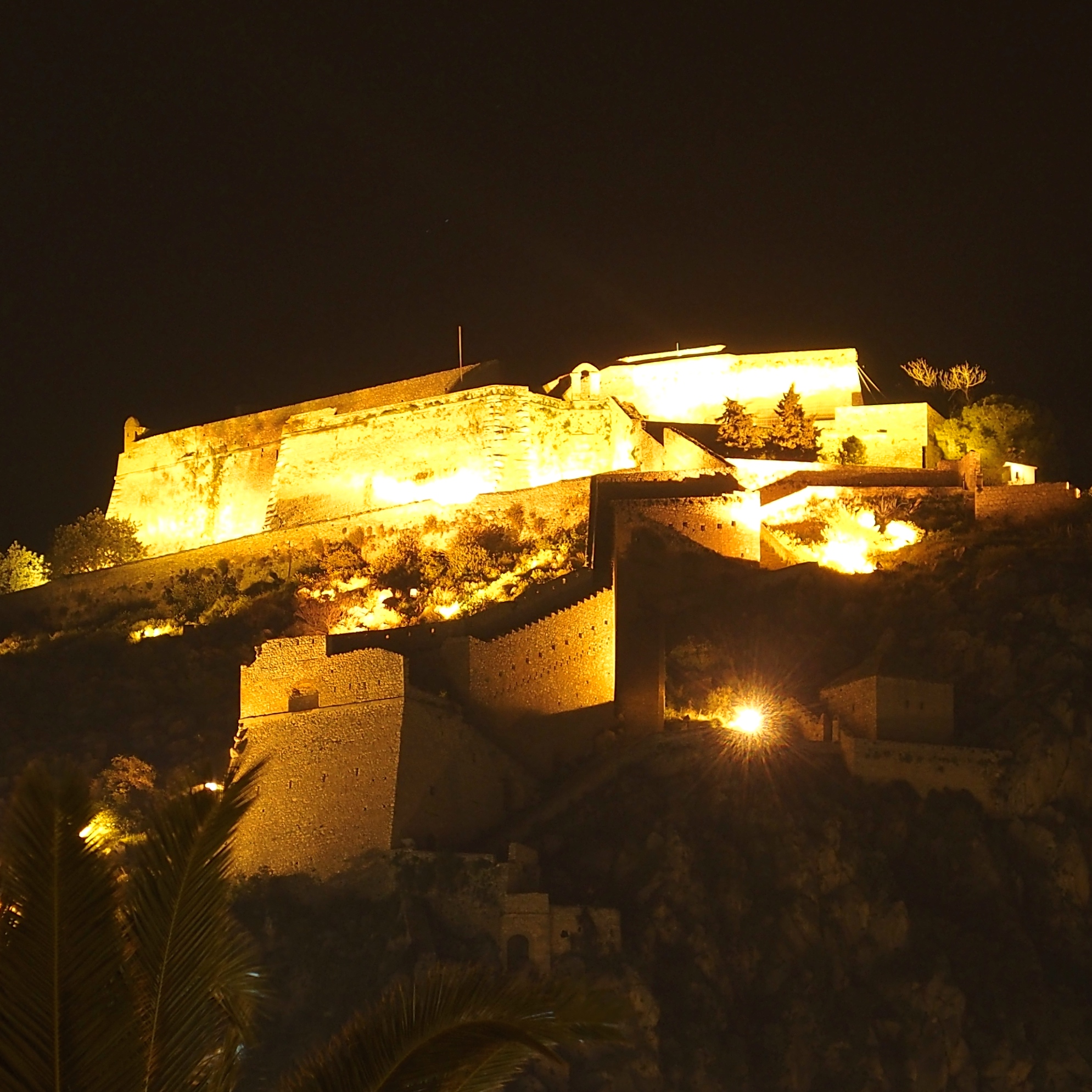
Palamidi at night.

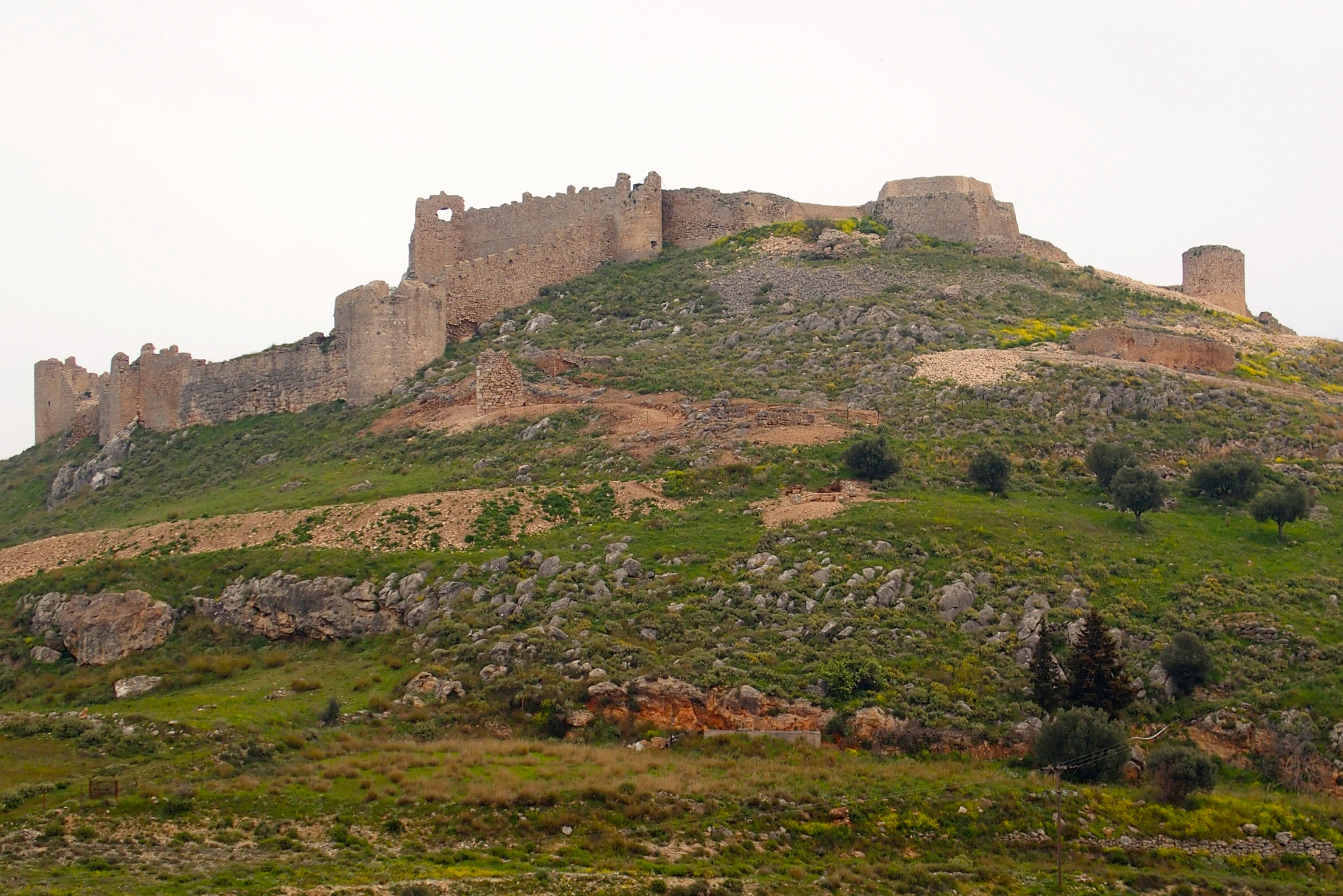
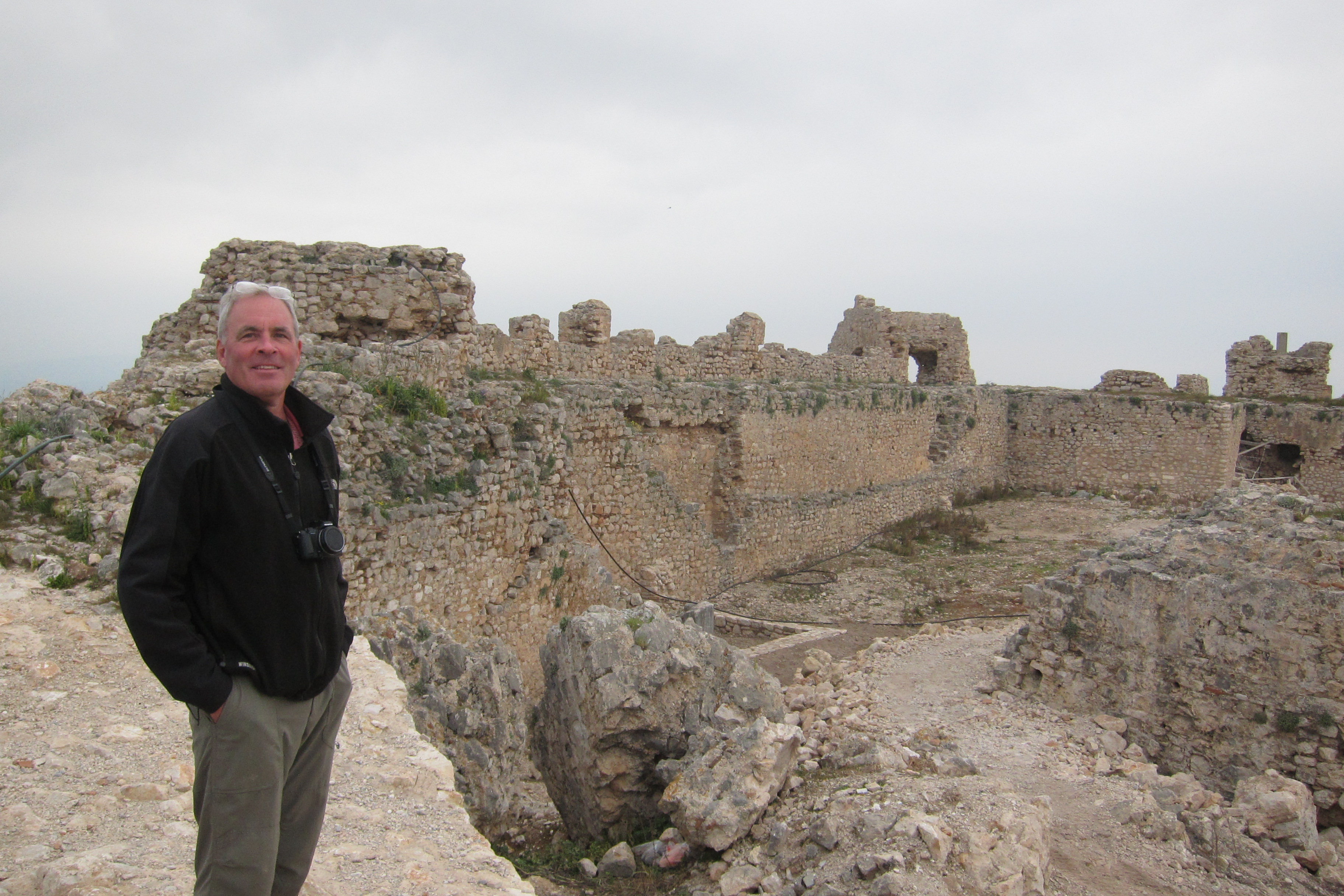
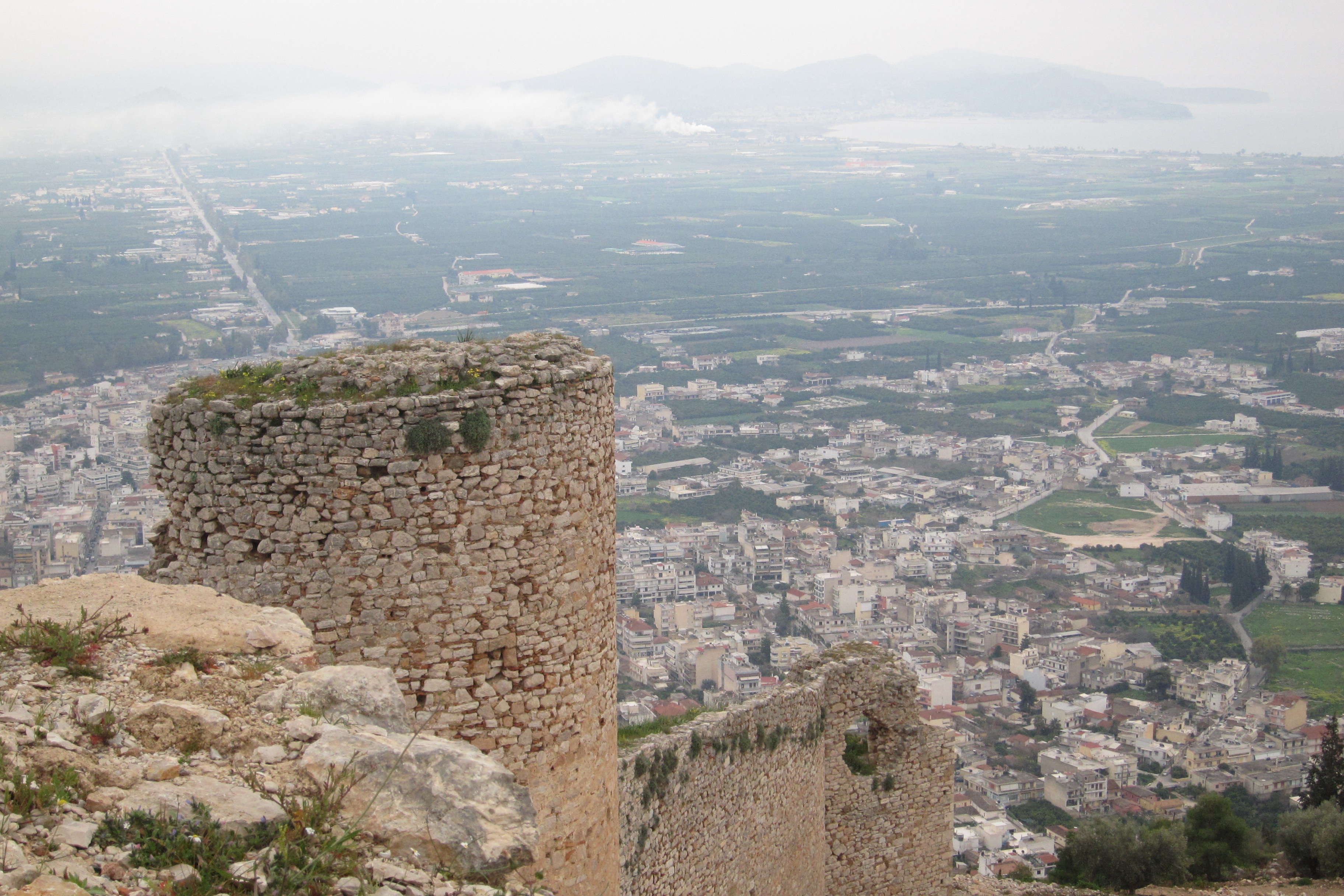
We drove around the countryside and happened to run across another ruin. It’s the Castle of Larissa in Argos.  This one wasn’t exactly open to the public. A sign noted that renovation construction was underway starting in 2008 to be complete in 2013.

2015-03-23 063

The castle is closed, not quite ready for tourists.

2015-03-23 068

Views from the hilltop are spectacular. The city of Argos has about 30,000 people now as it did in ancient days.

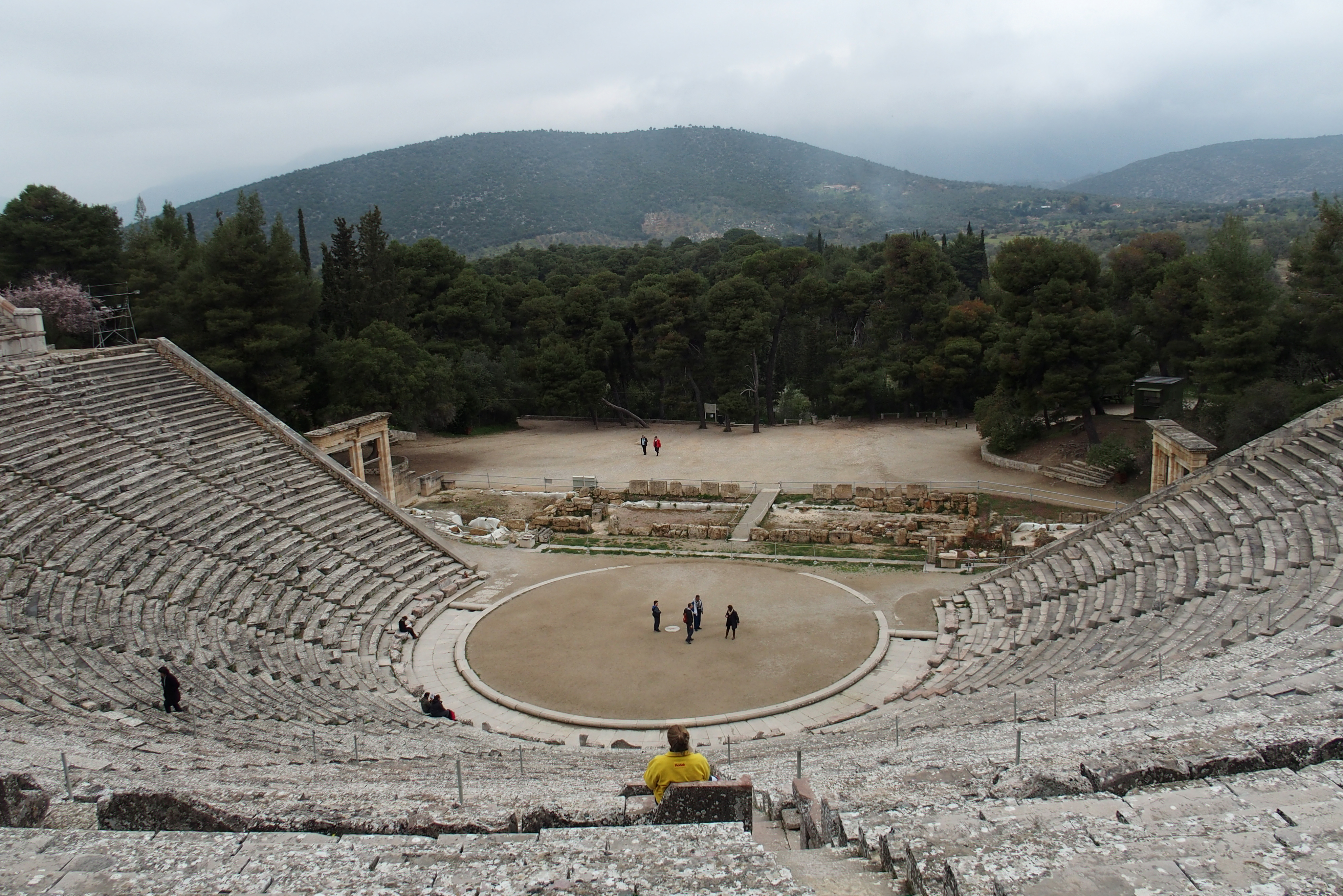
We visited Epidaurus to see the theater in the Sanctuary of Asklepios. The theater was built in the fourth century B.C. It seats up to 14,000 people. Seats in present tense as well as past. During July and August, plays by  Aeschylus, Euripides and Sophocles will be performed. The acoustics are fantastic. One German tourist stood at the center and recited passages in three languages. We didn’t understand what he was saying, but we heard them all.

OLYMPUS DIGITAL CAMERA

Yes we could hear a coin dropped on the rock at the center.

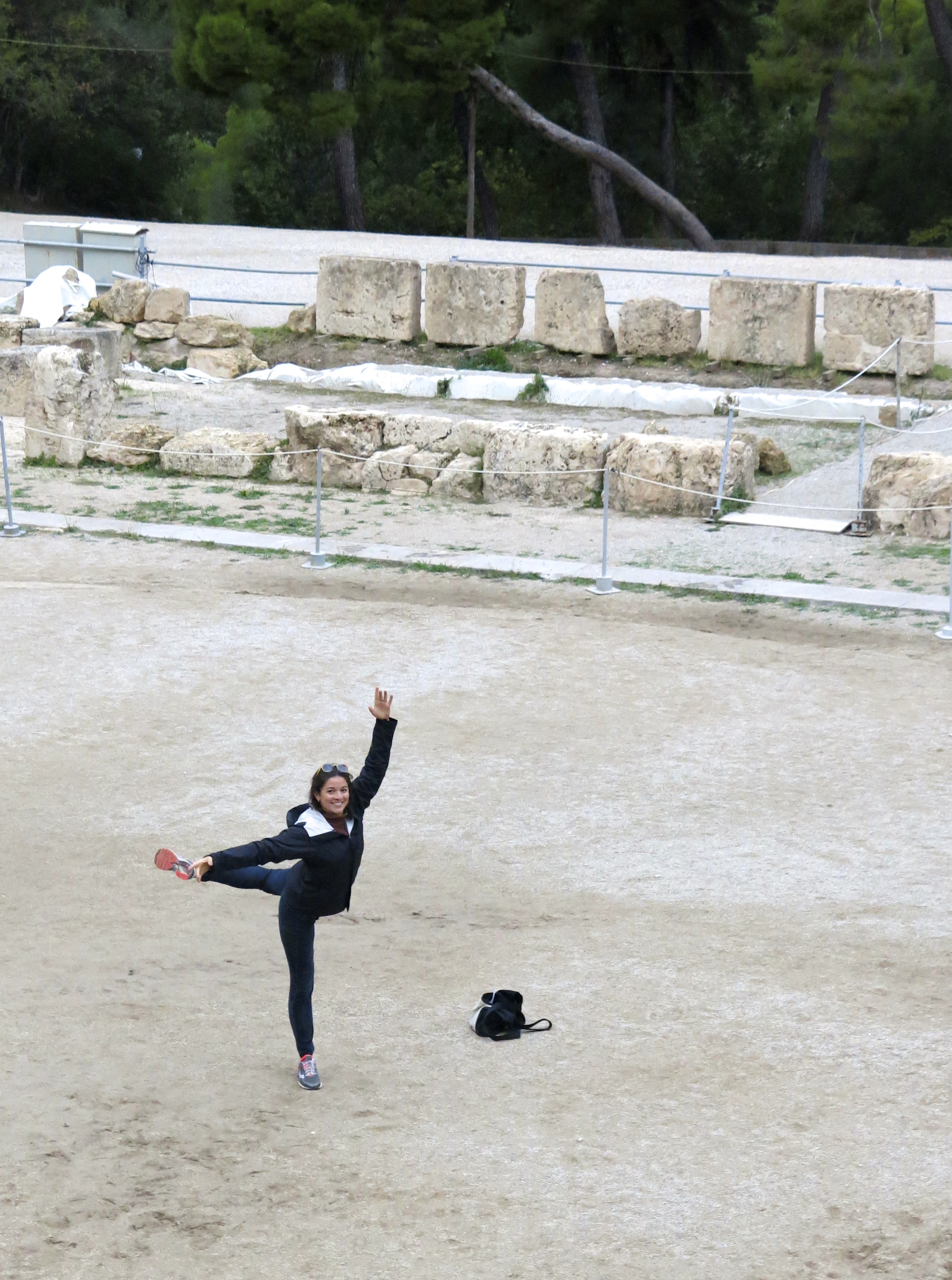
We have heard that famous dancers also come to this theater to practice.
IMG_0728

That’s Elizabeth posing at the Epidaurus Theatre.

Following Liz and Jesse’s path, we’re going next to the Greek isle of Hydra.


Posted in Travel Journal | Tagged , , , , , , , | Leave a comment

Toga Anyone? We’re in Athens!

Welcome to Greece, the land of beautiful sunny beaches…

OLYMPUS DIGITAL CAMERA

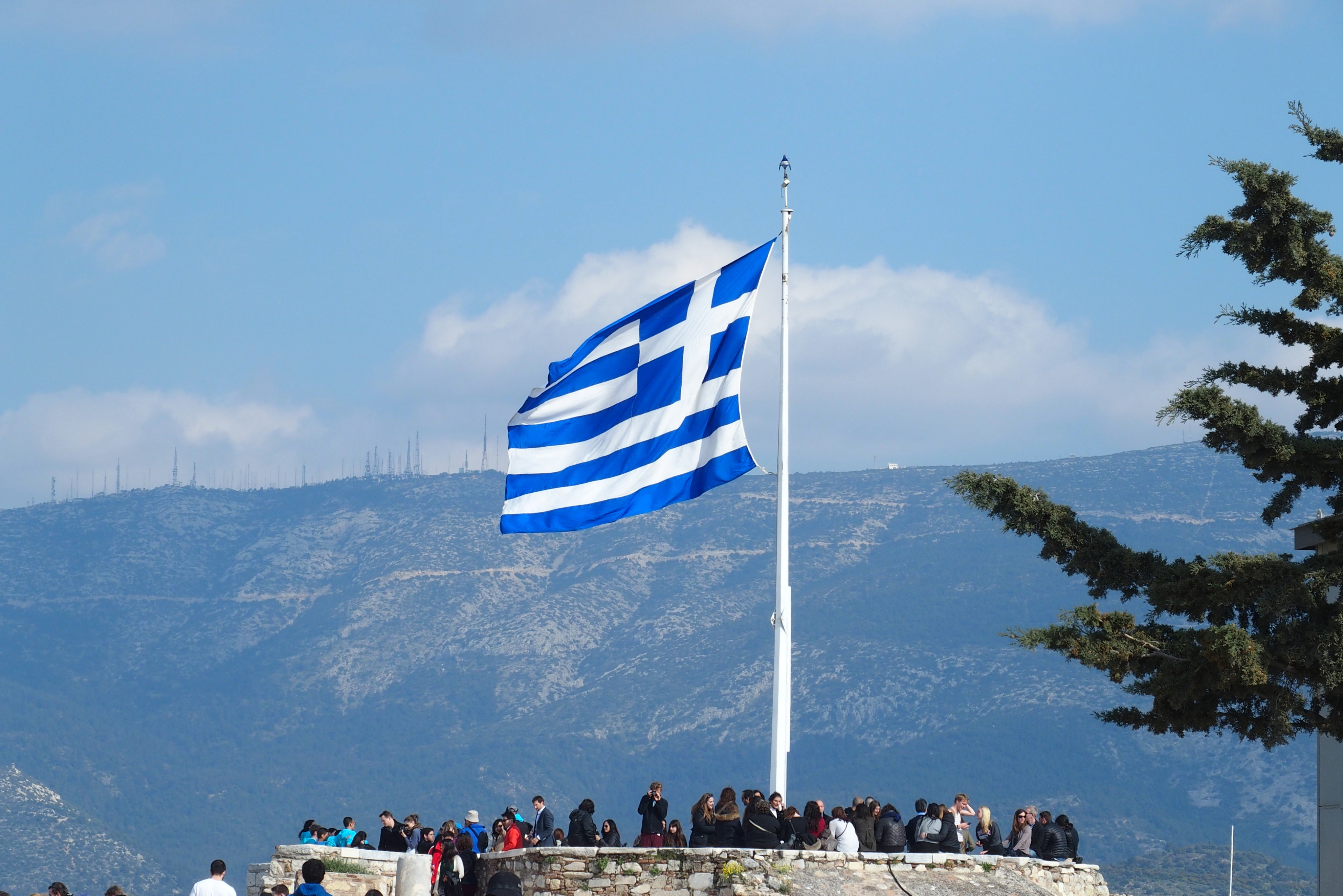
The Greek flag flies atop the Acropolis.

except in March, when there is a lot of rain. That just meant that we would spend less time at beaches and more time at ruins…and there are plenty of them. Our lovely little neighborhood of Thissio is in the shadow of the Acropolis.

OLYMPUS DIGITAL CAMERA

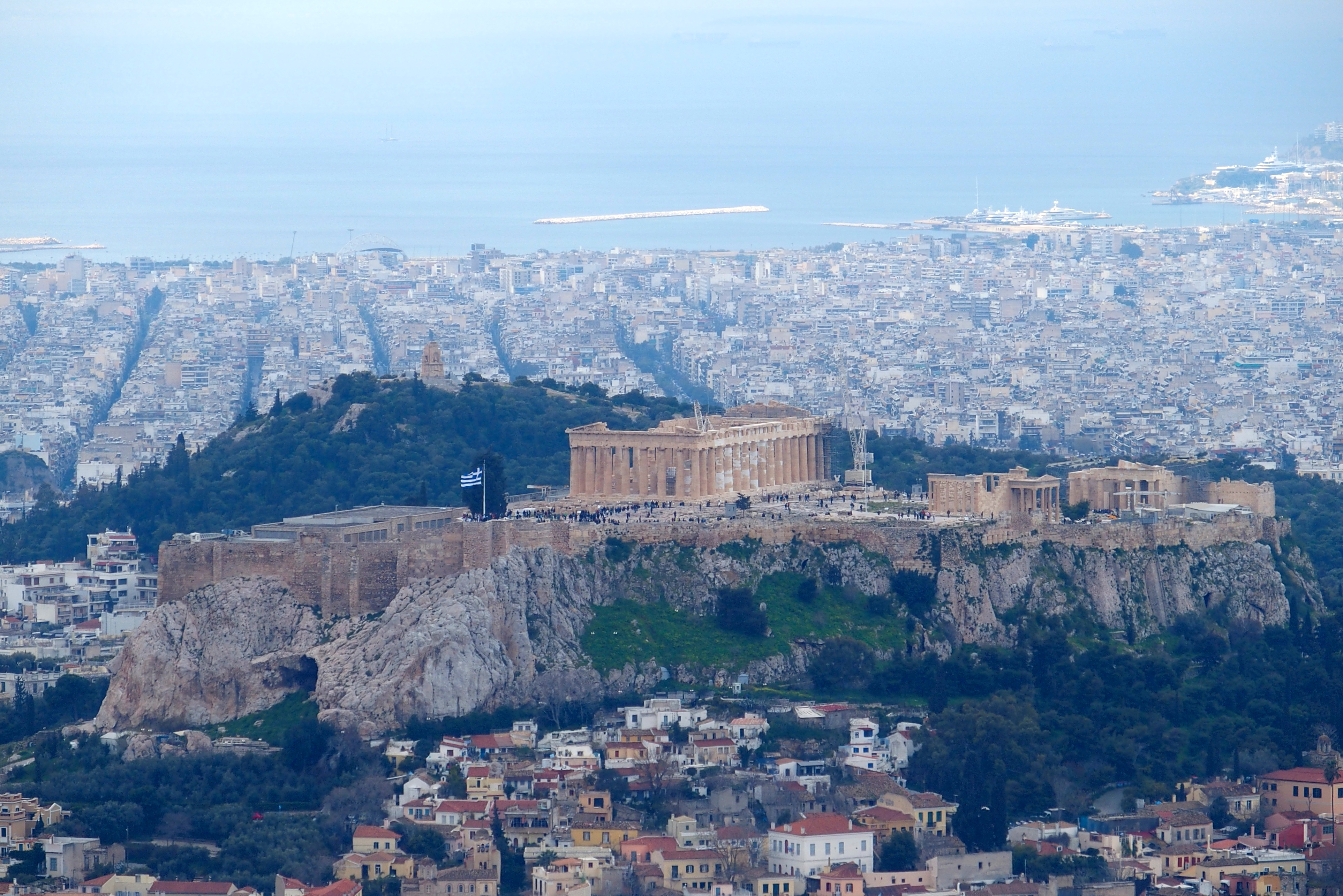
The ancient Acropolis stands as the most visible location in modern Athens.

The Acropolis view above is from Mount Lycabettus, across the city. It’s likely that ancient Greek structures lie beneath everything in the path between the two hills.

The Acropolis is actually the rocky hilltop and complete citadel area, a fortress for the Greeks . The Parthenon is the most spectacular building, built between 447 and 438 B.C. and masterminded by Pericles. It was a temple to the goddess Athena but also served  as a treasury. In other ages it became a Catholic church and an Ottoman mosque.

OLYMPUS DIGITAL CAMERA

How did the ancient Greeks build this huge structure on top of a tall hill without cranes, trucks, conveyors, and Caterpillar machinery?

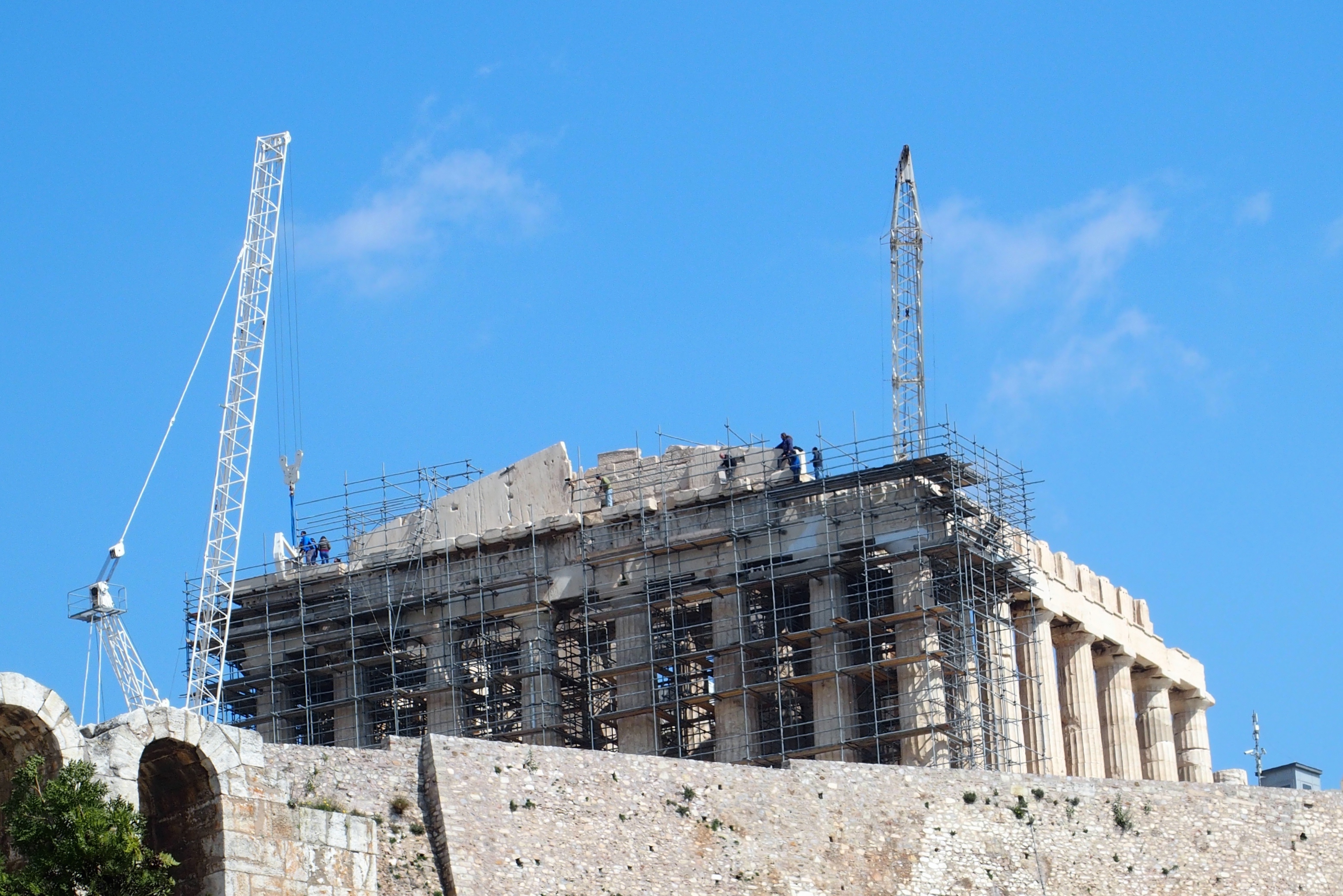
Now it’s impossible to get a photo of the Parthenon without some evidence of reconstruction. Damage to the original structure occurred in the 1600s when it was being used to store gunpowder. A Venetian bomb in 1687 caused further damage.

OLYMPUS DIGITAL CAMERA

Imagine the building without scaffolding and cranes.

Renovation efforts seem to be unending. The latest project started in 1983 and was continuing slowly during our 2015 stay. That’s 32 years so far, compared to the original 9 years to construct.

IMG_7188

Liz and Jesse were here in October.

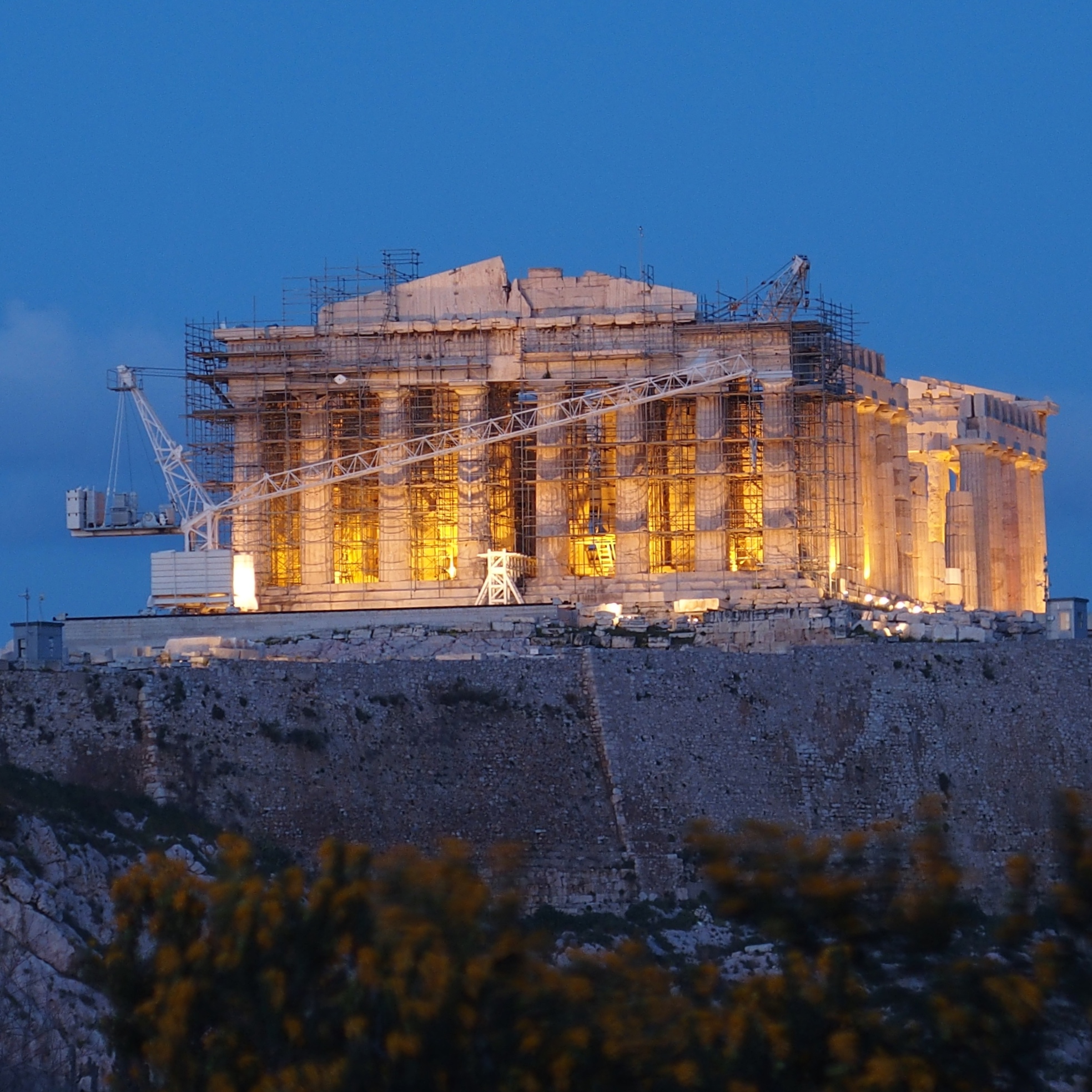
At night the Parthenon is lit with an inner glow to display this national treasure’s great beauty.

OLYMPUS DIGITAL CAMERA

Squint at this picture to block out the scaffolding and imagine the glory that was Greece.
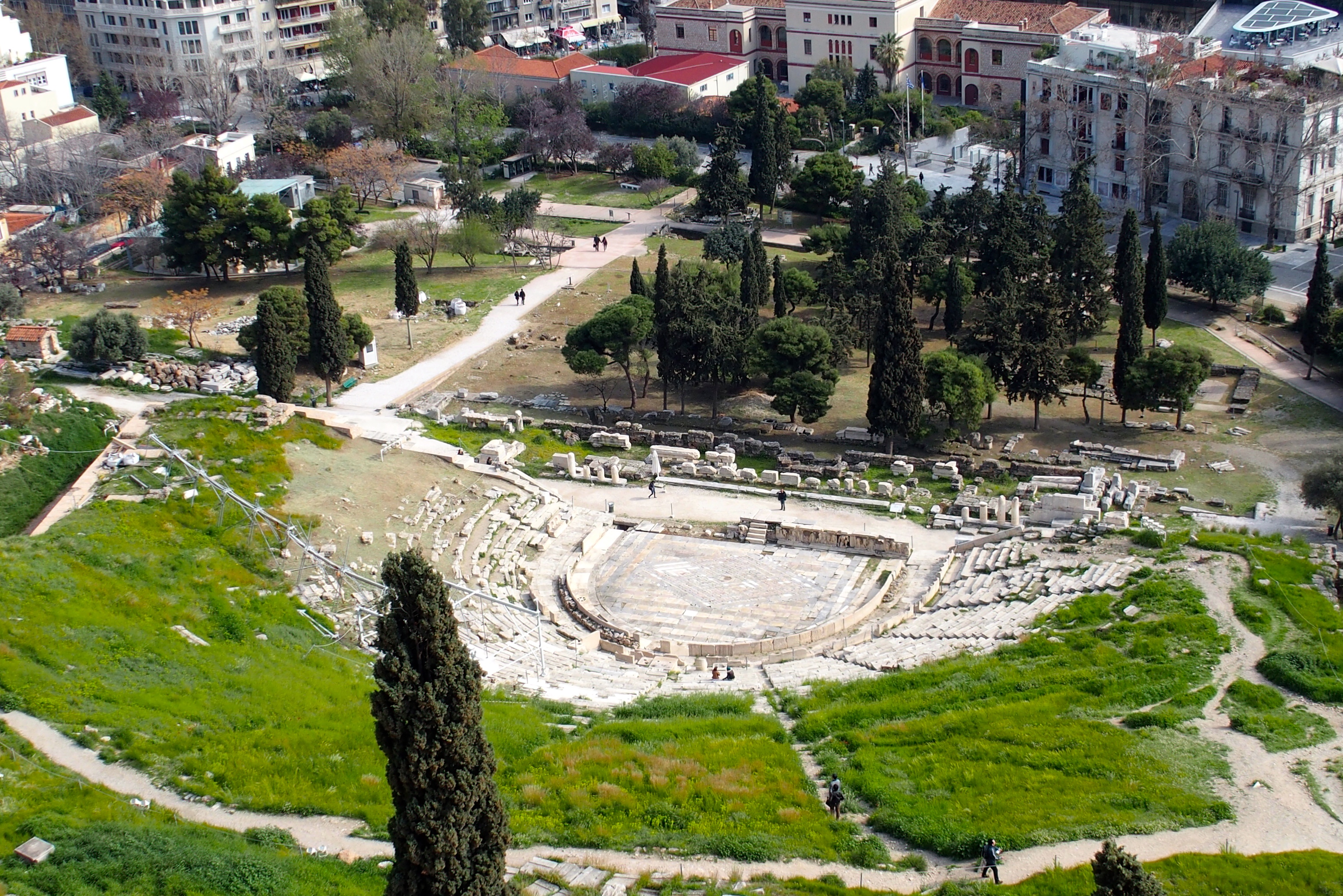
Down the hill from the Parthenon is the Theatre of Dionysus (Greek god of wine, intoxication and ecstatic dance). Here, up to 17,000 Greeks gathered to watch performances of works by Sophocles, Euripides, Aristophenes and others.

OLYMPUS DIGITAL CAMERA

Now tourists and cats sit on the theater’s marble seats.

In 2007, Athens created the current Acropolis Museum. Smaller museums had existed in the past but weren’t large enough to contain all the ancient treasures. For decades prior to the final completion, Greek politicians including Melina Mercouri (once a Greek actress and then Minister of Culture) planned and campaigned for this structure to be completed. The construction includes glass flooring at the entryway to show glimpses of the ancient passageways and buildings unearthed below modern Greece.
OLYMPUS DIGITAL CAMERA

Inside, the museum has recreated the structure of the Parthenon with 50 meters of the frieze that once stood at the top of the columns.
The whole Acropolis as it once was is reproduced inside the museum in a 300,000-block Lego structure created by the Australian artist/architect Ryan McNaught. He has depicted numerous ancient and modern visits to the Acropolis including Sigmund Freud, Agatha Christie, and Elton John at a grand piano.

IMG_4964

Perhaps this is close to the model Pericles used in designing the structures.

Most of the remaining statuary from the Parthenon and other buildings of the Acropolis have been removed to the museum for preservation. In some cases relatively small bits of statues have been recovered and the missing sections are filled in with plaster, like a giant 3-D jigsaw puzzle. Six statues of maidens, the Caryatids, served as columns supporting the Erechtheion.

IMG_4960

The Caryatids are surprisingly whole.

A large amount of the Parthenon’s frieze (80 meters!) was removed from the Greek hilltop in the 1800s by Lord Elgin for “protection” in the British Museum. In the Acropolis Museum, missing bits of frieze are filled in with plaster. The Greek government and many museum curators around the world now urge the British to return the Elgin marbles to their rightful home.

IMG_4969

Beige is the original, white is the temporary plaster awaiting return of the original from the British Museum.

Melina Mercouri campaigned for her position with a platform of the return of the Elgin marbles. Even the Lego reproduction represents the removal of the marbles.

IMG_4972

Lord Elgin is caught in the act of removal of his marbles  in the Lego depiction while Pericles looks on in horror.

Nearby, the changing of the guard at the Parliament Building is an interesting display of pageantry and tradition. Two very tall guards stand at the entrance in kilts and pom-pommed shoes. A new regiment of replacement guards arrive, appearing out of nowhere. After their uniform is checked down to the stocking garters, they high step into place with their shoes tapping a bit of a shuffle ball change.  Note the Greek writing on the wall behind them.

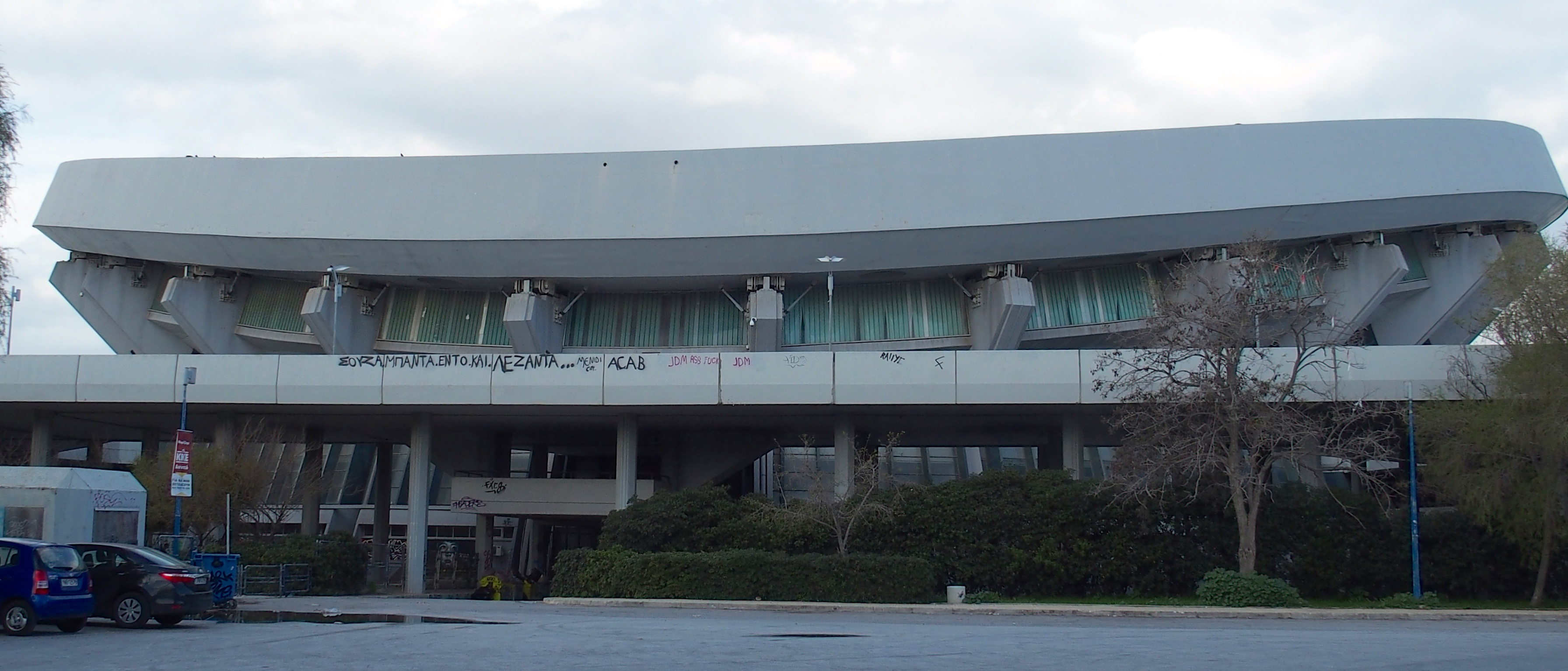
Athens is actually a very large city. Infrastructure installed for the 2004 Olympics makes it quite navigable, with a very nice subway/train that reaches from the city center to the port area of Piraeus. Here we saw the Peace and Friendship Stadium, built for Olympic basketball and volleyball, now a bit less glorious.

OLYMPUS DIGITAL CAMERA

Does this stadium look familiar from the 2004 Olympics? It is now covered with graffiti and we thought it was abandoned, but apparently still used.

The port area shows that at least some visitors to Greece are doing quite well. Lots of large sailboats and motoring yachts.

OLYMPUS DIGITAL CAMERA

A small boat owned by a Qatari leader. “My other boat is an aircraft carrier.”

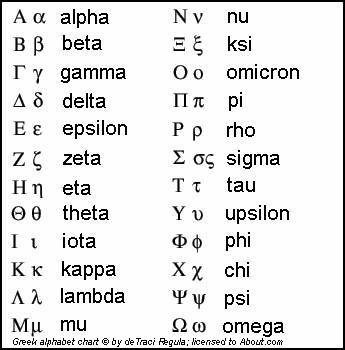
Michael has been driving all over Greece and we’re navigating using street signs. But guess what…It’s all Greek to me! Interestingly, we did start understanding the place names by remembering some of the Greek alphabet: pi is P, p is rho or R, sigma is S, v is nu or N.

Greek alphabet

So we could get to where we needed to be without wandering into Turkey or Albania.

Πειραιάς = Piraeus

Αθήνα = Athens (Athena)

Ναύπλιο = Nafplio

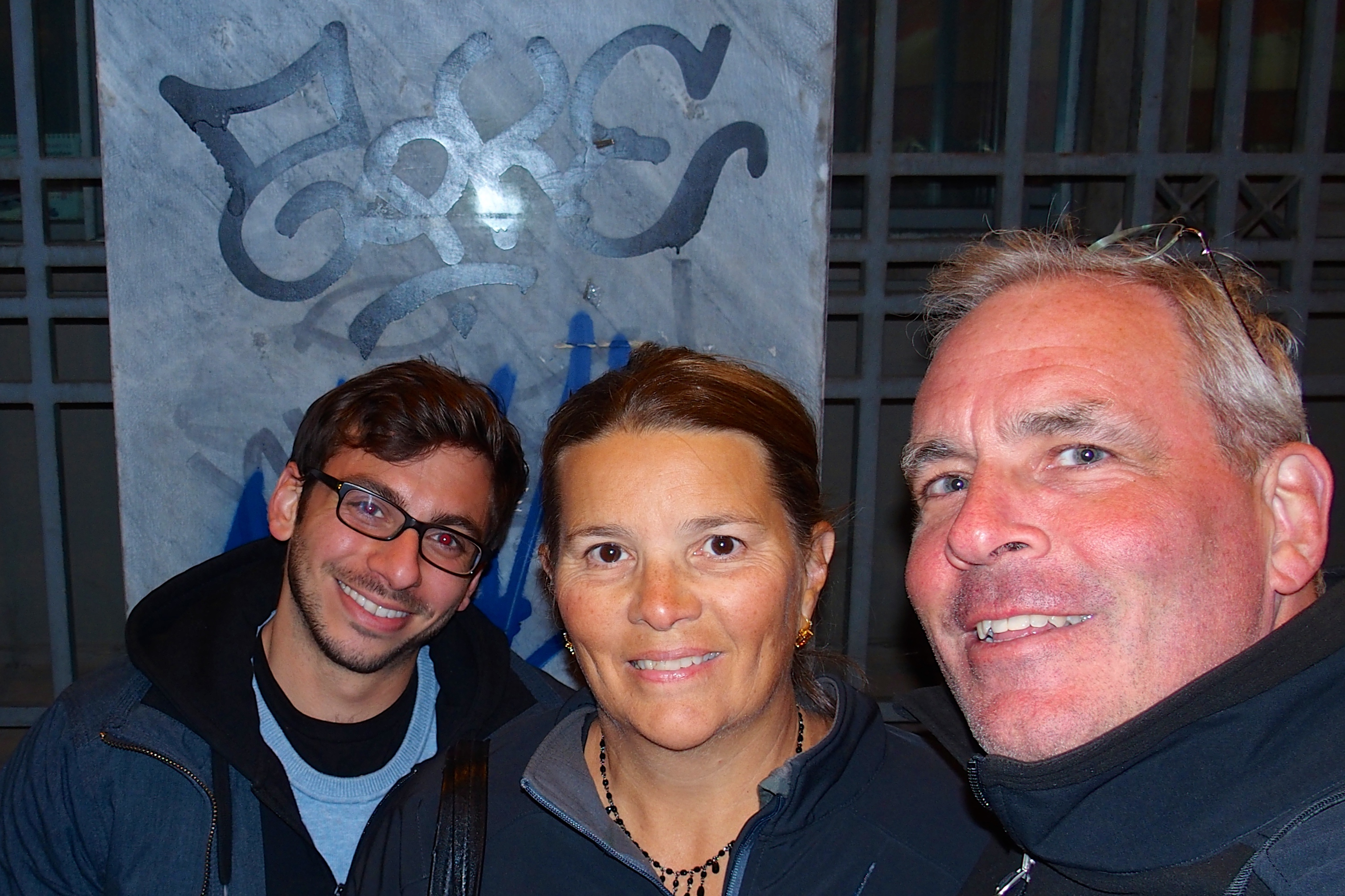
We didn’t see a single toga, except on a few of the statues, but we did have dinner with an honest-to-goodness Greek. We met up with Liz’s friend Nick who is living in Athens on a Fulbright scholarship.

OLYMPUS DIGITAL CAMERA

Authentically Athenian: Nick and lots of graffiti

Next we’re off to the Peloponnese.


Posted in Travel Journal | Tagged , , , , , | Leave a comment

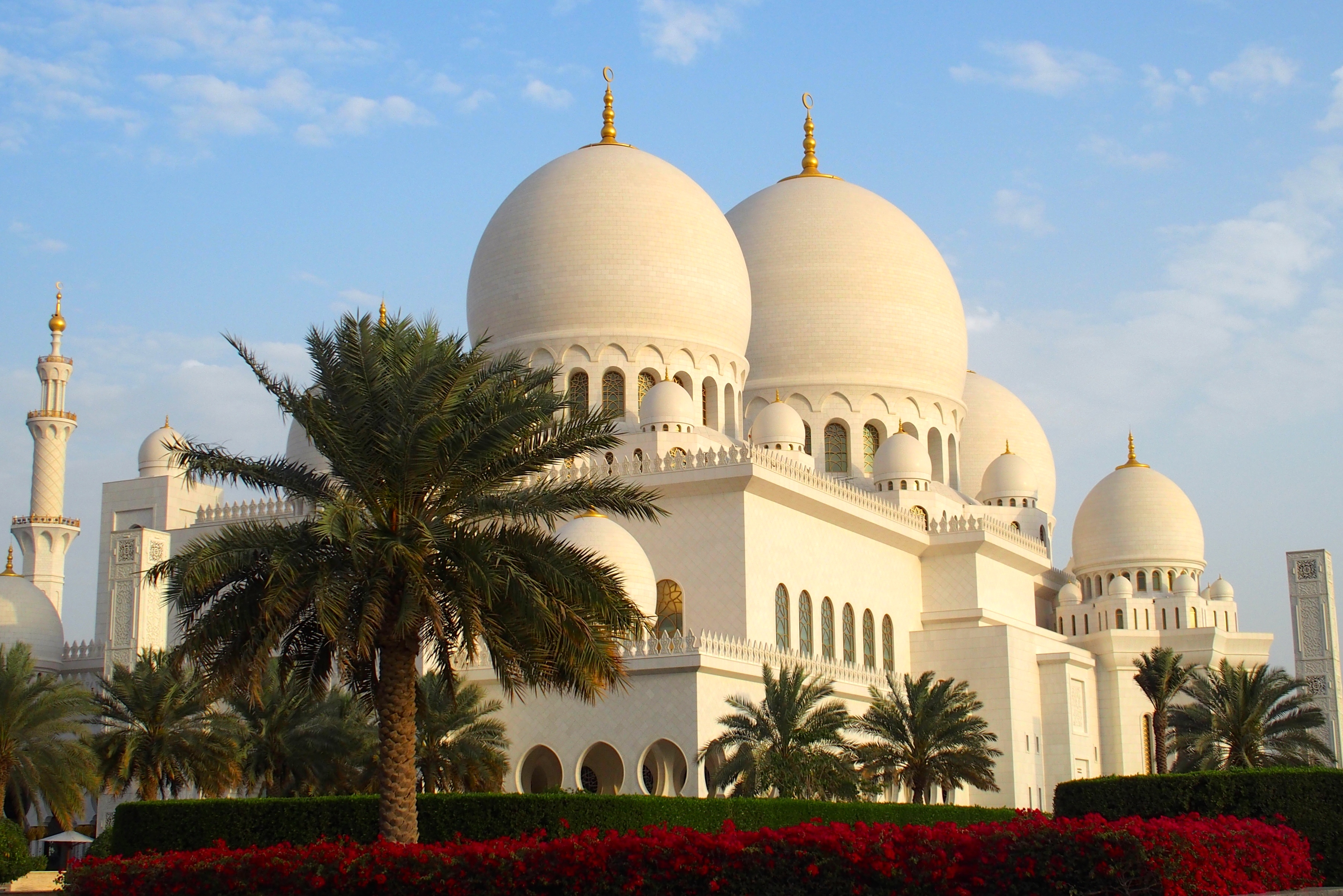
Sheikh Zayed Grand Mosque – March 2015

The highlight of any trip to Abu Dhabi, and maybe to U.A.E. in total, is the Sheikh Zayed Grand Mosque. This is the largest mosque in the world. It is larger and perhaps more impressive than either St. Peter’s Basilica or the Taj Mahal.

OLYMPUS DIGITAL CAMERA

Impressive even driving by.

Both the exterior and interior of the mosque are amazing. Most of the space is open to tourists, with only the prayer areas closed off so Muslims can practice their religious rites in private.

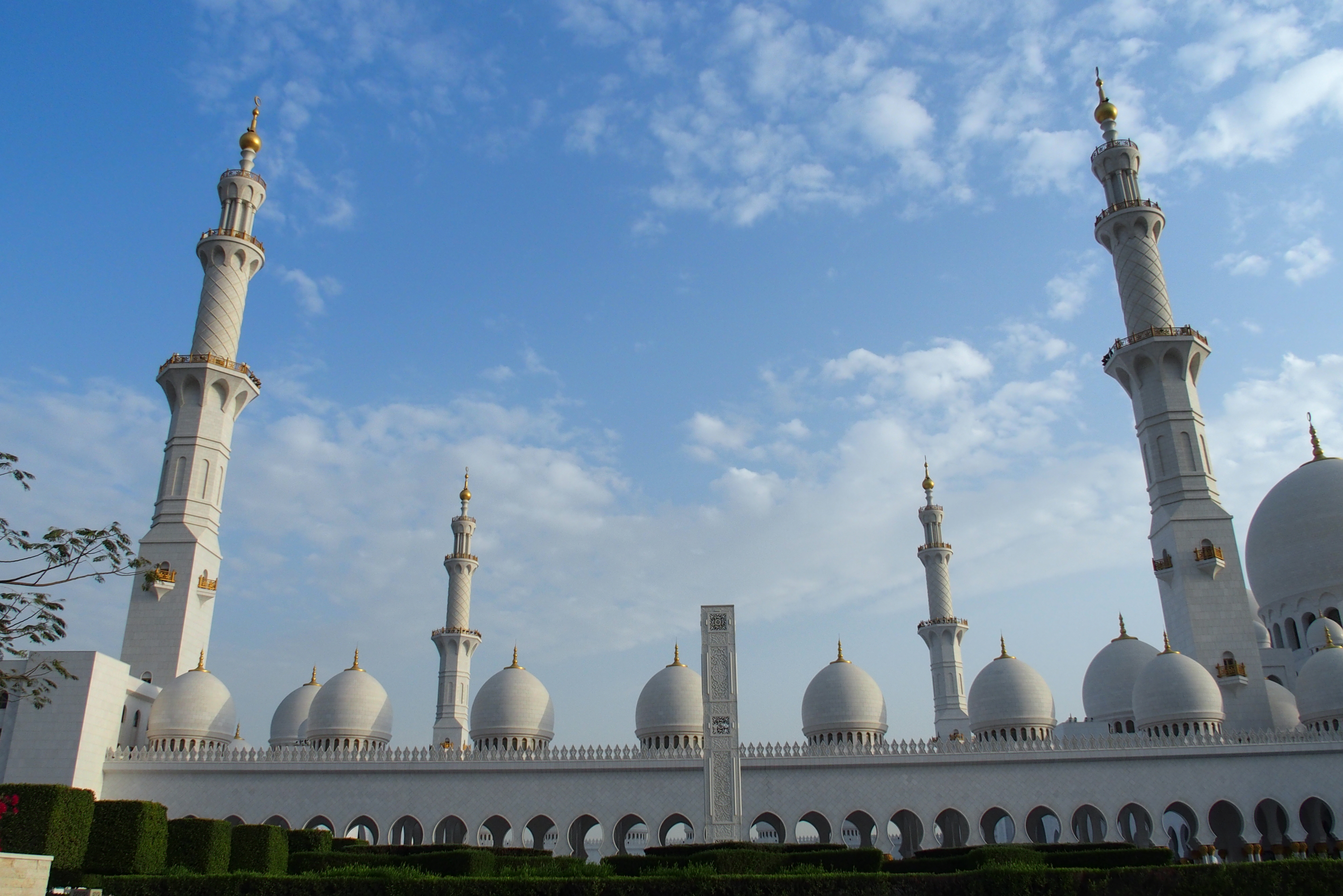
OLYMPUS DIGITAL CAMERA

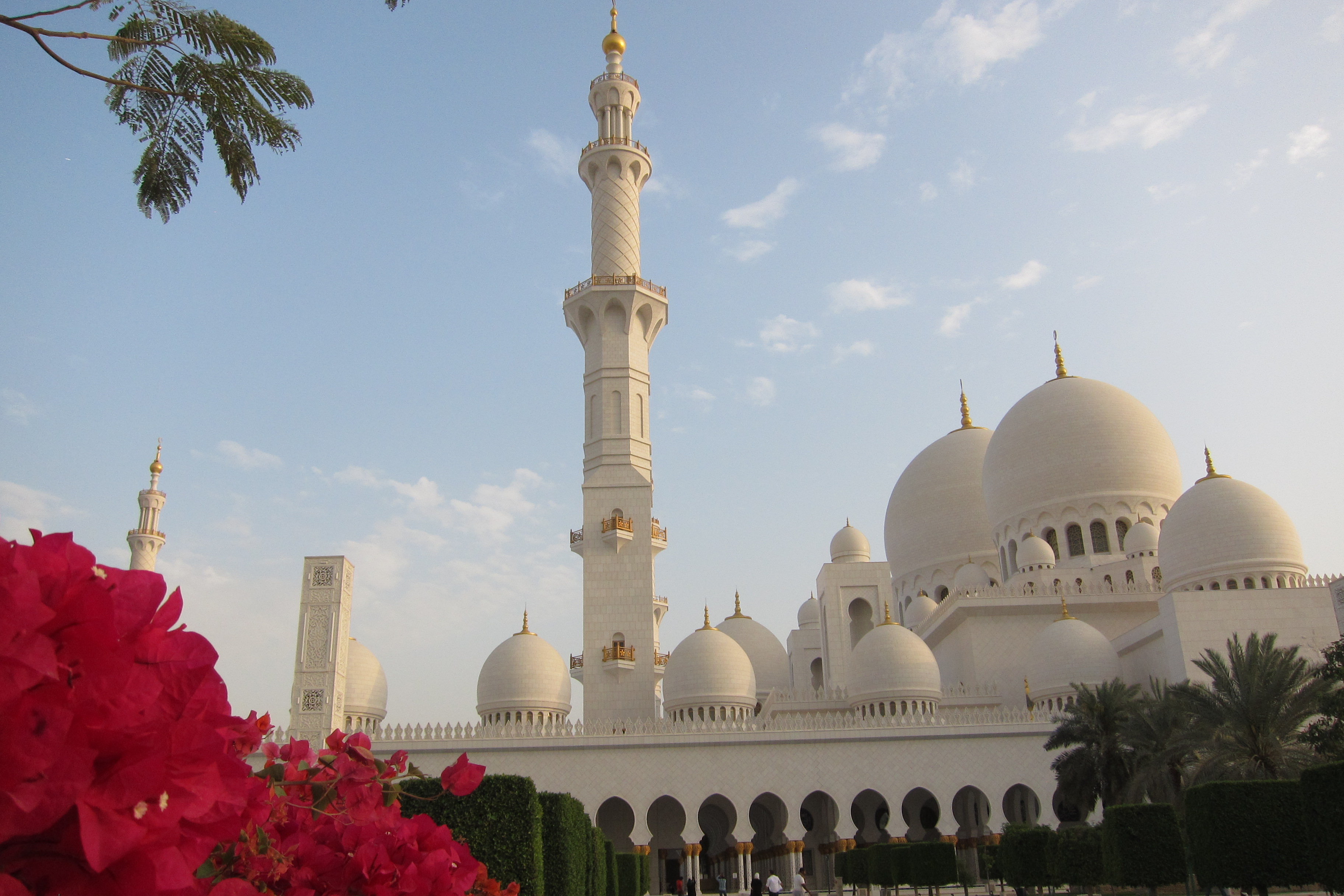
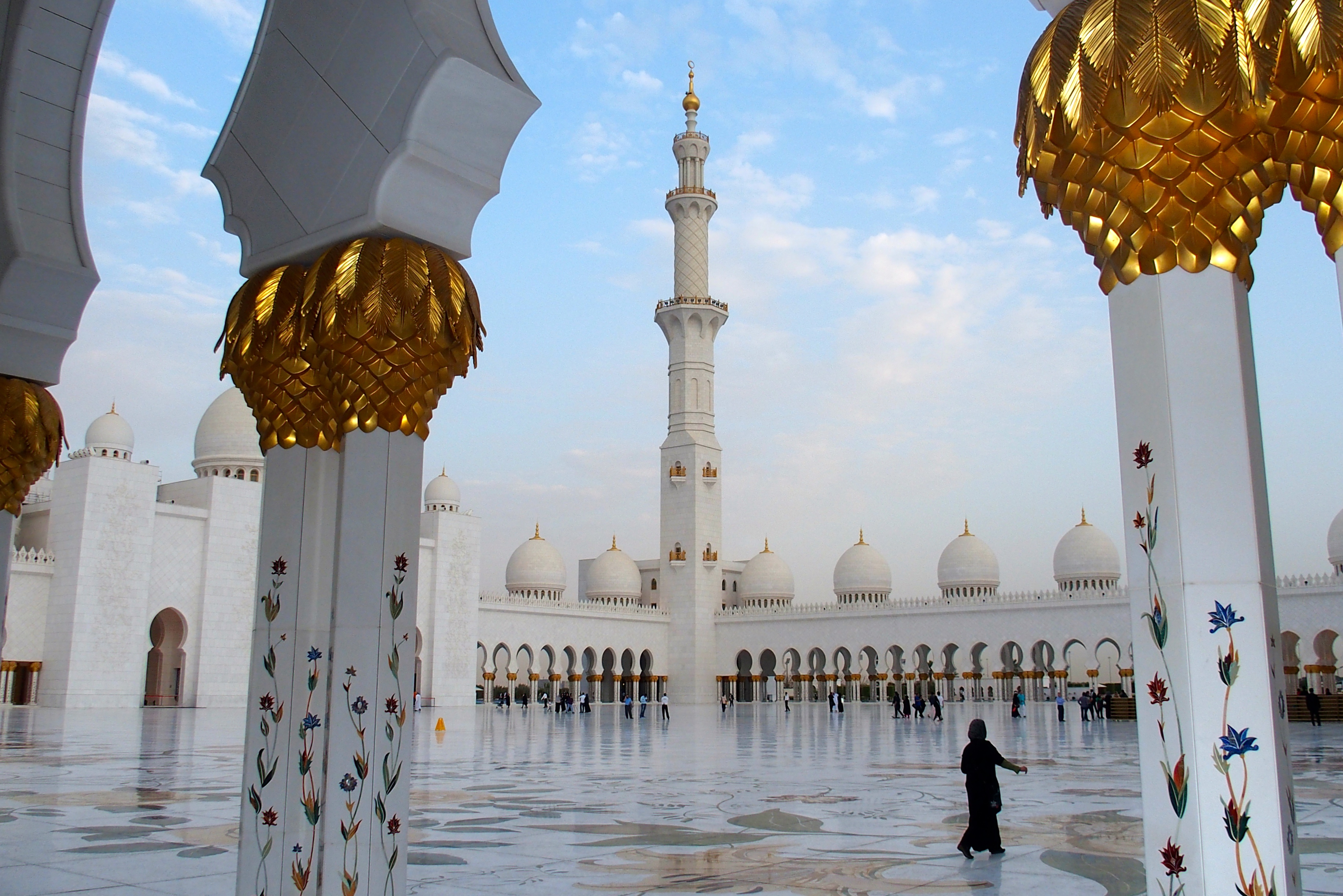
Four minarets on the four corners and 82 domes. The complex is 30 acres in area, hard to get everything into a single photo.

Surprisingly, it’s not an ancient building like the Taj Mahal (built in 1653) or St. Peter’s (1626). It was completed in 2007! The mosque is named for the late Sheikh Zayed bin Sultan Al-Nahyan, who wanted to show unification of Islamic culture through architecture, art, and spirituality. The structure also used building materials sourced from numerous countries, again showing unification rather than isolationism.

OLYMPUS DIGITAL CAMERA

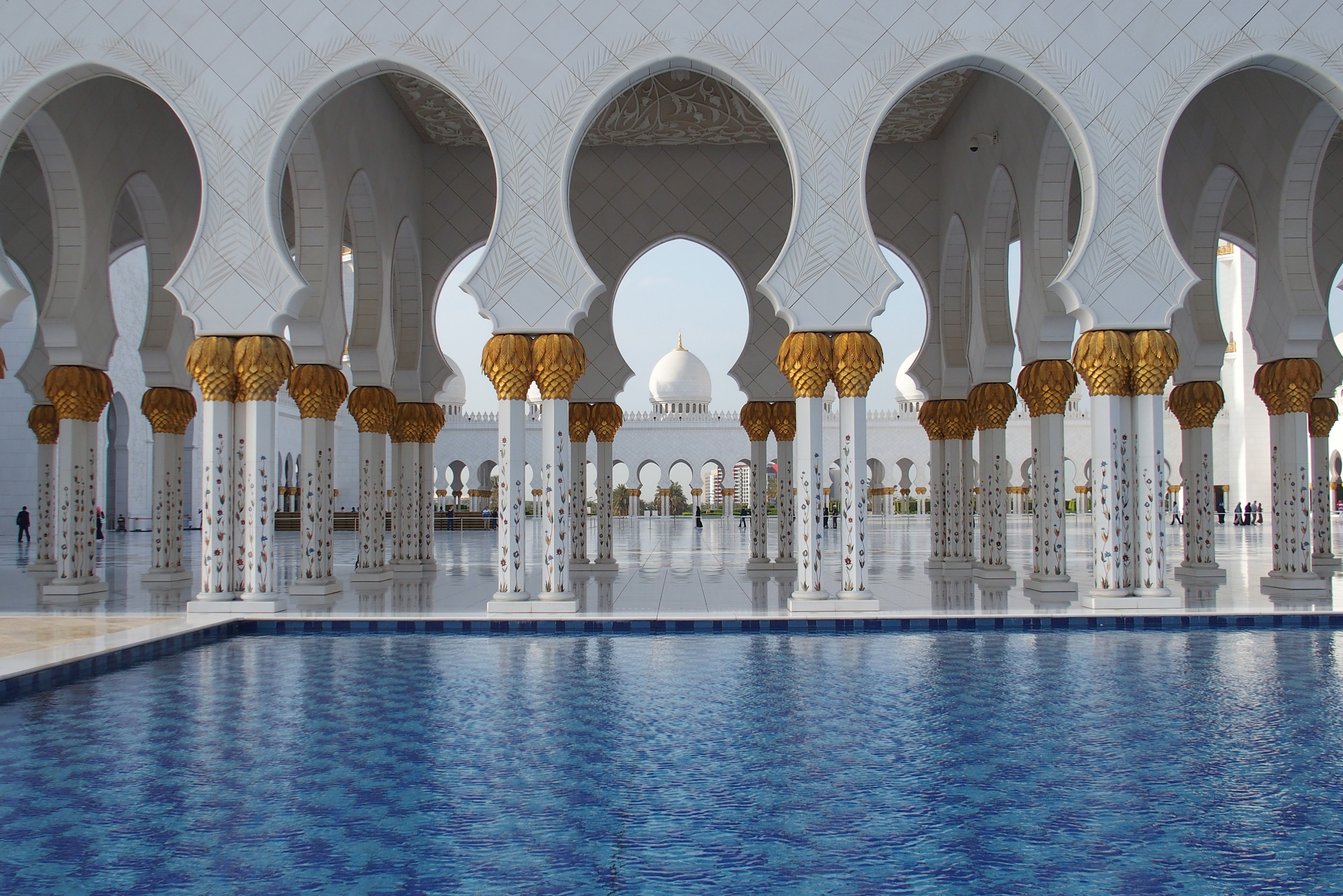
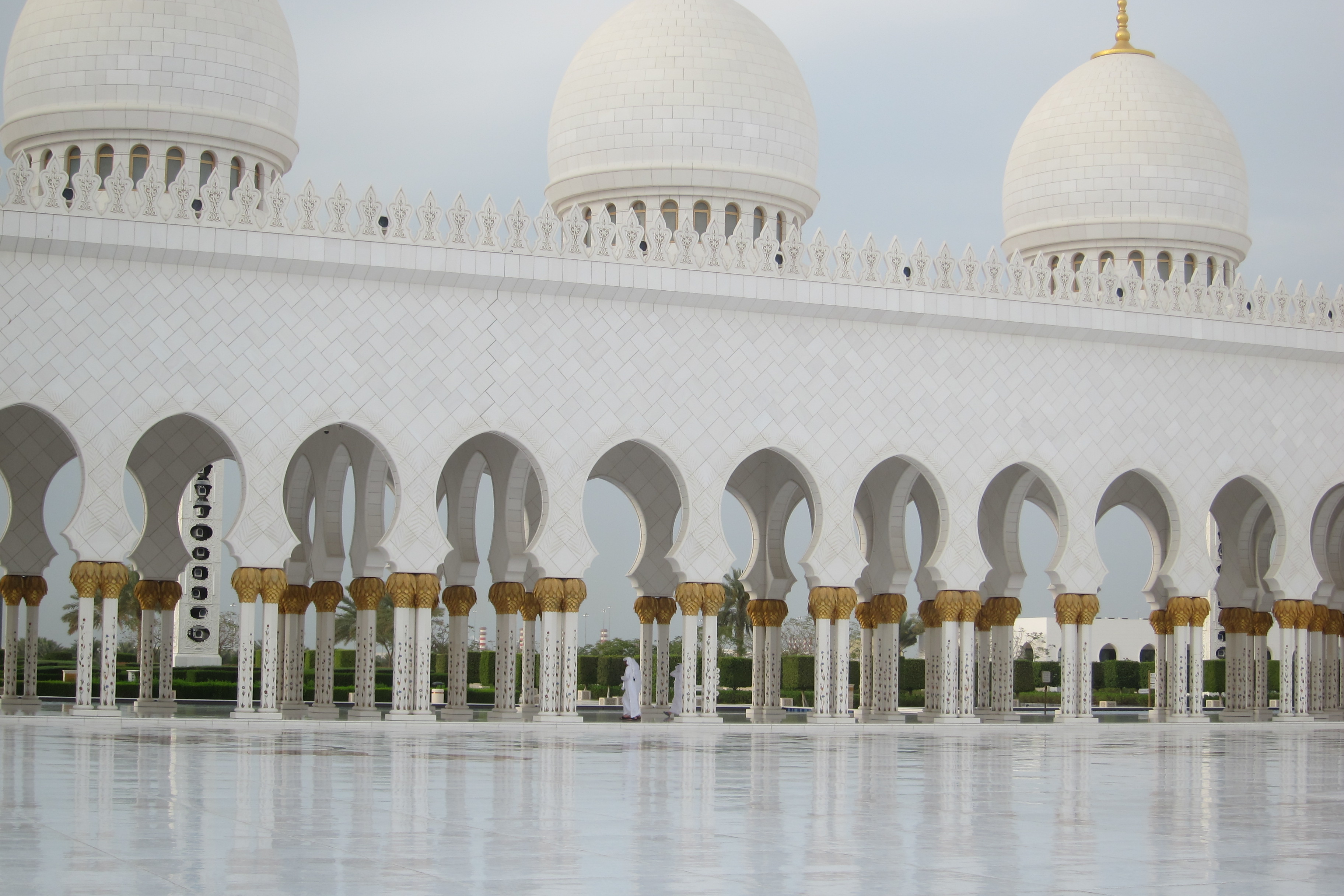
The shallow reflecting pools mirror the white columns.

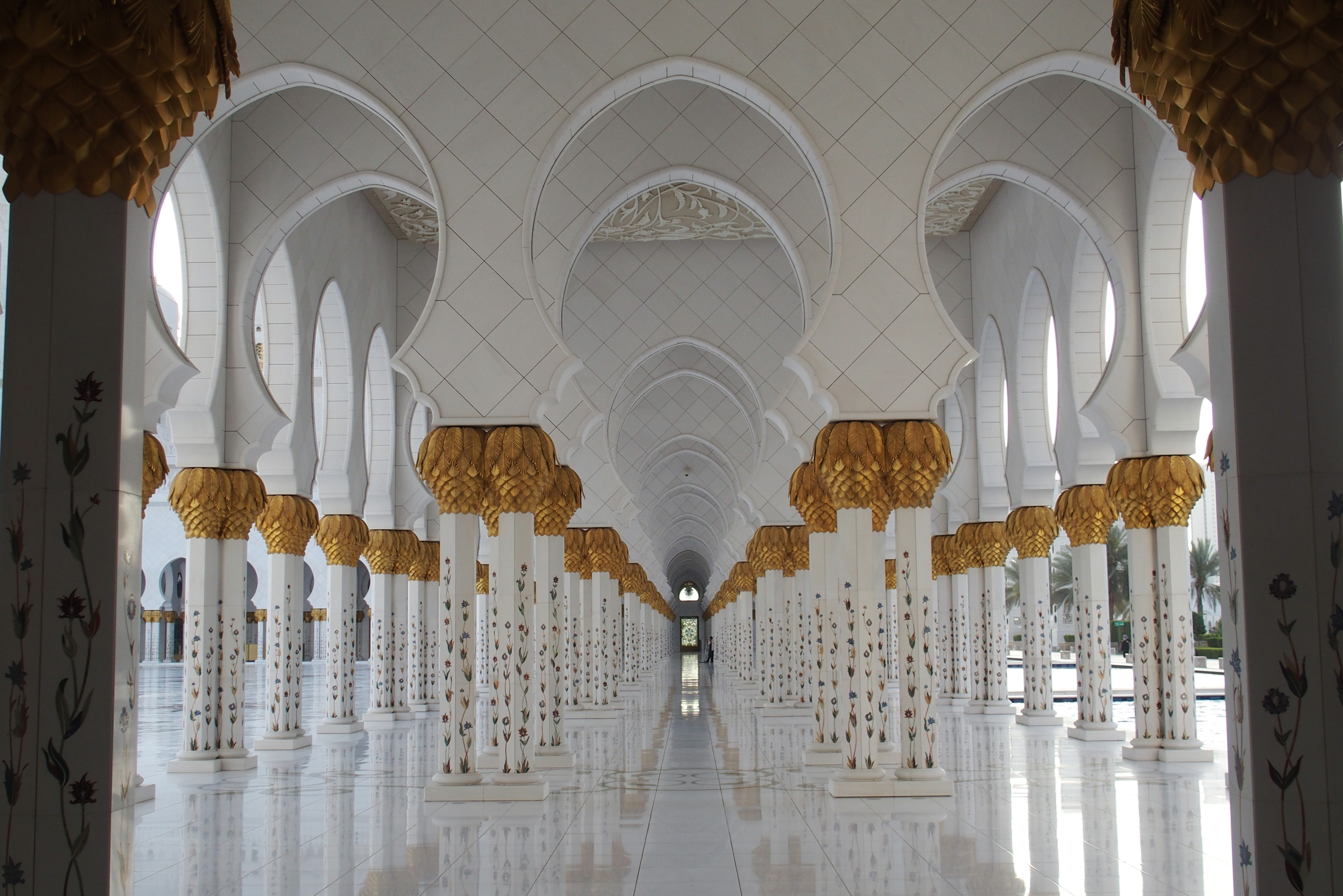
On each side of the inner courtyard is a long corridor.

OLYMPUS DIGITAL CAMERA

With thousands of visitors a day, you wouldn’t expect to see so much empty space. But it’s just so big.

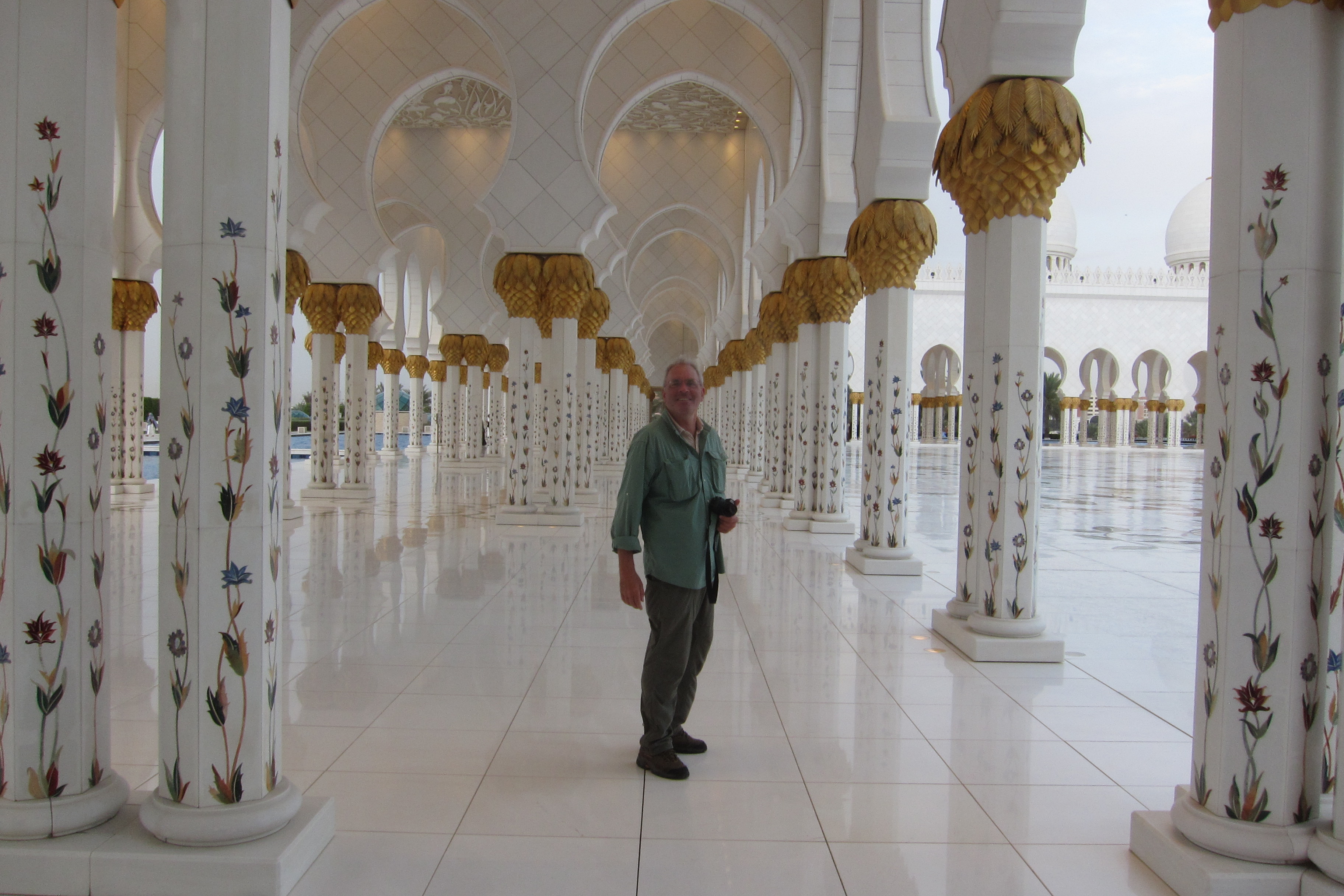
One corridor is for men and one for women. A guard very politely redirected Michael when he wandered into the wrong corridor.

2015-03-16 159

Oops! Doesn’t he look chagrined?

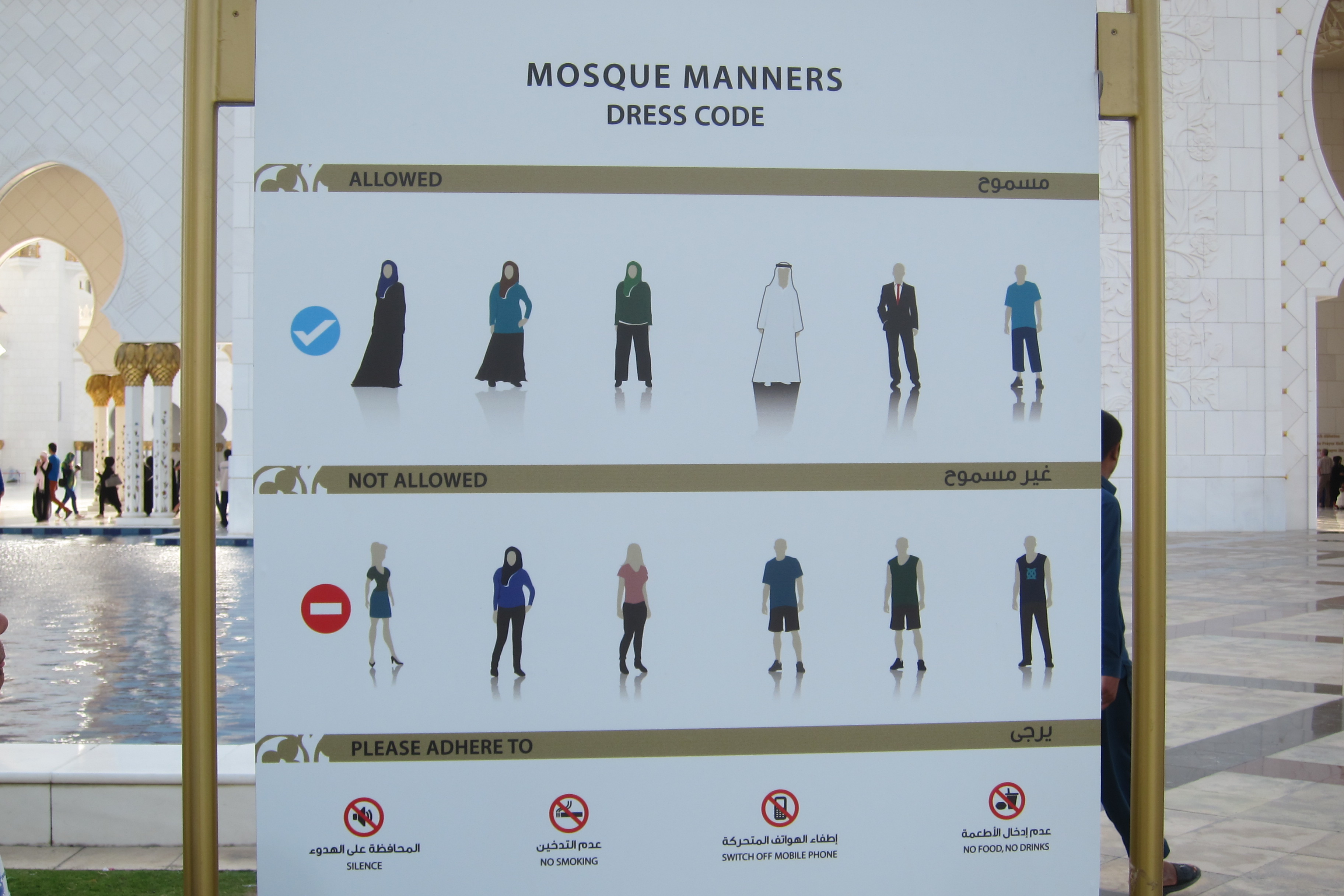
Although women are not required to wear clothing to cover their hair and ankles in general in U.A.E., inside the mosque they are. Men too have to cover their legs.

2015-03-16 033

Selena Gomez recently had an ankle showing in an Instagram photo at the mosque. Muslim fans were not happy.

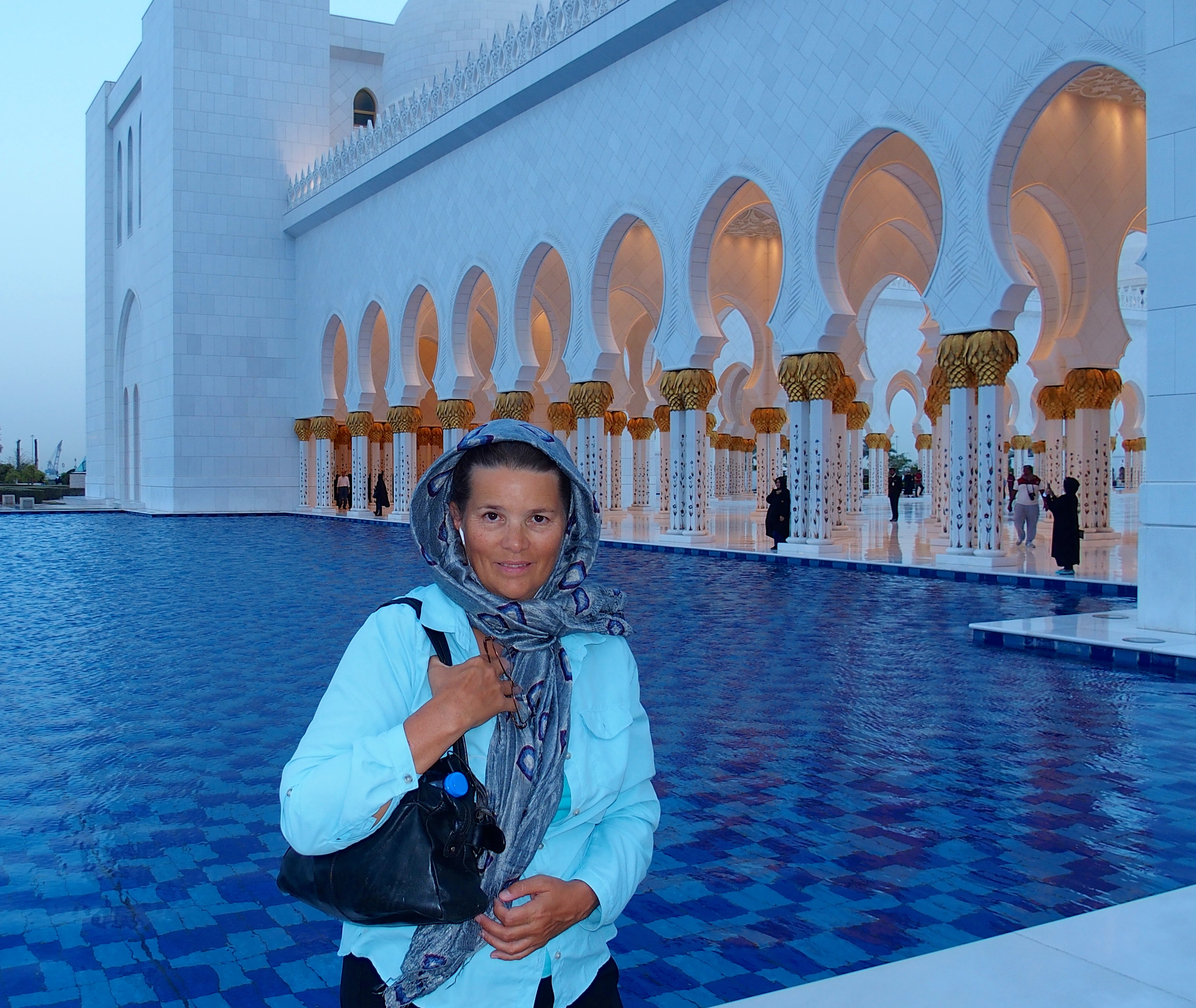
Fortunately, black abayas (cloaks) and shaylas (headscarves) are available for women to borrow and white dishdashes (cloaks) for men who show up in shorts. My scarf was adequate when worn over my head even though it wasn’t black.

OLYMPUS DIGITAL CAMERA

Color coordinated with the floor of the reflecting pool rather than black.

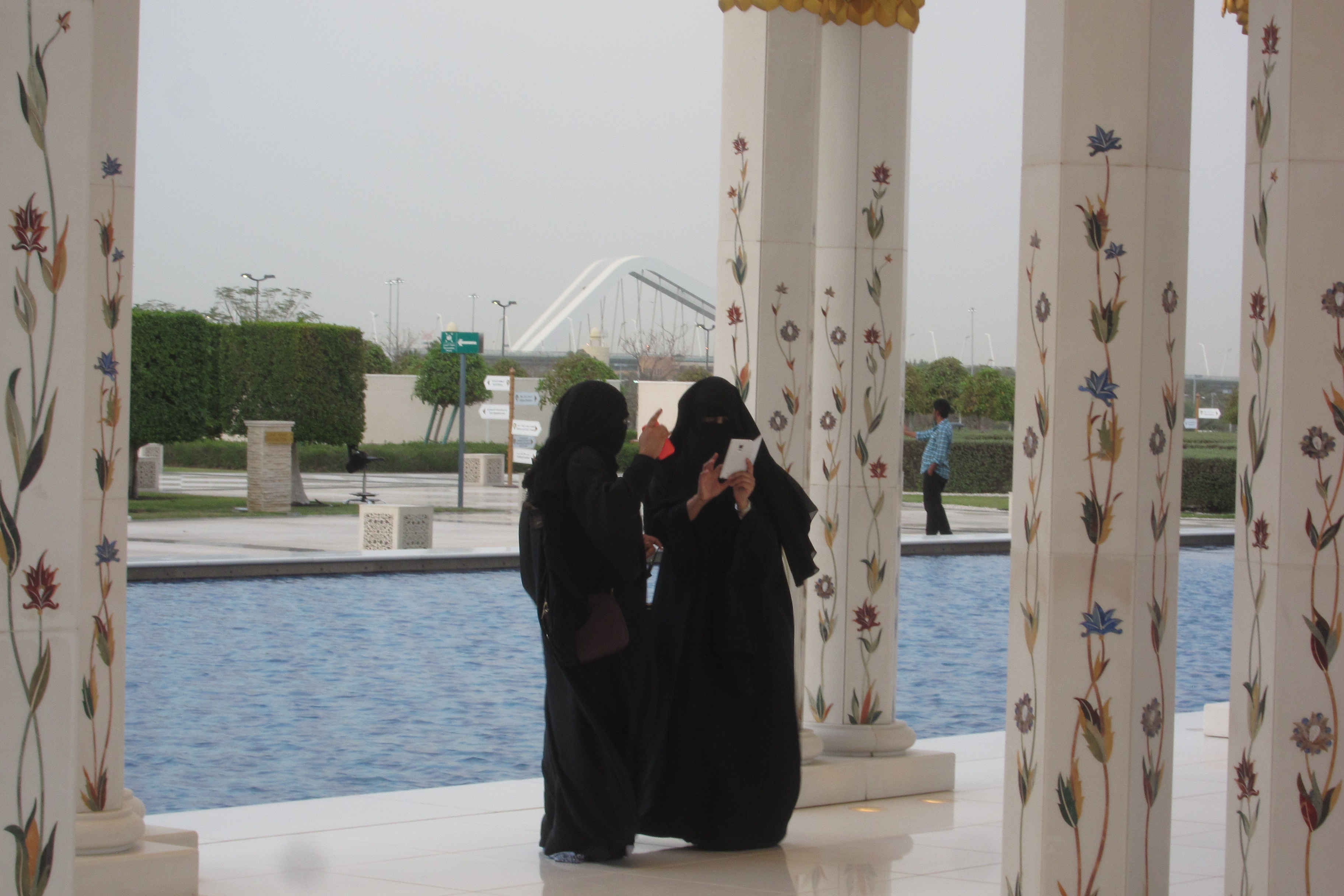
We saw Islamic women wearing abaya and shayla (not always black), niqab (black cloak and veil with open slits for eyes), and full burka (black head to toe, eyes behind a black veil).


2015-03-16 161

Question: When women in burka do selfies, can they tell who they are?

Visitors are also required to remove their shoes before entering the interior of the mosque. This was quite pleasant, since the path through was on a plush carpet.

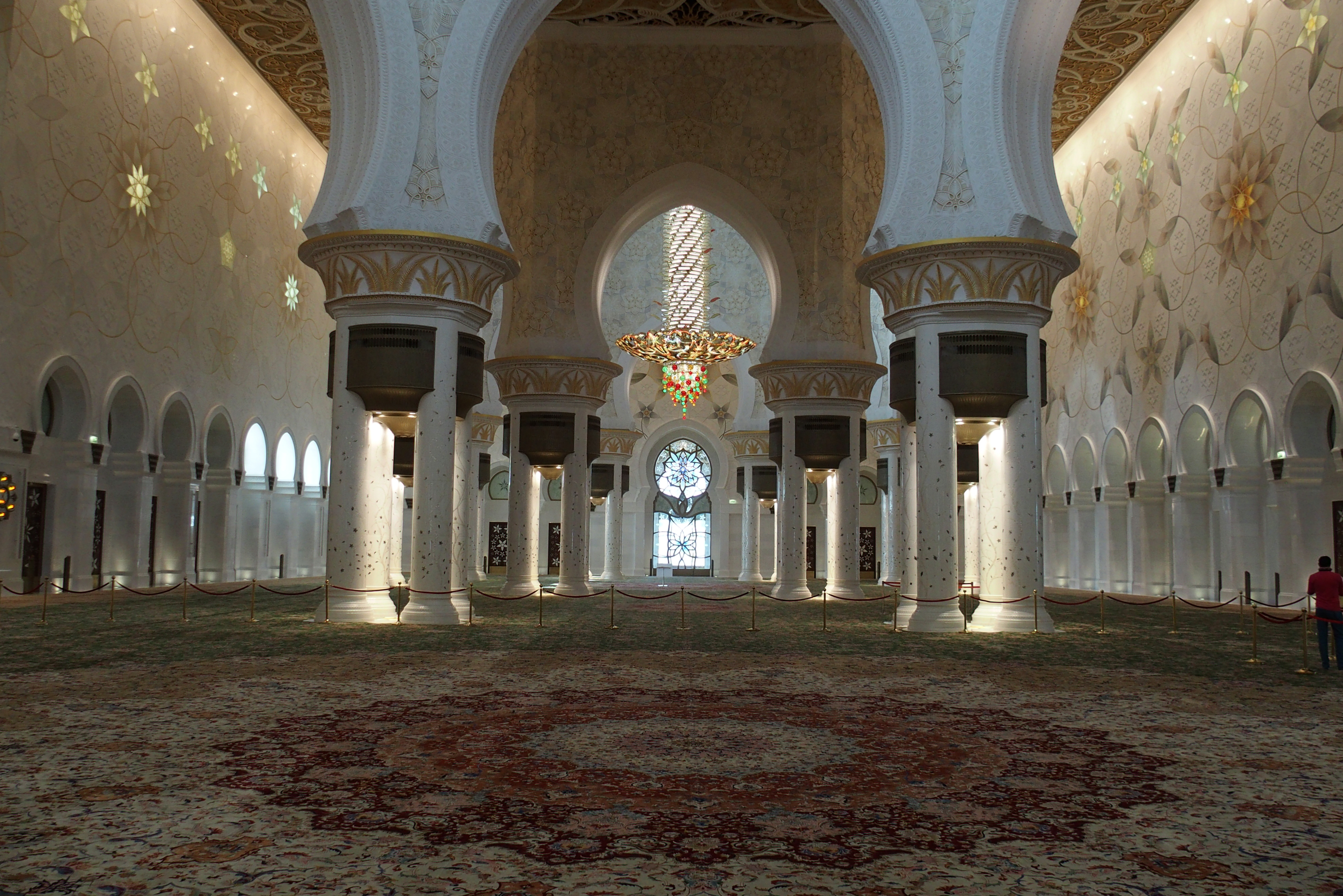
OLYMPUS DIGITAL CAMERA

This rug is the largest in the world, over 61,000 square feet or 1.4 acres in area. It took 1,200 artisans 12 months to hand knot it.

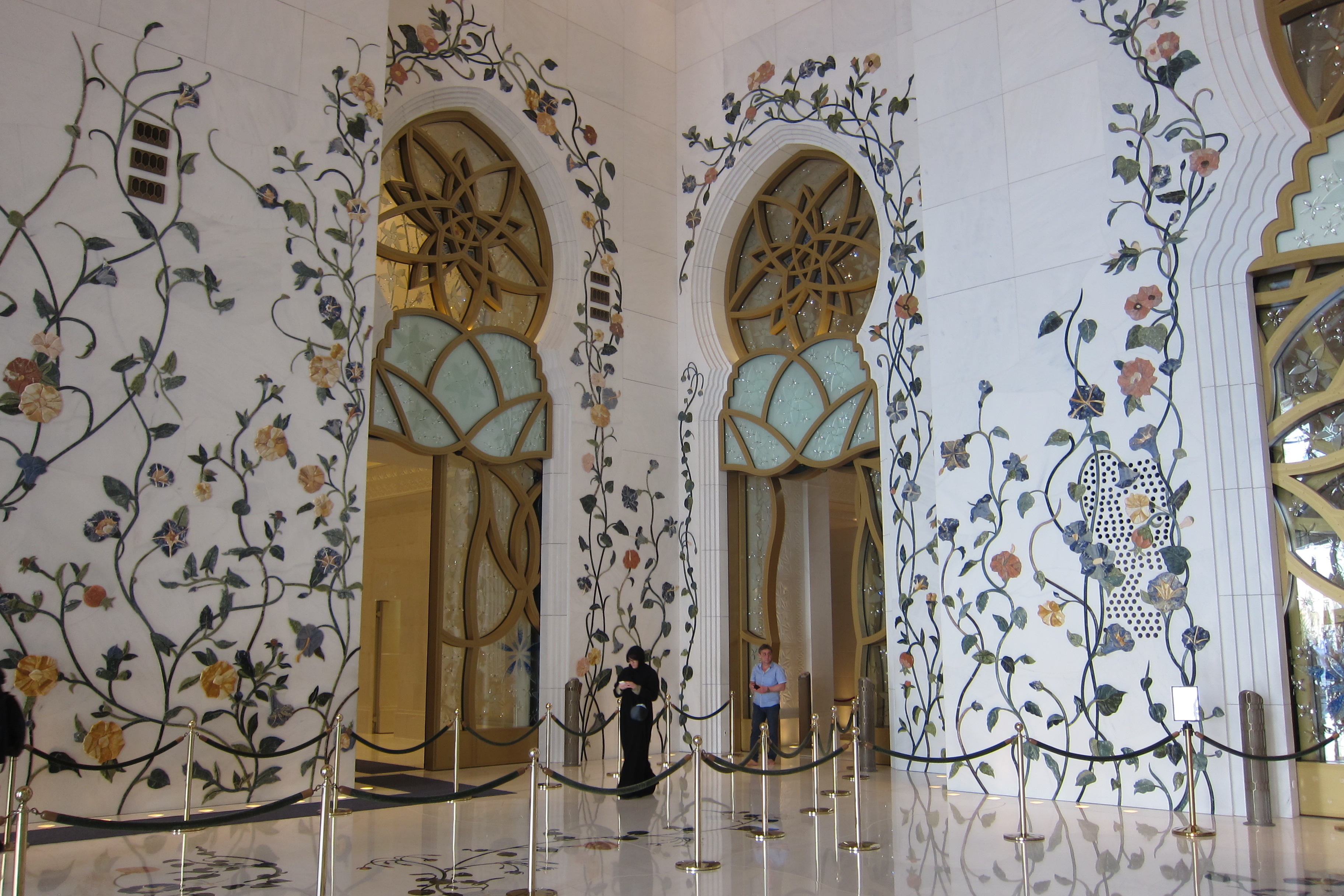
There was so much to see, every detail exquisite.

2015-03-16 050

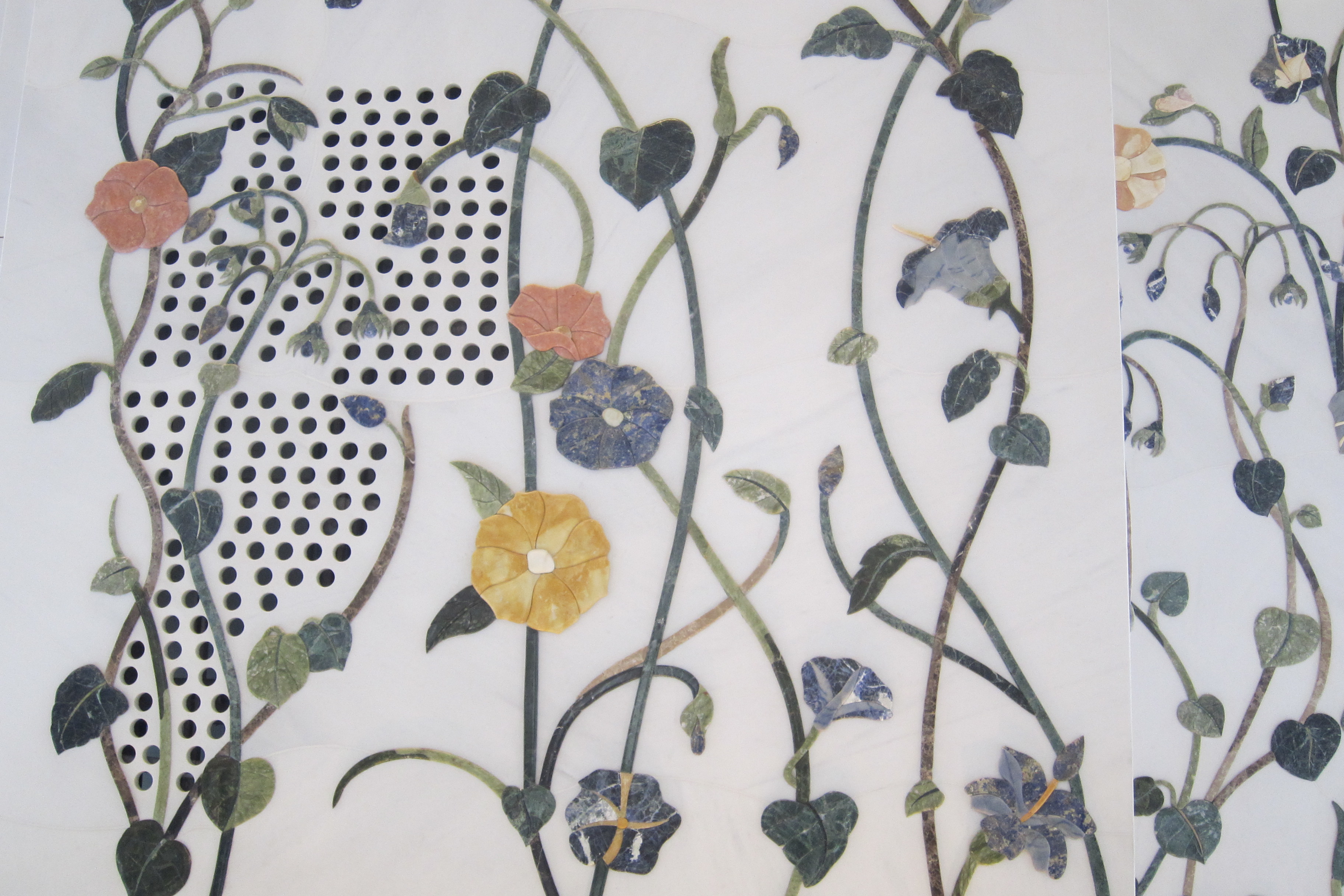
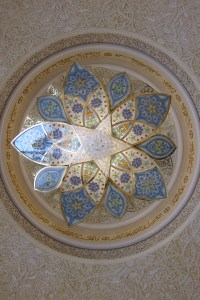
The marble is white to symbolize purity and piety. The designs are Islamic geometrics and florals.

2015-03-16 090

Beautiful from far away or close up.

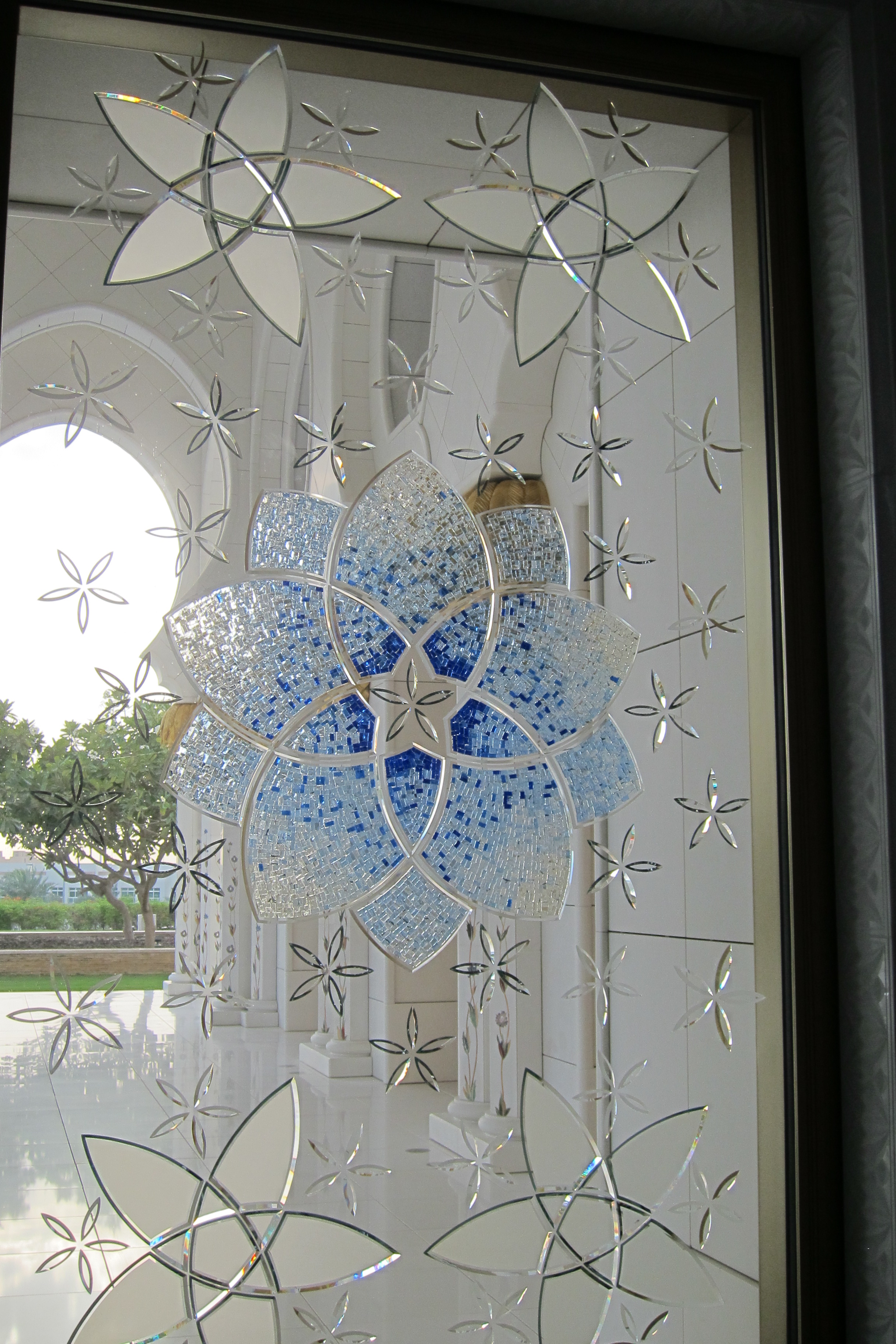
2015-03-16 077

Looking out to the courtyard through amazing glasswork.

2015-03-16 071

This chandelier was made in Germany by Faustig. It weighs 12 tons and contains Swarovski crystals.

2015-03-16 047

Another chandelier with Swarovski crystals. This one is only 2 tons.

2015-03-16 151

Outside the mosque is beautiful too. Note the red bougainvillea landscaping.

2015-03-16 118

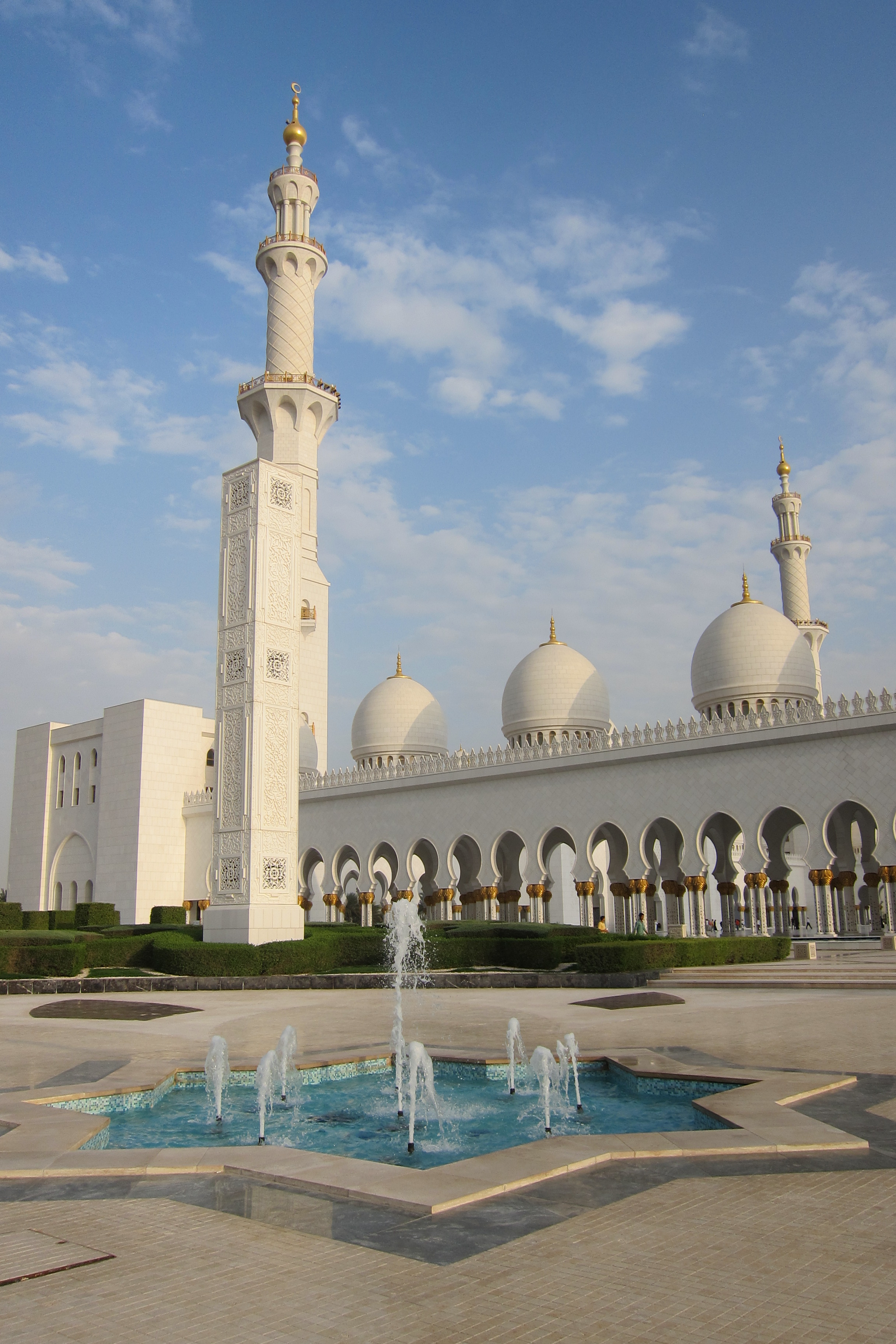
Not as big as the Dubai Fountain, but still quite pretty in front of the mosque.

2015-03-16 178

Just like snowflakes, no two views of the mosque are the same.

We visited during the day and stayed on into the evening.

2015-03-16 100

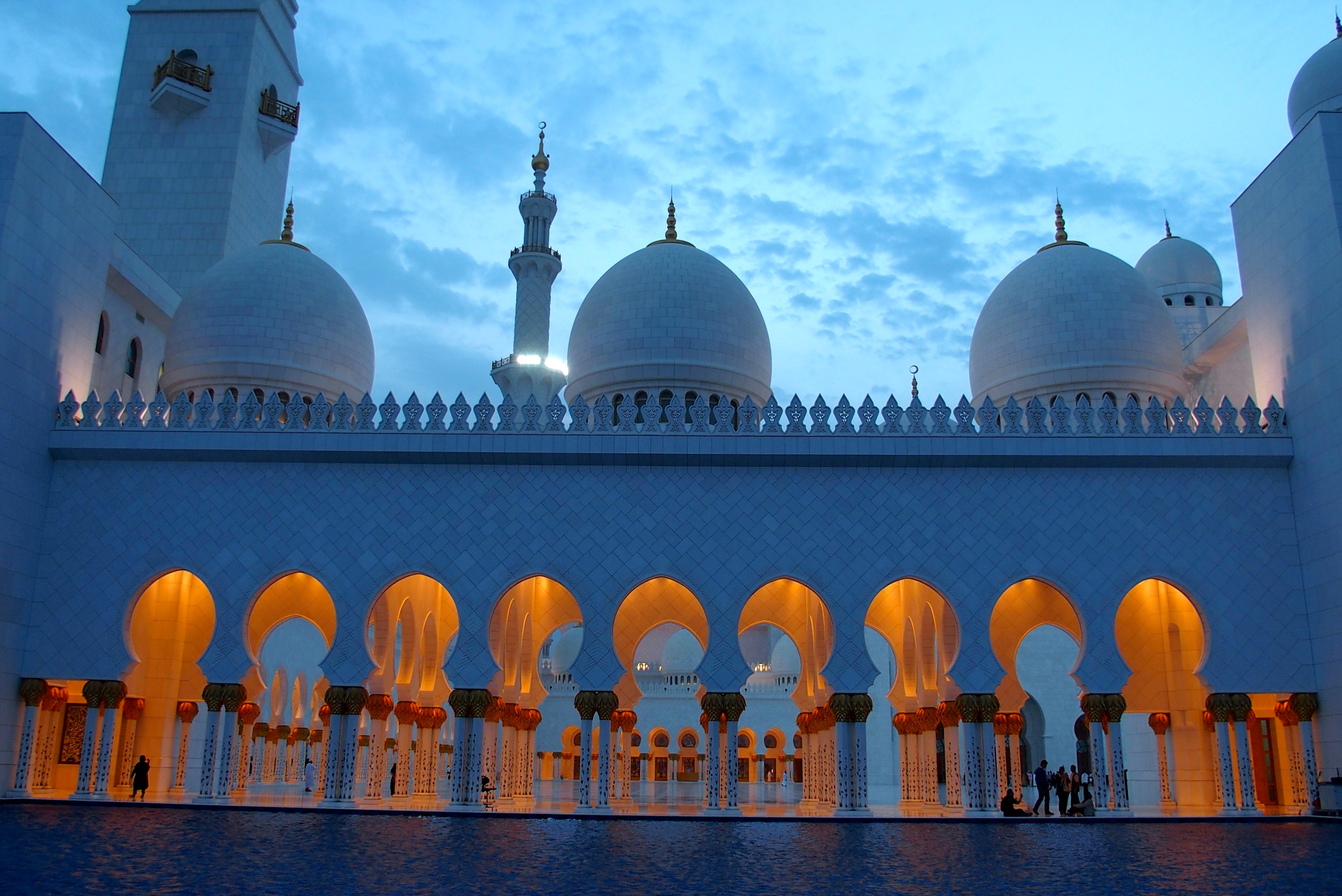
The mosque takes on an even more spiritual atmosphere as the sun goes down.

OLYMPUS DIGITAL CAMERA

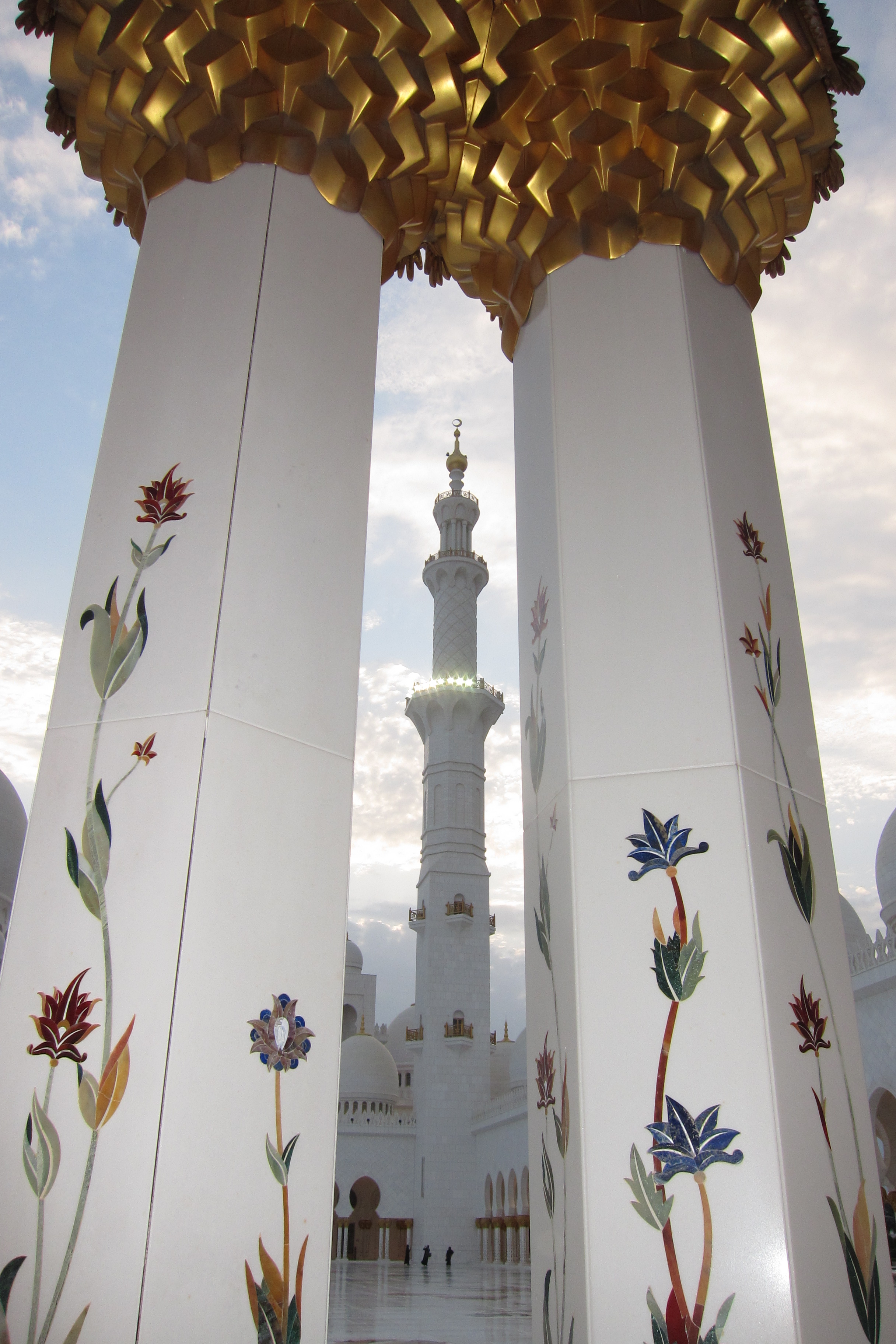
Note all the details in gold.

2015-03-16 203

The onion dome pattern repeats in the arches.

OLYMPUS DIGITAL CAMERA

It looks very warm and inviting.

OLYMPUS DIGITAL CAMERA

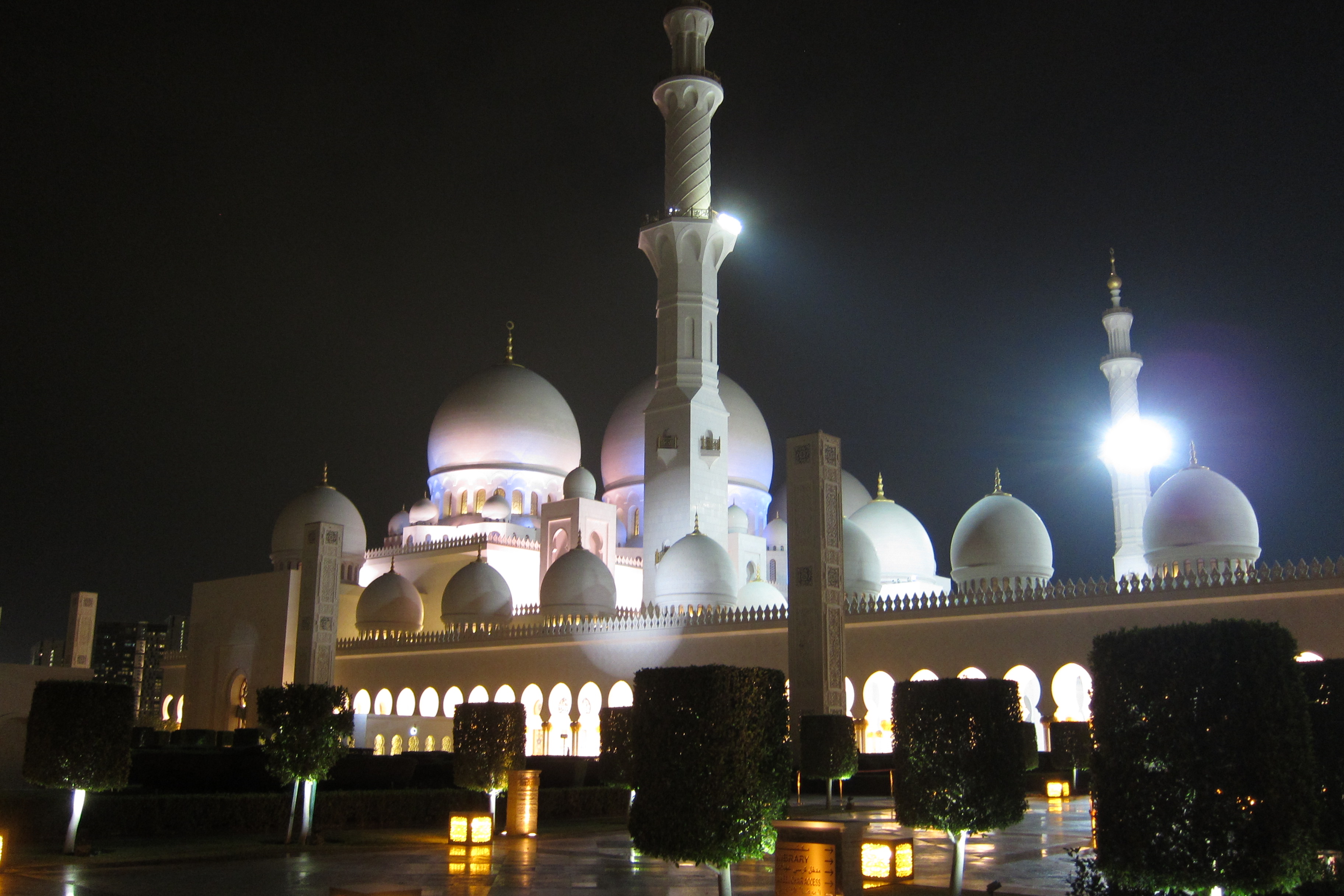
The outdoor lighting is adjusted to follow the phases of the moon.

OLYMPUS DIGITAL CAMERA

The mosque after dark…outside. It is still brilliantly lighted inside.

2015-03-16 249

Impressive even driving by.

The whole place was so strikingly beautiful it was difficult to leave.


Posted in Travel Journal | Tagged , , , , | 2 Comments

1001 Arabian Minutes

Actually it was more like 1,920 if you count just the minutes we were awake on our very short layover in the U.A.E. We visited Abu Dhabi and Dubai. The country has lots of sand!

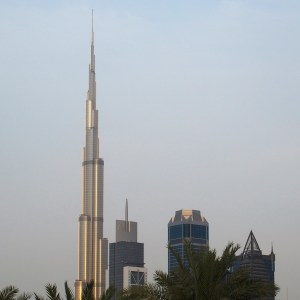
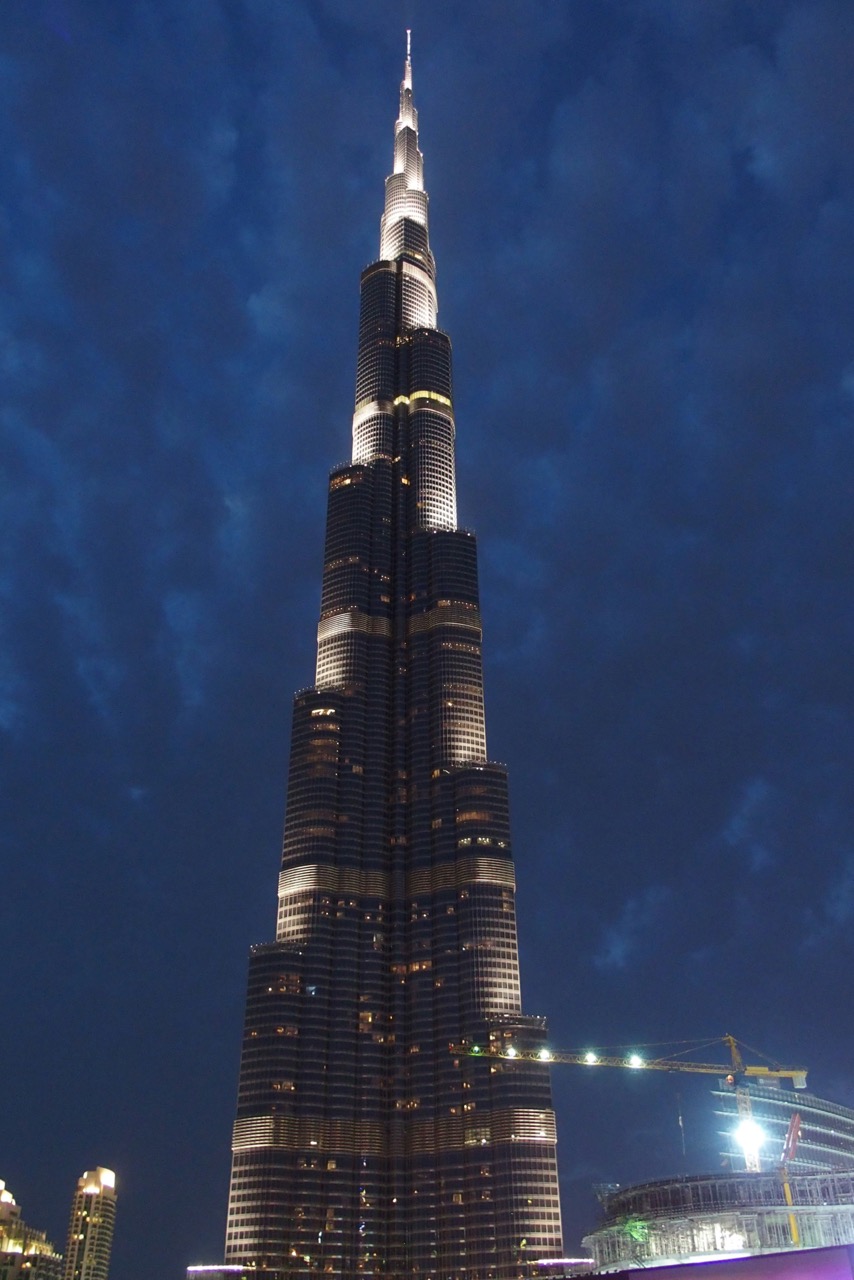
Our main focus in Dubai was the Burj Khalifa, a tall building — quite an understatement! It is the tallest building in the world, 2,716.5 feet tall. (That extra half foot may be important someday if another country tries to challenge the record.) By the way, that’s more than half a mile! Some call it a giant toothpick.

OLYMPUS DIGITAL CAMERA

In any other spot, the “dwarfs” next to the Burj Khalifa would be wondrous skyscrapers by themselves.

The 148th floor has an observation deck, the world’s highest outdoor observation deck, fittingly called SKY. The New Year’s Eve fireworks and lights show is pretty spectacular.

IMG_4933

It really is difficult to get the whole Burj Khalifa in one photo.

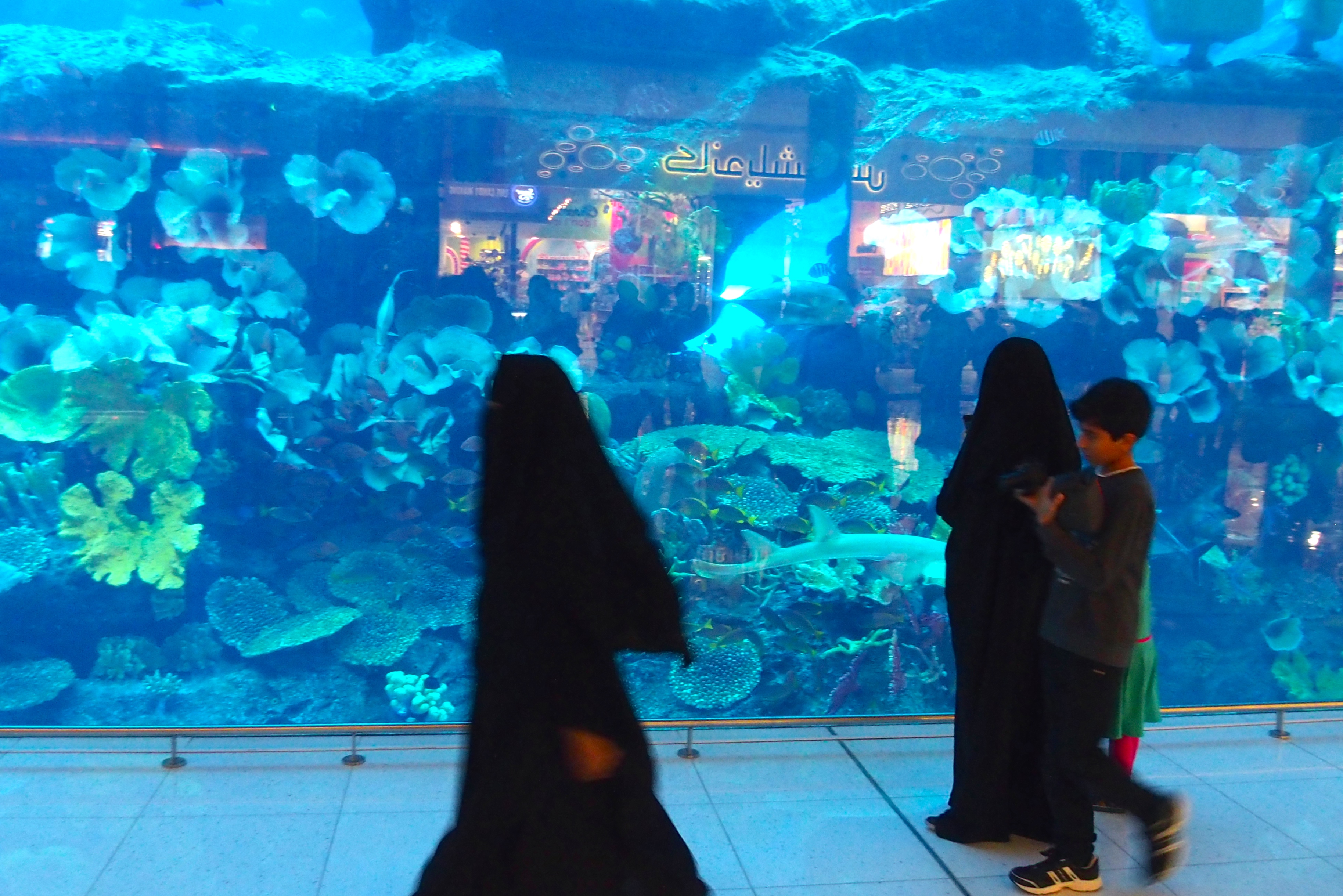
Adjacent to the tower is the Dubai Mall, the world’s largest shopping and entertainment center. According to its website, the Dubai Mall has the largest collection of fashion brands under one roof anywhere in the world and is set to become the next fashion capital of the world. It has over 1,200 stores, an ice rink, and the Dubai Aquarium.

OLYMPUS DIGITAL CAMERA

We wondered what the fish thought of the ladies in black.

Ground level in front of the building is just as impressive as the skyscraper.  If you’ve seen the Bellagio in Las Vegas, this multimedia fountain in Burj Khalifa Lake may look familiar; it’s by the same designer. Only in Dubai, the fountain is much bigger, 900 feet long. Here, the Dubai Fountain shoots water up to 500 feet. The lighted sprays dance to music. Unlike the Great Wall of China, this fountain is visible from space, or at least it is claimed to be. It is the brightest spot in the Middle East, possibly the world. Play the video to watch the fountain dance to the music.

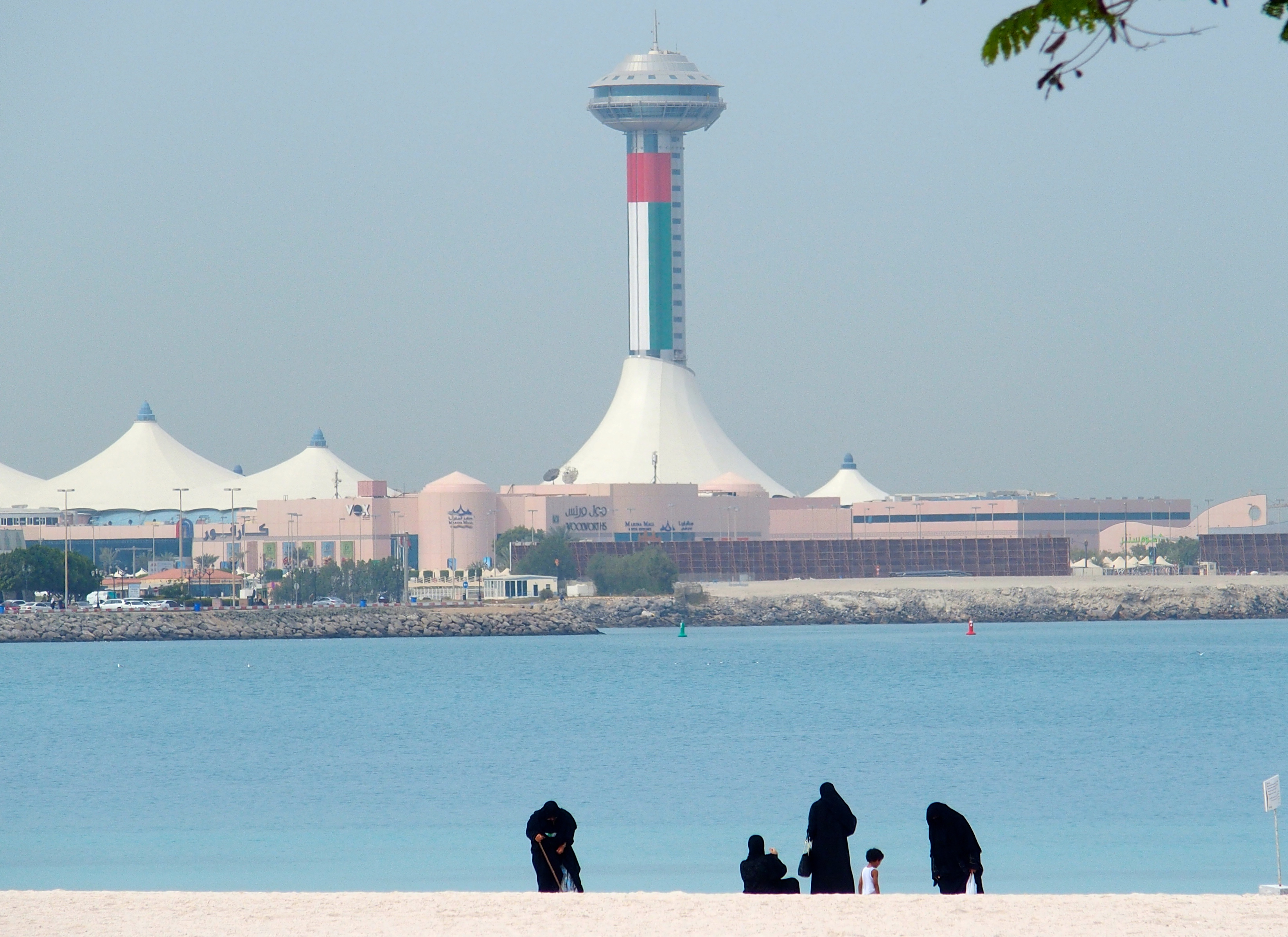
Our first stop in Abu Dhabi was the Corniche area along a lagoon off the Persian Gulf, with white-sand beaches and turquoise water. Much of the nearby area is built on reclaimed land. You must pay to enter many of the beaches here, and of course follow rules for appropriate swimwear.

OLYMPUS DIGITAL CAMERA

Men swim in typical Western-style swim trunks (not Speedos) while women are covered top of the head to toe in heavy black cloaks. Not too good for tanning.

Nancy’s seatmate from Sydney to Abu Dhabi was a woman in a full black, rather heavy cloak, her hair covered, but her face exposed. She actually was wearing two layers of black and put on a third, an abaya, before we got off the plane. She added a black veil and black gloves. The veil was somewhat transparent so she could see lights and shapes looking out, but we could see nothing looking in. This one had no slits for the eyes. She explained that she has worn these garments her whole married life. Even though her husband passed away years ago, she simply would not feel comfortable in public without them. She has three kids who are practicing medicine around the world, probably not in abayas! She pulled out a small pouch filled with beautiful gold jewelry and gave us some good advice for visiting Abu Dhabi at this time: “Gold is cheap!” Her daughter, a perky recent high school graduate, sat next to her wearing a striped polo shirt and jeans.

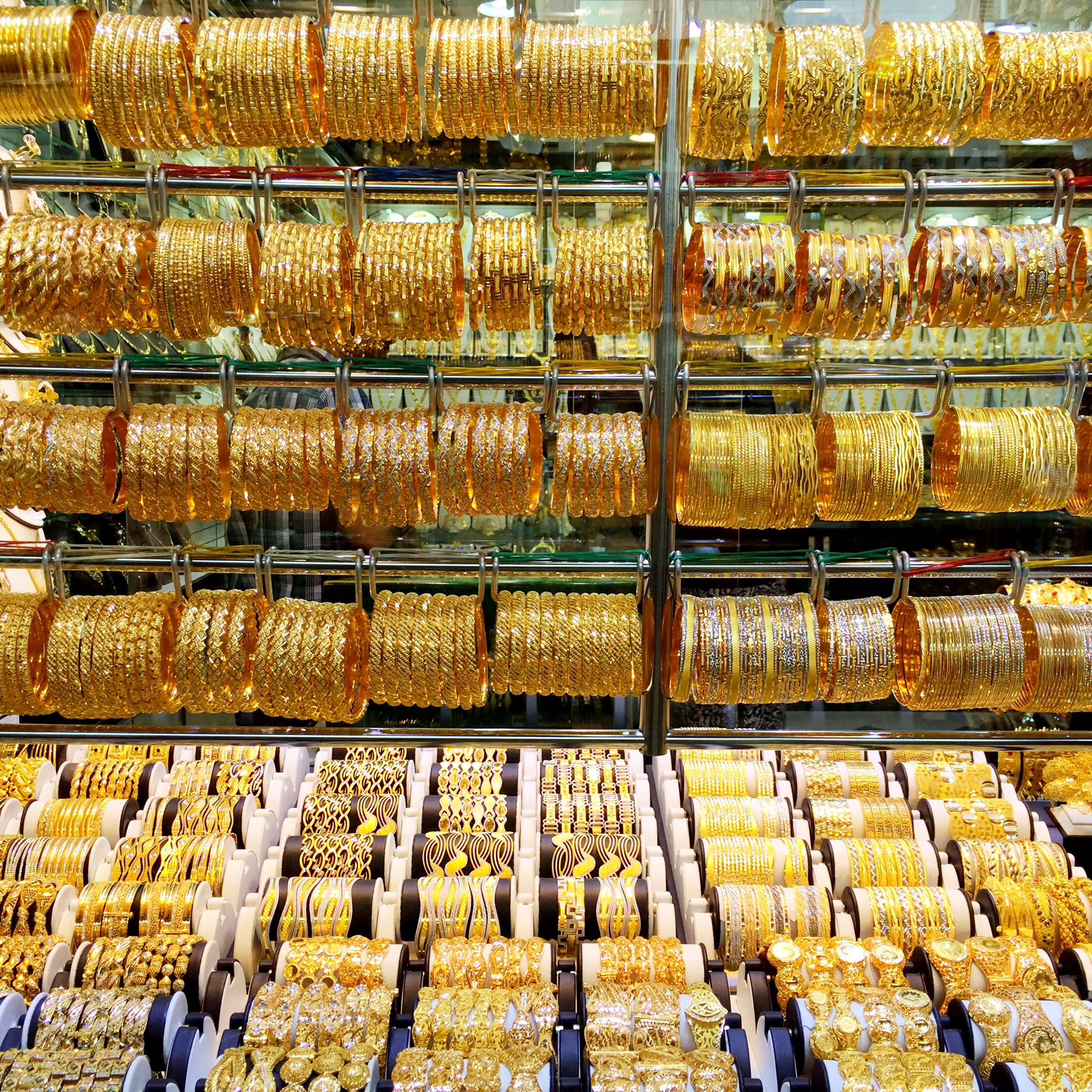
Following her advice, we spent some time in a gold souk.

IMG_4906

Care for a bracelet?

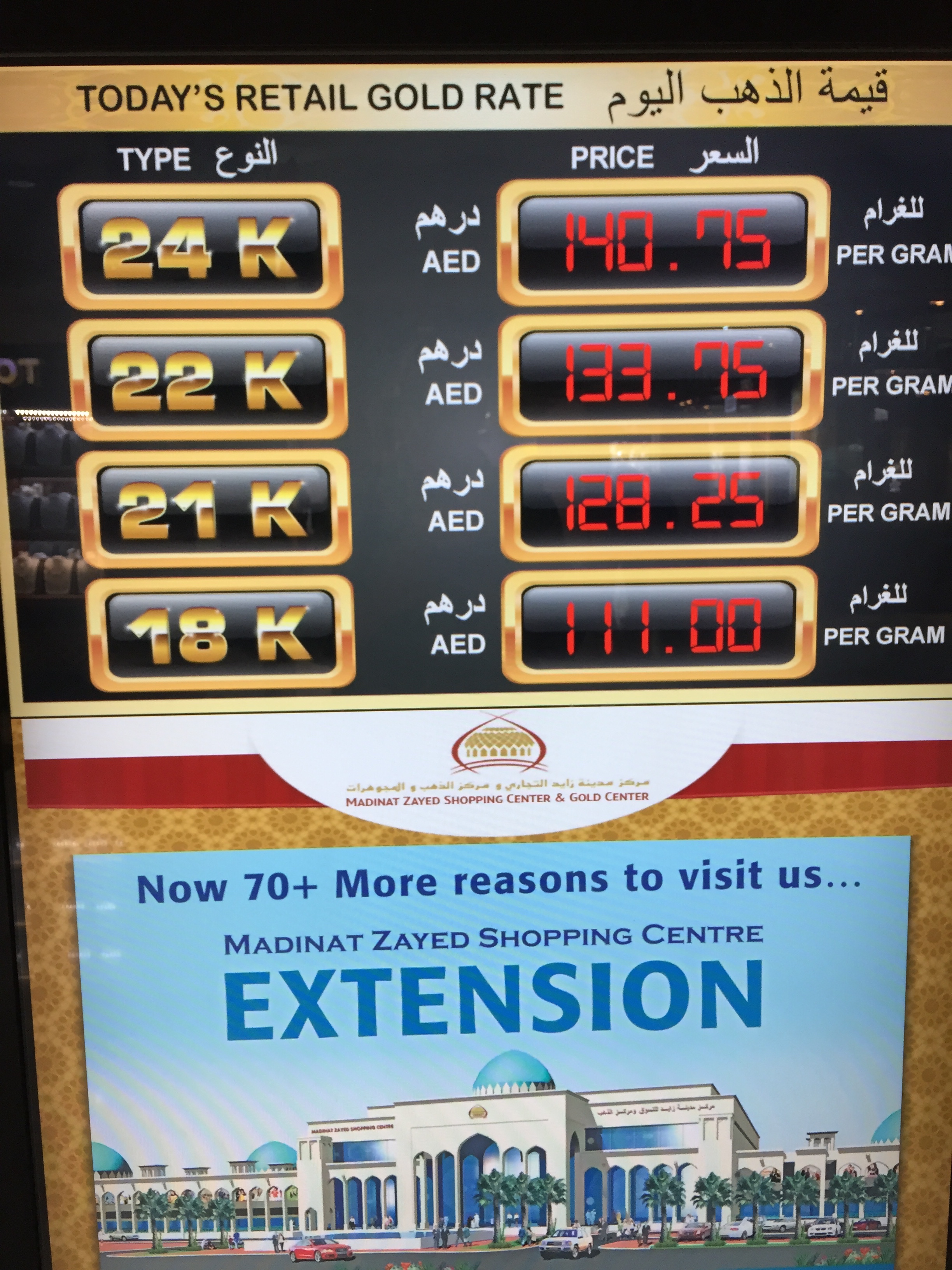
These are not shiny baubles that turn your wrists green or flake off a thin veneer. The gold is 18 to 24 carat and is sold by weight with that day’s price.

IMG_4844

Translated to units we’re accustomed to, that’s 850 to 1,070 USD per ounce, a steal!

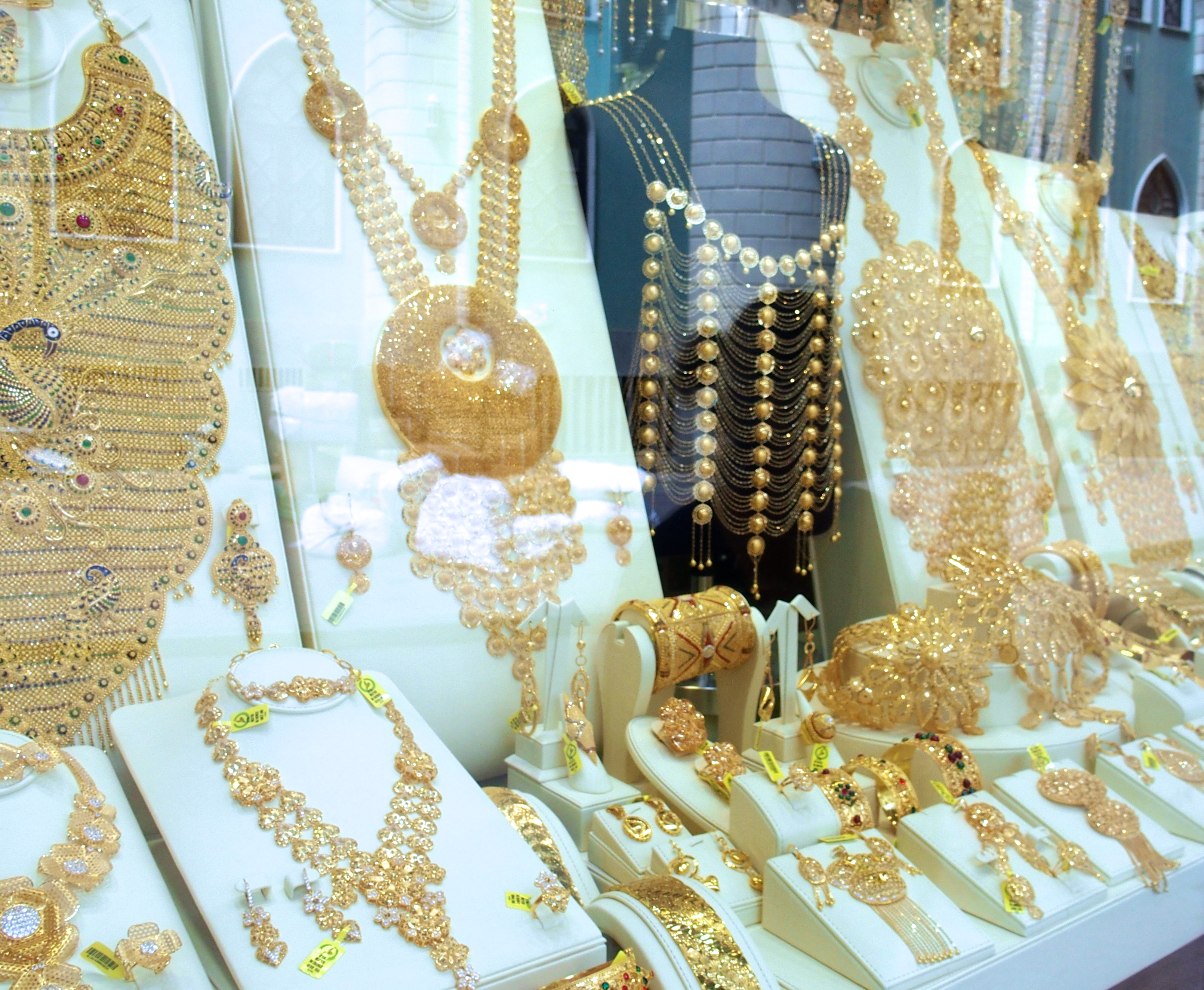
In many shops, even the more decorative pieces were still sold by weight, despite the extensive beautiful workmanship involved.

OLYMPUS DIGITAL CAMERA

These were not quite ornate enough for my style.

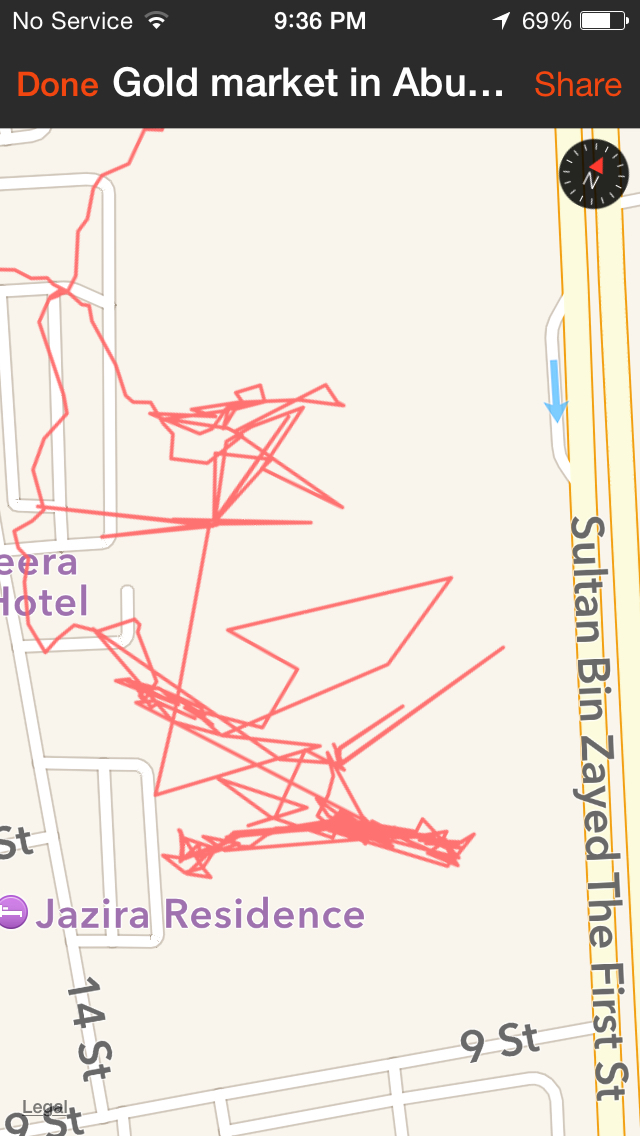
We actually found a beautiful ring in the second shop we visited and planned to buy it but circled around to other stores first. Then we couldn’t find the original shop. This is our path on Strava, trying unsuccessfully to get back to where we started. Amazingly, we are not KOM/QOM of this segment; many others have done the same route, but much faster. (Just kidding.)

Gold Market Strava Map

Strava documents our fruitless hunt for gold!

The highlight of any trip to Abu Dhabi, and maybe to U.A.E. in total, is the Sheikh Zayed Grand Mosque. This is the largest mosque in the world. Note that U.A.E. seems to be trying to have all the biggest and brightest of everything. They do, after all, have a lot of oil money to spend.

The mosque is so “-est” that it gets its own post.

Posted in Stravaficionados, Travel Journal | Tagged , , , , , , | Leave a comment

Aussie Odds and Ends

We’re already on to the next phase of our journey, so these are just a few tidbits that didn’t fit into our other Australia posts. Not nearly everything from the trip, but a few items we don’t see in the US.

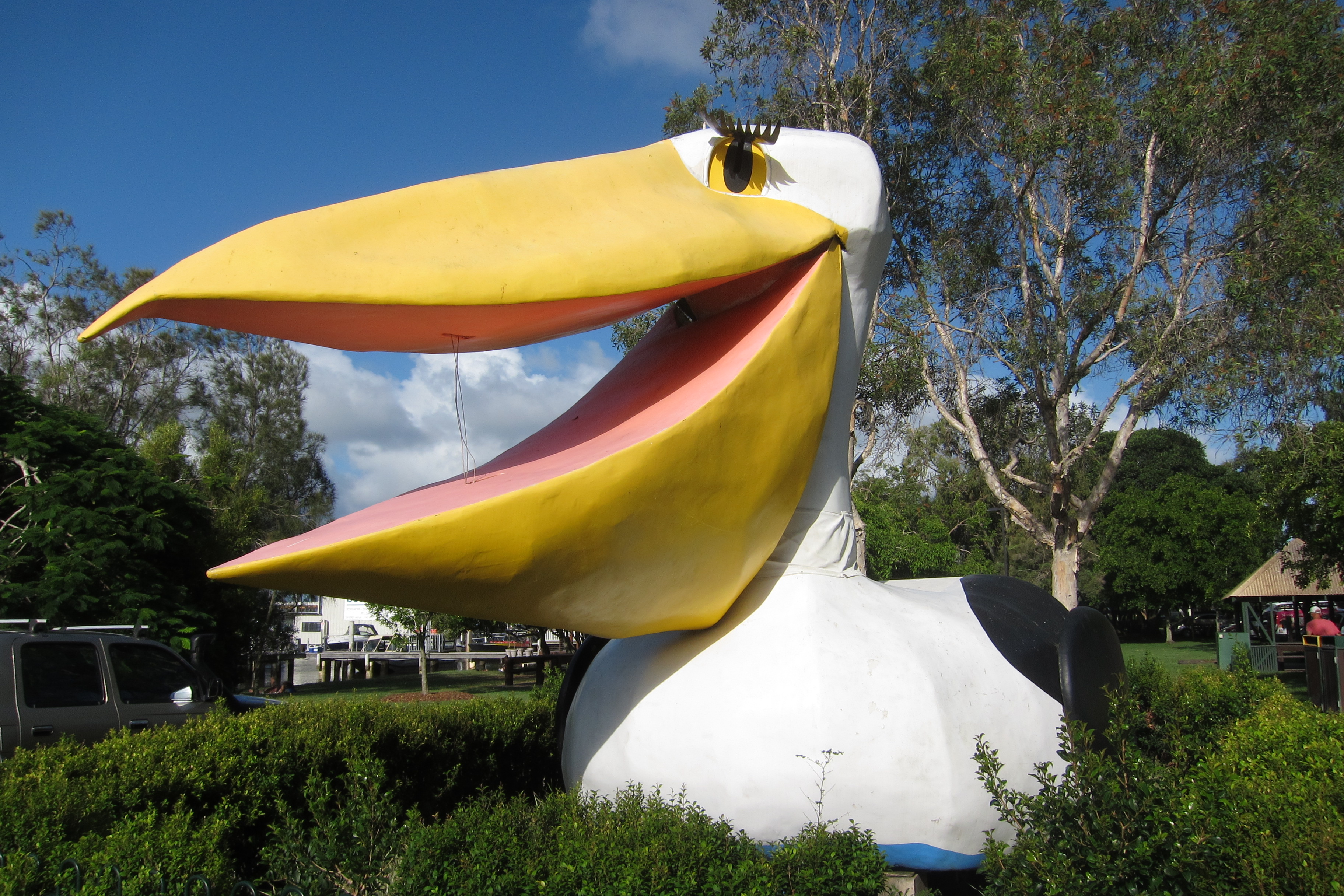
We mentioned the Big Animals in Australia. We spent a week near the Big Pelican in Noosaville.

2015-03-01 002

Once on a float, now renovated with $10,000 of community contributions.

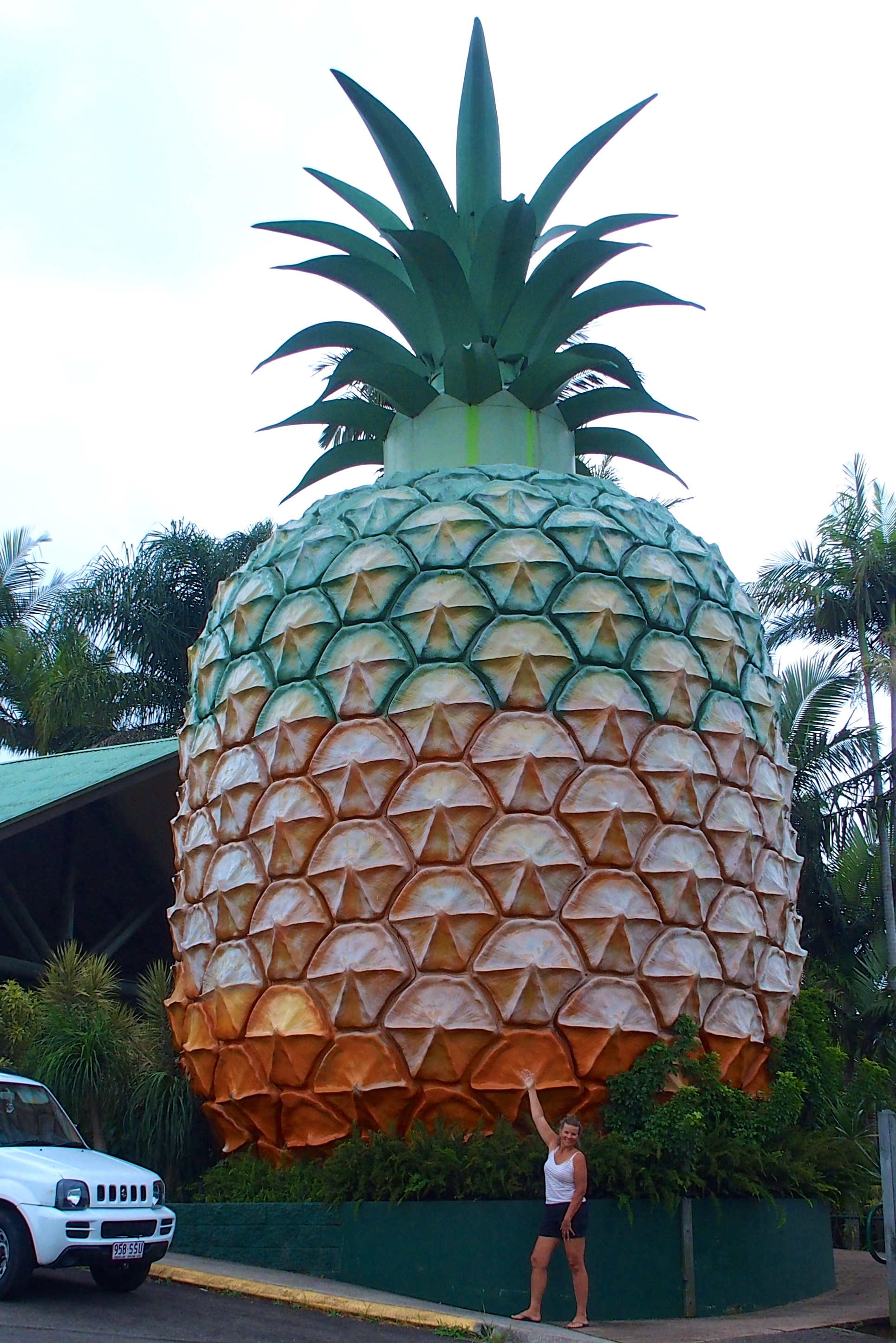
And we made a short stop at the Big Pineapple in Woombye, now possibly the world’s biggest pineapple after a Hawaiian competitor bit the dust. When our kids were little we stopped for photos at every roadside big animal, usually just slightly larger than lifesize. The kids loved it! (Not.) Australia’s big things are significantly bigger.

OLYMPUS DIGITAL CAMERA

52 feet tall!!

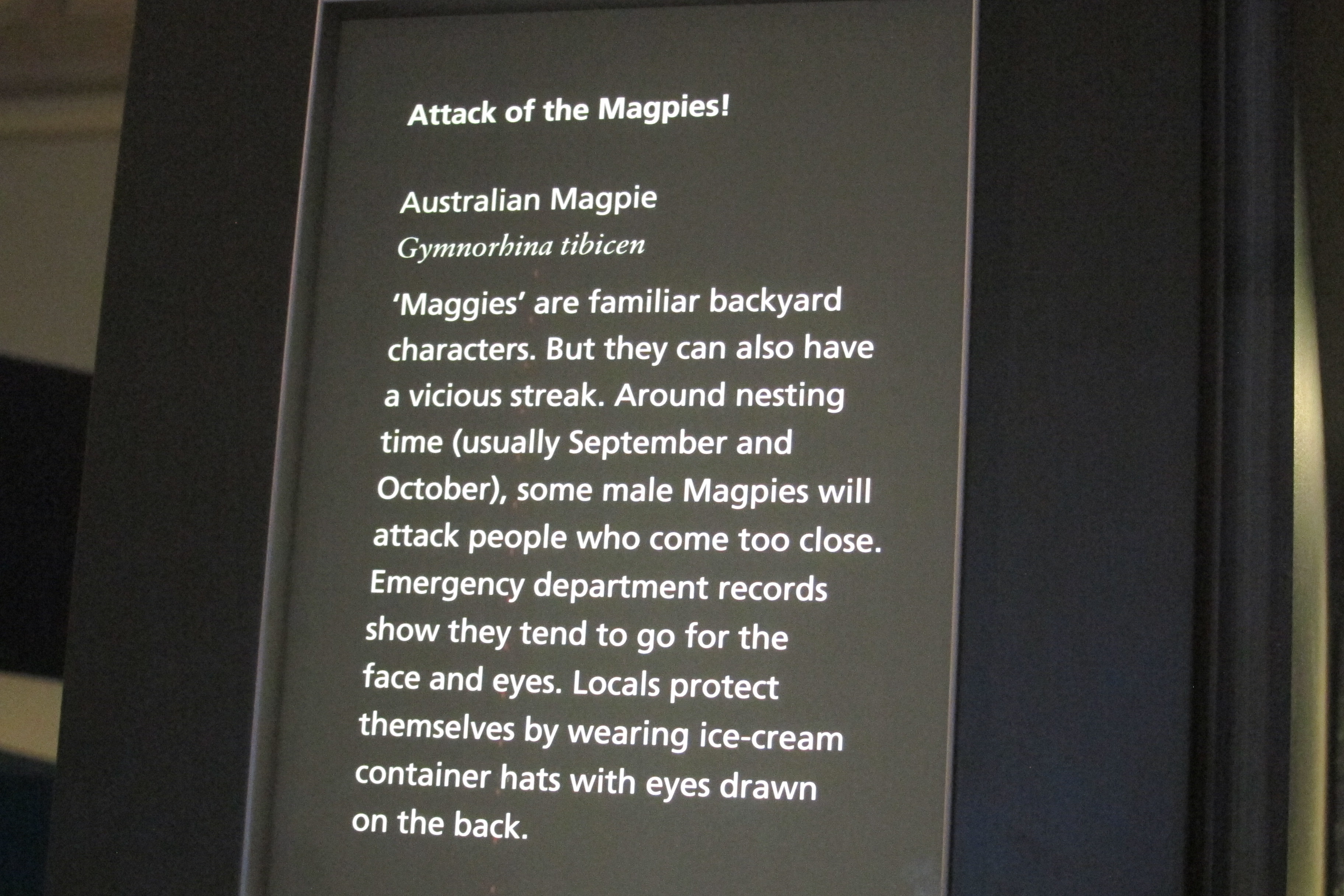
We’ve been chasing after the magpie birds thinking they were so strikingly beautiful. Apparently, locals don’t share our perspective and find them quite nuisances.

2015-03-13 015

Shades of Alfred Hitchcock

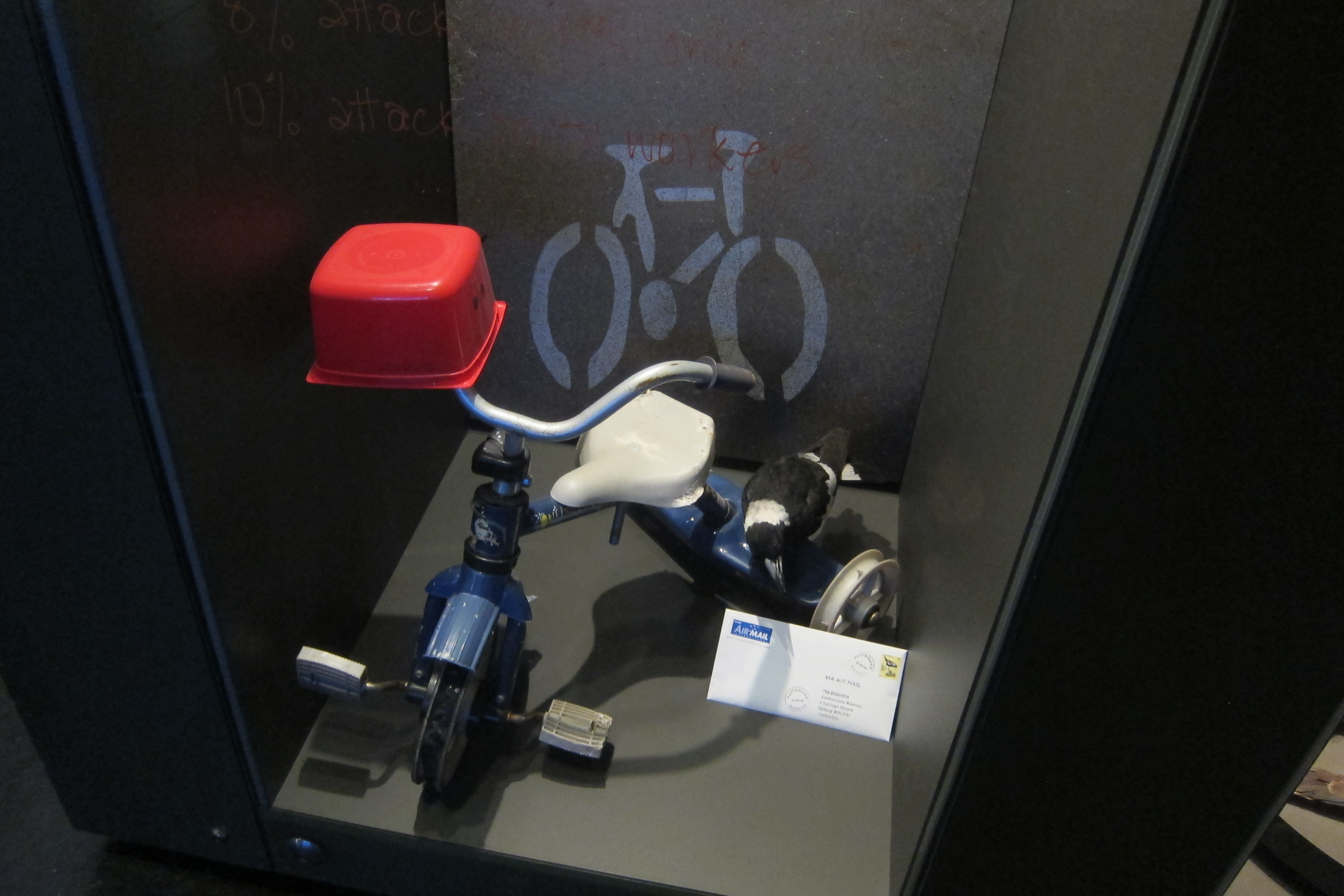
2015-03-13 016

Note the eyes on the back of this ice cream container. Magpie defensive gear!

Our hosts in Noosa, Jamie and Judie Baker have an export business for the Jetsleeper, an interesting twist on an air travel pillow that keeps you from slumping over in the aisle. (Michael could use this.)

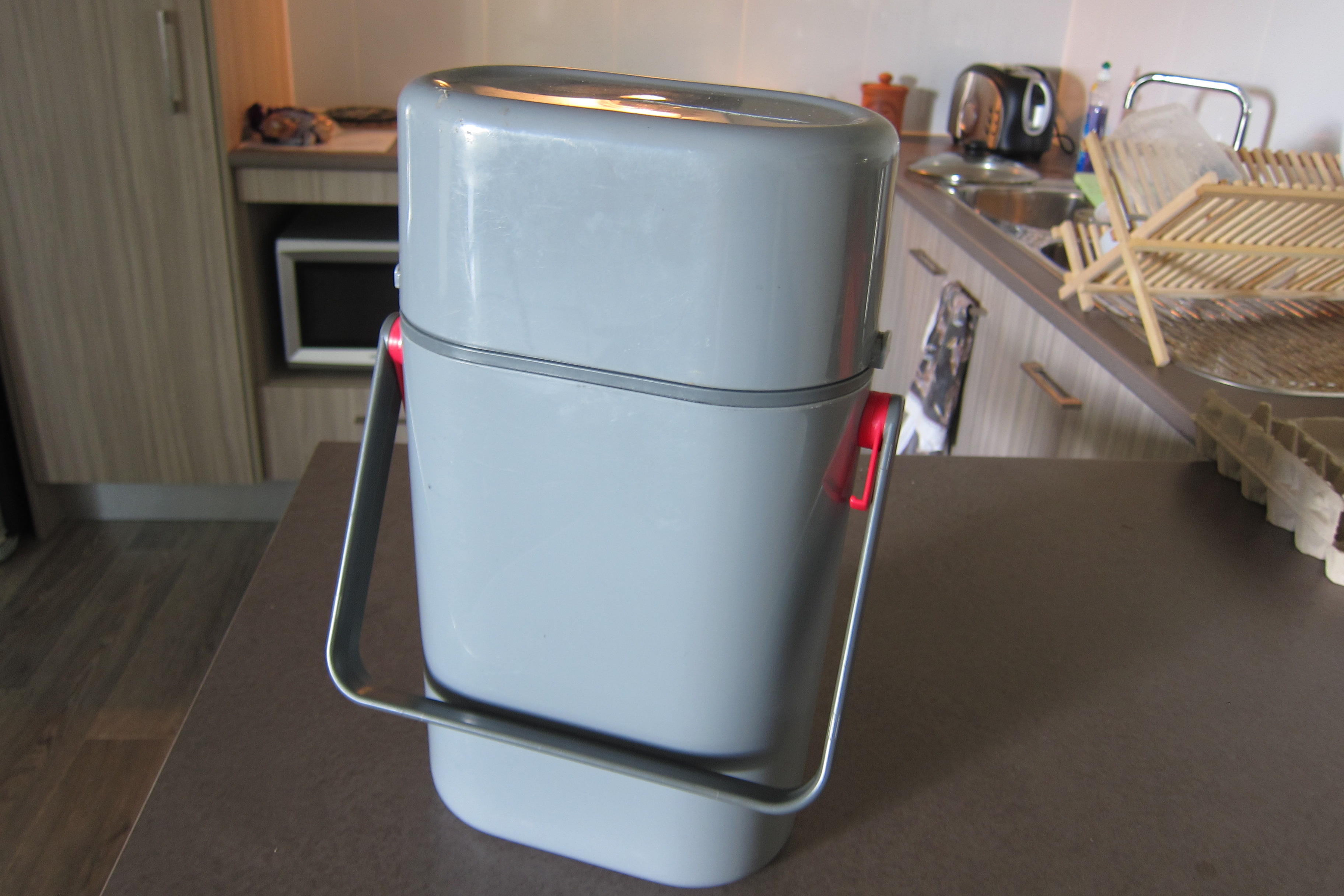
Their commerce initiative got us interested in becoming importers of a great product we used in the hot Australian climate: the Decor wine cooler.

2015-03-07 001

Looks pretty sleek on the outside.

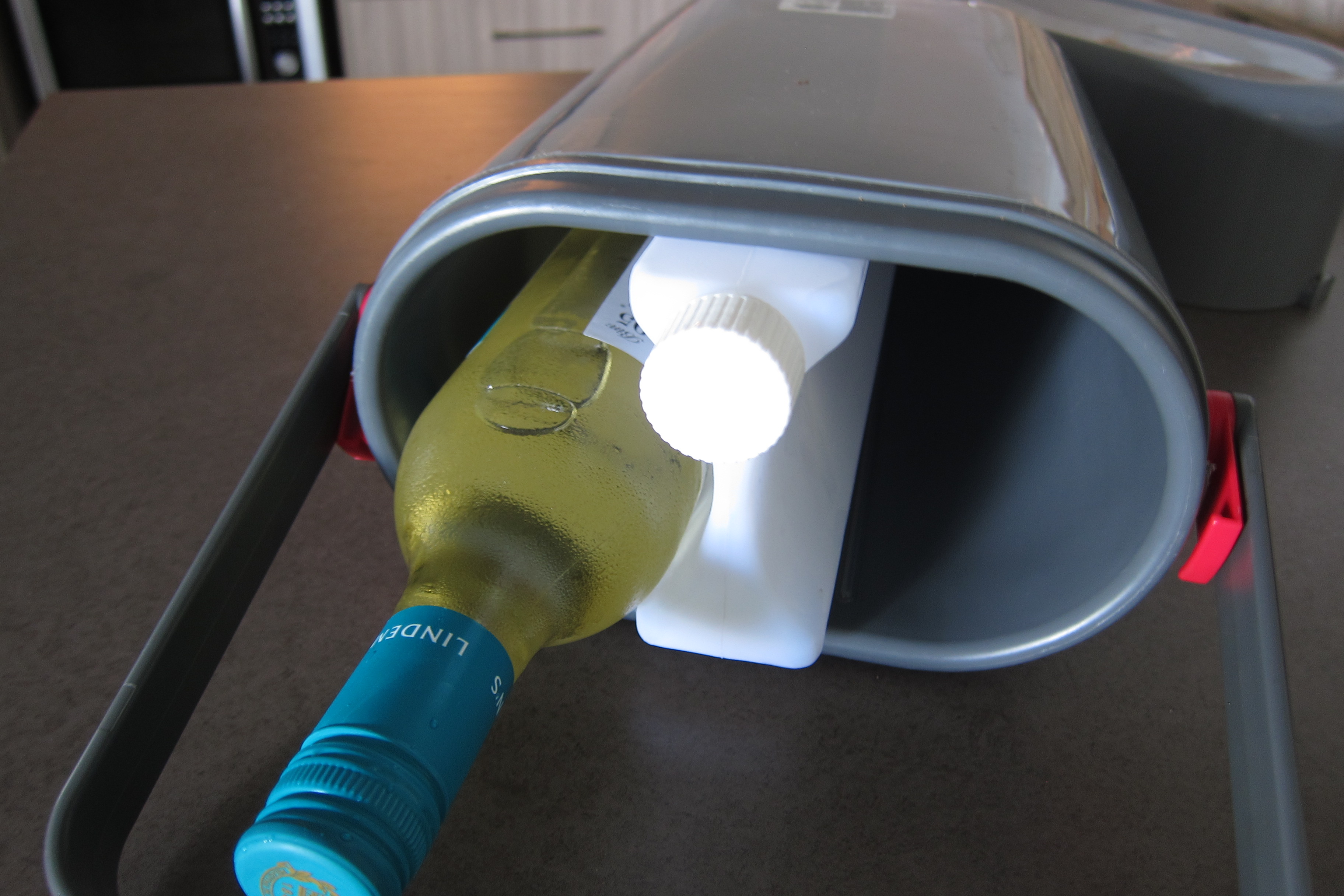
The product is so cleverly designed that it is in MOMA in New York. The innovative element of the wine cooler is what’s inside, a freezable water pack, so the wine actually continues to be chilled until the ice melts. Every winery in America could sell these (well, maybe not those in Washington since it doesn’t get hot enough there!) We would love to import this to the US, or at least one that we can use at the lake.

2015-03-07 003

We used this every day at the pool.

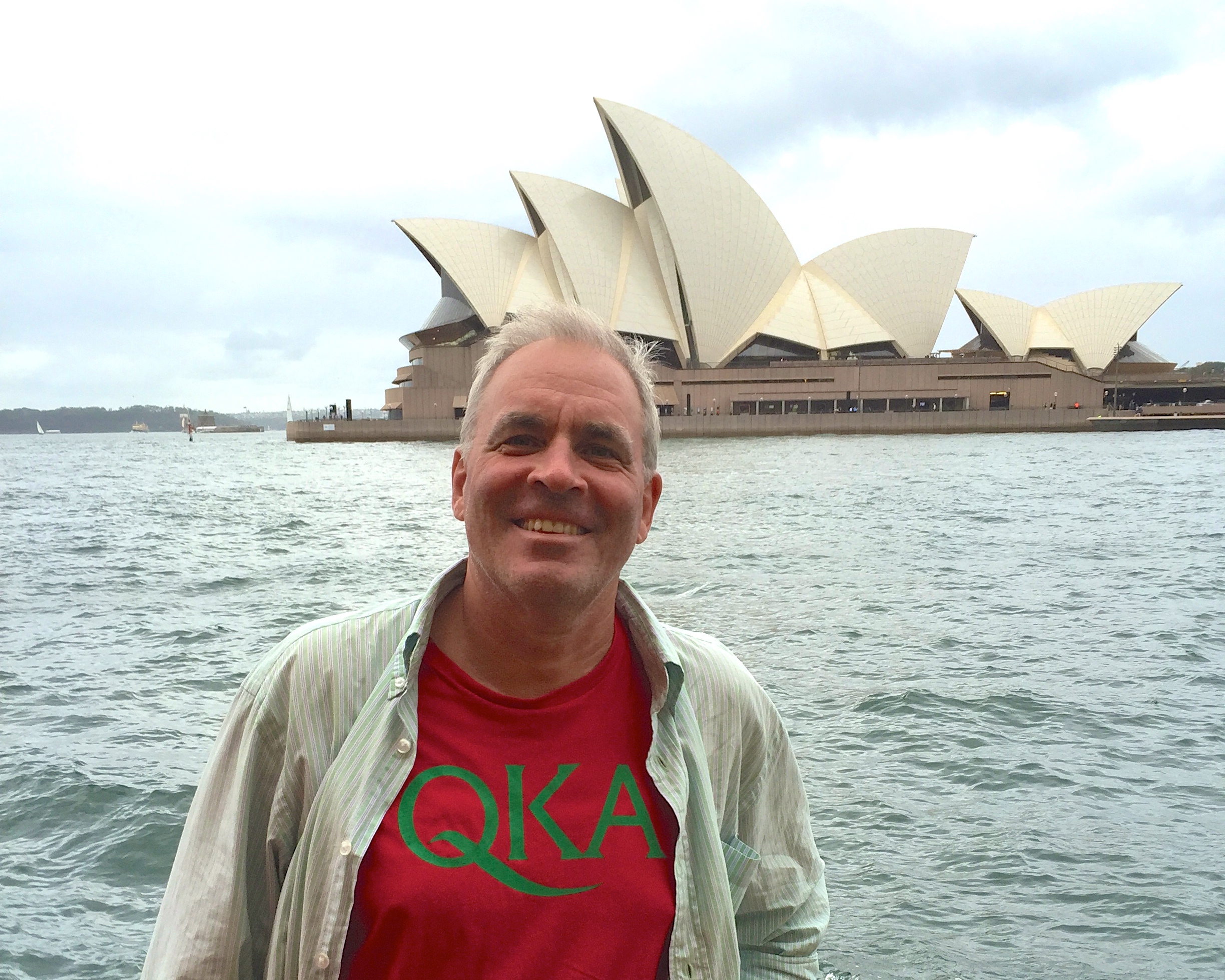
Speaking of the lake, Keuka Lake, we continue to offer QKA sightings around the world.

IMG_4774

How many other QKA shirts have visited the Sydney Opera House?

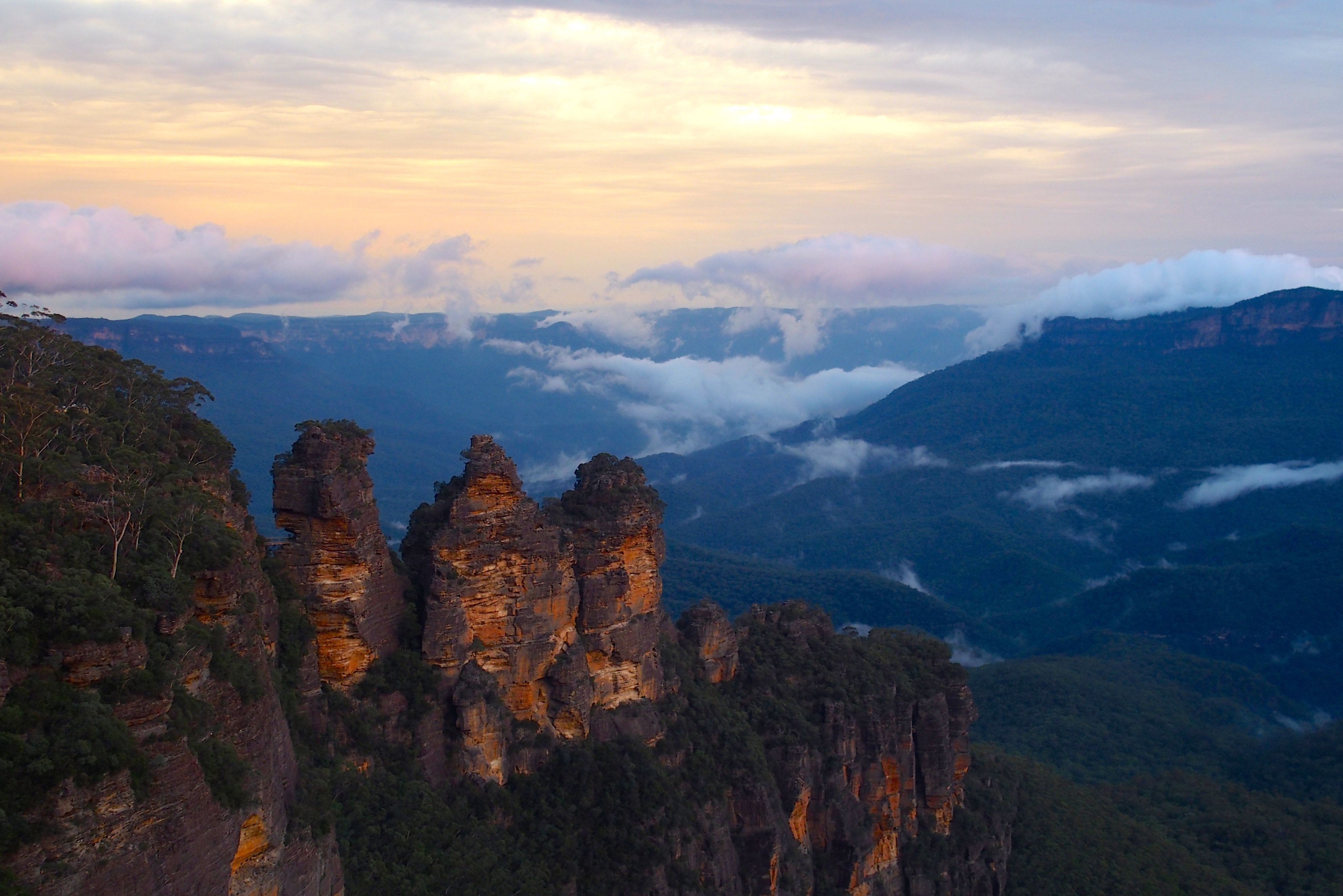
We mentioned the Blue Mountains. These are west of Sydney. The source of their blueness is hotly debated. Some say it is the effect of light diffraction by particulate in the air, similar to the particulate in water that causes it to appear blue. Others claim it is related to eucalyptus oil in the air. Either way, they are pretty.

OLYMPUS DIGITAL CAMERA

The Three Sisters, near Katoomba, with the Blue Mountains in the background.

We really do hate to leave Australia.

OLYMPUS DIGITAL CAMERA

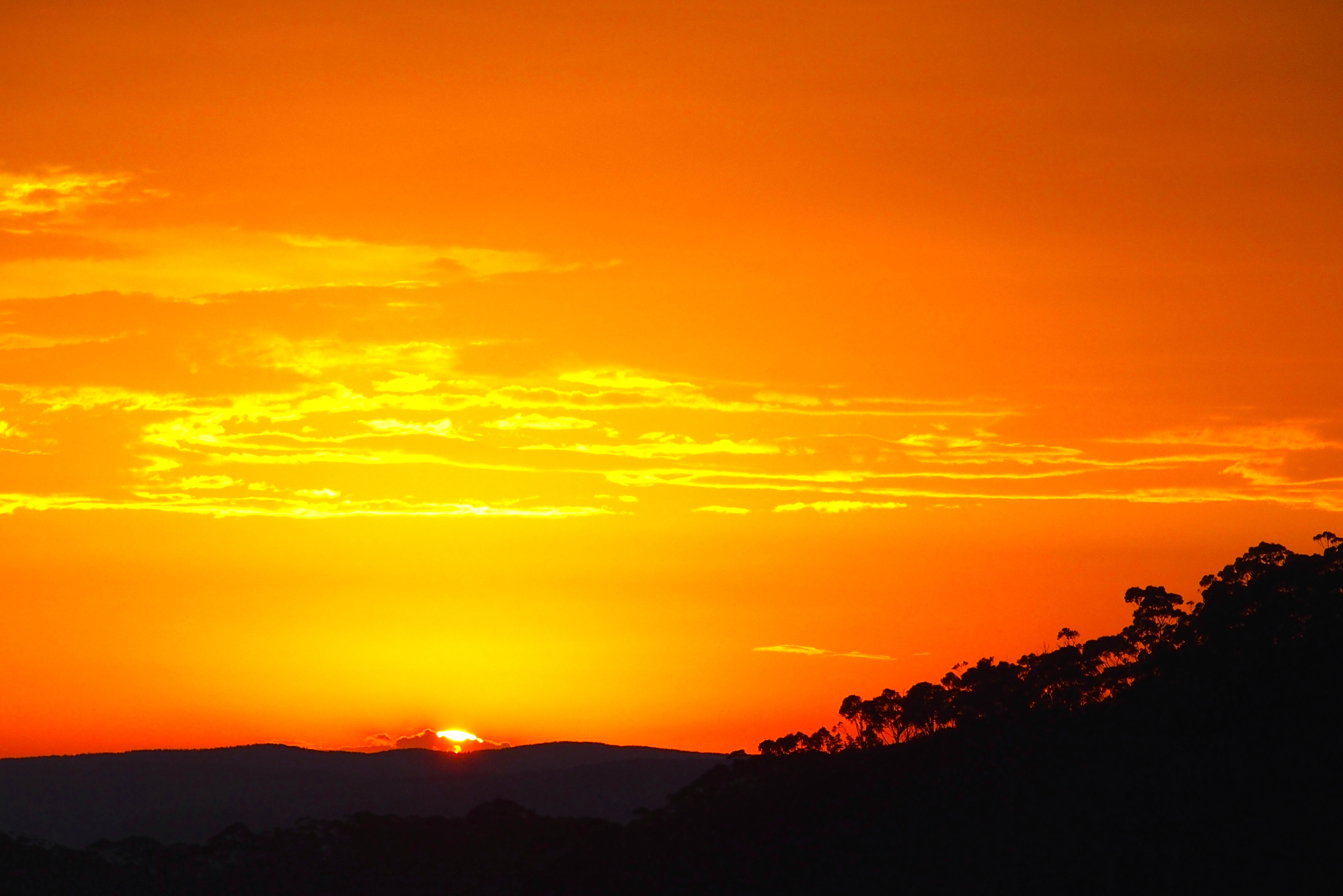
Sunset in the Blue Mountains


Posted in Smell the Roses | Tagged , , , , , , | 3 Comments